We understand the ever changing needs of our customers

we provide a high level of service dedicated to fulfilling all your shipping requirements

Watch Video
Road Freight

Keep all your data in one place which can be accessed from anywhere and anyplace

Let us help you 24/7 manage your supply chain needs

Back to Global Coverage

USA Freight Forwarding Services
Air & Sea Freight Between USA And The UK

Intercargo provides reliable freight forwarding services between the USA and the United Kingdom, helping businesses import and export cargo efficiently by air and sea.

Whether you are importing goods from the USA into the UK, exporting products from the UK to the USA, or managing regular international shipments, our experienced freight forwarding team provides complete end-to-end logistics solutions. From collection and customs clearance to final delivery, we manage every stage of the shipment process.
Logistics solutions
Air Freight USA to UK
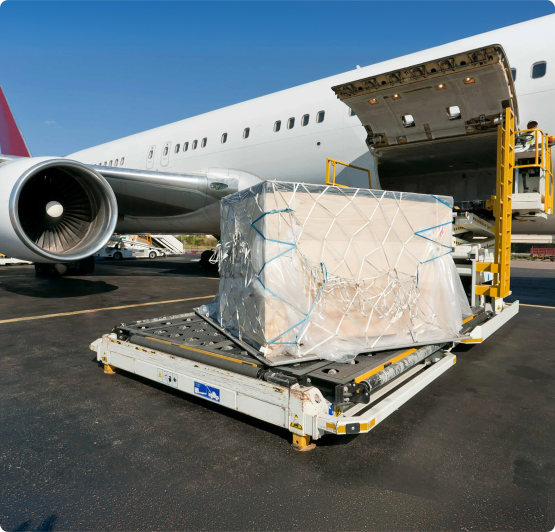
When speed matters, our USA air freight services provide fast, secure and reliable transportation between the USA and the United Kingdom.
We arrange air freight through major US airports including John F. Kennedy International Airport (JFK), Chicago O'Hare International Airport (ORD), Los Angeles International Airport (LAX), Hartsfield-Jackson Atlanta International Airport (ATL), Miami International Airport (MIA) and Dallas Fort Worth International Airport (DFW), with UK arrivals through London Heathrow, London Stansted, Manchester Airport, Birmingham Airport and East Midlands Airport.

Our air freight solutions include:

  • Air freight from USA to the UK
  • Express and economy air cargo
  • Door-to-door delivery
  • Time-critical shipments
  • Air freight from the UK to USA
  • Airport-to-airport services
  • Customs clearance support
  • High-value and commercial cargo

Whether you need urgent delivery of electronics, manufacturing components, retail stock, machinery or commercial goods, our air freight specialists can provide the most efficient solution.
Logistics solutions
Sea Freight USA to UK
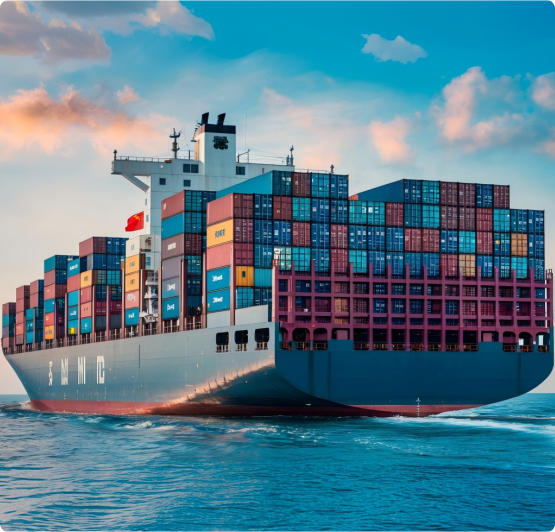
For larger shipments and cost-effective transportation, our sea freight services provide dependable shipping solutions between the USA and the UK.
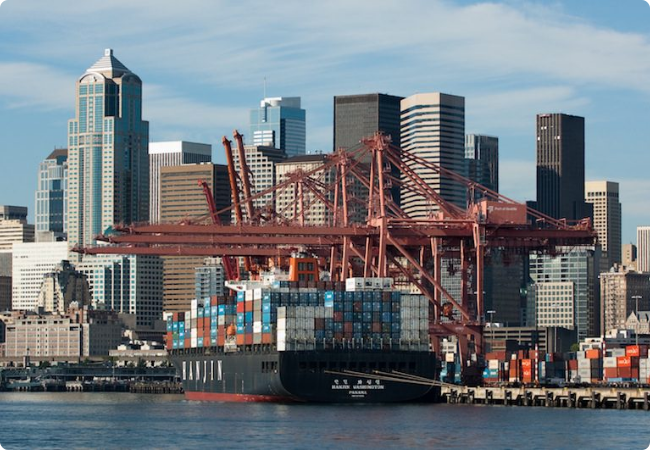
We regularly arrange cargo movements through major US ports including Port of Los Angeles, Port of Long Beach, Port of New York and New Jersey, Port of Savannah, Port of Houston and Port of Norfolk, with UK arrivals through Port of Felixstowe, Southampton, London Gateway, Liverpool, Tilbury and Immingham.
Our sea freight services include:

  • Full Container Load (FCL)
  • Port-to-port shipping
  • Customs documentation
  • Project cargo
  • Less than Container Load (LCL)
  • Door-to-door logistics
  • Cargo insurance
  • Oversized and heavy-lift shipments

Whether you are shipping machinery, consumer products, electronics, industrial equipment, retail stock or manufacturing materials, our sea freight specialists deliver reliable, flexible and cost-effective shipping solutions between China and the UK.
Logistics solutions
Import from USA to the UK
Intercargo helps UK businesses import products and cargo from the USA through a fully managed freight forwarding service. Our import services include:

  • Supplier coordination
  • Air and sea freight transportation
  • Duty and VAT guidance
  • Final delivery throughout the UK
  • Collection from American factories, warehouses and commercial premises
  • UK customs clearance
  • Warehousing and distribution

We regularly support imports including:

  • Electronics
  • Machinery
  • Manufacturing components
  • Consumer goods
  • Automotive parts
  • E-commerce products
  • Retail stock
  • Furniture
Our experienced team ensures your cargo moves efficiently from the USA to the UK while remaining compliant with all customs and import requirements.
Logistics solutions
Export from the UK to USA
We also help UK businesses export goods to customers, distributors and partners throughout the United States. Whether shipping to New York, Los Angeles, Chicago, Houston, Miami, Atlanta, Dallas, Seattle or San Francisco, our export specialists can arrange a seamless freight solution by air or sea.
Our export services include:

  • Air freight exports
  • Export documentation
  • Cargo insurance
  • Commercial & industrial shipments
  • Sea freight exports
  • Customs compliance
  • Door-to-door delivery

From single shipments to regular freight movements, we provide scalable logistics solutions designed around your business requirements.
Logistics solutions
Customs Clearance & Freight Forwarding
Successful international shipping depends on accurate customs documentation and compliance. Intercargo provides:

  • Import customs clearance
  • Commodity code guidance
  • Duty and tax assistance
  • End-to-end shipment visibility
  • Export customs clearance
  • Shipping documentation
  • Freight forwarding management

Our experienced freight forwarding team helps minimise delays and keeps your cargo moving smoothly between the USA and the United Kingdom.
Logistics solutions
Why Choose Intercargo for USA Freight?
We support importers, exporters, manufacturers, distributors, retailers and e-commerce businesses moving cargo between USA and the UK.
Air Freight And Sea Freight Specialists
Uk And Usa Trade Lane Expertise
Import And Export Solutions
Customs Clearance Support
Door To Door Logistics
Dedicated Account Management
Global Carrier Network
Competitive Shipping Rates
Get a USA Freight Quote

Looking for air freight from the USA to the UK, sea freight from the USA to the UK, or export services from the UK to the USA? Contact Intercargo today for a tailored freight forwarding quotation and expert advice on the most efficient shipping solution for your cargo.
Logistics solutions
Latest News & Updates

Post-peak spot rates tumble as ocean carriers eye price increases

China's Golden Week holiday appears to have marked the end of the protracted transpacific peak season, as container freight spot rates out of Asia to the US declined this week. According to Drewry's World Container Index (WCI), the spot rate on its Shanghai-Los Angeles route declined 3% week on week, to finish at $7,624 per 40ft, while the Shanghai-New York leg was down 2%, to $10,220 per 40ft. US west coast forwarder Freight Right said the market had, basically, been static over the past week due to the holiday in China. Meanwhile, spot rates on the Asia-Europe routes fell for the 13th consecutive week as contracting season gets under way, potentially putting shippers and their forwarders in a stronger negotiating position than they have seen this year. "For European shippers, tender season is in full force, and falling short-term rates are a welcome development as they negotiate long-term contracts, because they also benchmark against the short-term market," said Peter Sand, Xeneta's chief analyst. "Demand has been very strong all year, not least into Europe, but it could not keep growing at double-digits indefinitely. "As demand eases from a very high level, the fight for capacity eases too, and even freight forwarders are now getting better deals from carriers in long-term contract negotiations," he added. According to this week's XSI by Xeneta, the Far East-North Europe spot rate fell 2.5% on the previous week, to end at $3,645 per 40ft, while the XSI's Far East-Mediterranean route was down 5.9% week on week, to end at $4,007 per 40ft. "Spot rates on the Far East to Europe trades have fallen heavily since the post-Hormuz crisis peak in July. The Mediterranean is taking the biggest hit, down 43% since 1 July, while North Europe is down 34%," explained Mr Sand. In comparison, the WCI's Shanghai-Rotterdam route fell 2%, to $3,337 per 40ft, while the Shanghai-Genoa leg was essentially flat, at $3,696 per 40ft. The next two-to-three weeks will likely determine the course of pricing for the remainder of the year, with carriers attempting to reverse the declines by seeking higher FAK rates in the second half of October. "However, the successful implementation of these increases remains uncertain - the faster-than-expected return to the Suez route remains the biggest threat to carrier efforts to support rates," Drewry noted. Mr Sand added: "The pace of the decline has eased a little, but rates are still elevated and the trend is still downward, so we are not at the floor yet." Speaking on an Asia-Europe webinar hosted by the Journal of Commerce yesterday, Drewry Supply Chain Advisors' head of advisory, Chantal McRoberts, agreed that early signs from shippers now running tenders were that rates could fall further. "We think they will soften, in terms of what we're seeing right now - shippers that have opened up competitive tenders are seeing a variety of different strategies. "We're seeing some better rates than this time last year last year," she added, but warned that price increases could come through surcharges rather than base rate levels. "It's the surcharges that are causing the biggest consternation - we're seeing inflated fuel prices appear; we're seeing some inflated pre-peak season surcharges coming in, so it's really important that shippers put up guardrails around contract rates. "There is scope to save some cost, but it will depend on the market, the risks, and the framework of whether it's the right time to go to bid, or whether it's better to try and extend. "And it's also whether the providers are also open to that, which is really important in terms of forwarders because they also have a role in setting the market expectation on rates as well," Ms McRoberts said.

Source: theloadstar.com

Read more

What crisis logistics taught me about the value of airfreight forwarders

Freight forwarders play a vital role in air cargo and logistics operations, especially during increasingly frequent supply chains disruptions, and the Airforwarders Association (AfA) will continue to evolve with three priorities. I have spent more than 25 years working across aviation, logistics and humanitarian response. At Rolls-Royce Civil Aerospace, I led airline campaigns including a $4bn plus engine and services agreement, the largest in the company's history. I then spent 13 years building Airlink, where aviation and logistics served a different purpose: getting aid to people affected by disasters, conflict and public health emergencies. At Airlink, more than 50 airlines and logistics companies worked alongside 250 humanitarian organisations to respond to more than 200 disasters and crises in 100 countries, including the Ebola outbreak, Covid-19, the war in Ukraine and the 2023 Turkey earthquake. Each time, essential supplies had to move quickly when established routes were disrupted. That is where air cargo proves its value. When conditions change, this industry finds capacity, develops alternative routings, solves regulatory problems and reconnects places that might otherwise be cut off. In a humanitarian response, that capability saves lives. In commercial supply chains, it keeps production lines running, medicines moving and businesses connected to their customers. In 2025, I served as a subject matter expert to NATO on public-private cooperation in crisis response and resilience planning. The clearest shift I saw is that logistics is now treated as critical infrastructure. Resilient civil transport is one of NATO's baseline requirements for national resilience, and at The Hague last year allies committed up to 1.5% of GDP to protecting critical infrastructure and strengthening civil preparedness. Much of the capacity those plans depend on is commercial, and much of it is arranged by forwarders. Commercial air cargo now faces sustained pressure of its own. Conflicts disrupt trade lanes, costs remain under pressure, trade policy is hard to predict, and congestion and cargo theft compound the strain. Forwarders sit at the centre of that. They find alternatives when routes change, manage new requirements, secure capacity, and keep goods moving. They are often the first to see when a policy or infrastructure decision has unintended consequences for trade. That operational experience needs to be heard, and it is why I was drawn to lead the Airforwarders Association (AfA). The AfA already has a strong foundation. Over 21 years, Brandon Fried built the Association into the voice of more than 225 member companies, from family-owned forwarders to global logistics providers. I am grateful for his work and his support during the transition. Three priorities Three priorities will shape my early focus. The first is predictability. Forwarders adapt for a living, but businesses still need enough certainty to plan capacity, invest, and price services. A change to a tariff, customs rule or security requirement affects costs, capacity, and transit times across an entire supply chain. Our role is to bring members' experience into those decisions before they take effect, and to press for requirements that protect cargo while remaining workable for the businesses moving it. The second is the whole cargo journey. Airfreight's speed advantage means little cargo is stuck in congestion outside an airport, delayed by inadequate facilities or stolen from a truck. However, last year the US Government Accountability Office confirmed what our members see every day: ageing cargo facilities, poor truck access and limited federal data on air cargo. The next step is turning those findings into better facilities and truck access, with forwarders helping decide where investment goes. Cargo theft legislation passed the House 348-60 in May, and the AfA is pressing the Senate to finish the job. The third is looking beyond Washington. Air cargo is inherently international, and decisions made by foreign governments and global industry bodies on customs, security and commercial terms can affect our members as quickly as decisions made at home. US forwarders need a voice wherever those rules are written. Underpinning all of this is value for every member, whatever their size. A five-person forwarder and a multinational logistics provider should both see a clear return: useful guidance on changing requirements, access to industry partners, and a say in shaping our advocacy. We will start by listening to what they need. Every chapter of my career has reinforced the same point: supply chains work best when relationships are strong, infrastructure is fit for purpose, and people with operational experience have a voice in the decisions that affect them. That is what freight forwarders bring to global trade every day. My job is to make sure they are heard, in Washington and beyond. In September, the Airforwarders Association (AfA) named Steve Smith as its new chief executive to take over from Brandon Fried. Fried, who has led the AfA for 21 years and announced his retirement in February, is now assisting Smith during a transition period, allowing him to assume responsibility for the new role gradually as the AfA continues its advocacy work.

Source: aircargonews.net

Read more

GFS ship sinks after missile attack, second ship sustains damage

Missiles struck two container ships in Global Feeder Shipping's (GFS) fleet in the Strait of Hormuz in the last 24 hours, with one vessel subsequently sinking after catching fire. Singapore's Maritime and Port Authority (MPA) said that the 2008-built 2,824 teu GFS Pride was damaged and caught fire before sinking. All of its 21 crewmen were evacuated, with no injuries reported. The other ship, 2015-built 4,350 teu GFS Giselle, sustained hull damage but remained operational and proceeded under its own power to a safe anchorage. All 22 crew members were safe, and no injuries were reported. Both ships are Singapore-flagged but had no Singaporeans among their crew. SeaSearcher's AIS data shows that GFS Pride was approximately one nautical mile east of Ras Makhbuq, Oman, when it was hit. Iran's Islamic Revolutionary Guard Corps Navy said an unnamed container ship carrying more than 2,500 containers had struck a mine while transiting what it described as an "unauthorised and dangerous" route through the strait. The sinking of GFS Pride is the second vessel loss since the US-Israel-Iran war began on 28 February, according to data from the International Maritime Organization, the United Nations' shipping agency. The earlier incident involved a bulk carrier, Cape Dao, which sank in the Gulf of Oman yesterday, after being hit by two torpedoes on 23 September. One Indian seafarer was killed and two others were injured. Both GFS Pride and GFS Giselle were originally owned by Dubai-based Simatech Shipping, before the latter's liner operations were acquired by GFS in October 2018. Abu Dhabi-based AD Ports owns 81% of GFS. GFS' website states that GFS Pride served a Khor Fakkan-Fujairah-Karachi service, and was supposed to have arrived in Khor Fakkan on Friday. GFS Giselle is deployed on a Fujairah-Khor Fakkan-India (Nhava Sheva) service and was due to have arrived in Khor Fakkan, also on Friday. MPA said it was in contact with the vessels' management company and was closely monitoring developments. The authority expressed concern over continued attacks on commercial shipping in the Strait of Hormuz, including the latest incidents involving the two Singapore-registered ships. It described the attacks as unprovoked and unjustifiable, saying they violated international law. MPA added that all actions affecting international shipping must comply with international law, particularly the United Nations Convention on the Law of the Sea, and must not jeopardise the safety of vessels or seafarers.

Source: theloadstar.com

Read more

Privacy Preference Center

This website uses cookies and similar technologies, (hereafter “technologies”), which enable us, for example, to determine how frequently our internet pages are visited, the number of visitors, to configure our offers for maximum convenience and efficiency and to support our marketing efforts. These technologies incorporate data transfers to third-party providers based in countries without an adequate level of data protection (e. g. United States). For further information, including the processing of data by third-party providers and the possibility of revoking your consent at any time, please see your settings under “Consent Preferences” and our Privacy Notice.


Manage Consent Preferences
Strictly Necessary Cookies
Always Active

Performance Cookies

Functional Cookies

Targeting Cookies