We understand the ever changing needs of our customers

we provide a high level of service dedicated to fulfilling all your shipping requirements

Watch Video
Road Freight

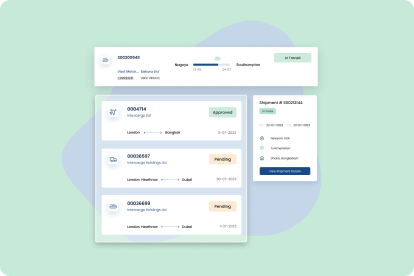
Keep all your data in one place which can be accessed from anywhere and anyplace

Let us help you 24/7 manage your supply chain needs

Back to Global Coverage

Abu Dhabi Freight Forwarding Services
Air & Sea Freight Between Abu Dhabi and the UK

Intercargo provides reliable freight forwarding services between Abu Dhabi and the United Kingdom, helping businesses import and export cargo efficiently by air and sea.

Whether you are importing goods from Abu Dhabi into the UK, exporting products from the UK to Abu Dhabi, or managing regular international shipments, our experienced freight forwarding team provides complete end-to-end logistics solutions. From collection and customs clearance to final delivery, we manage every stage of the shipment process.
Logistics solutions
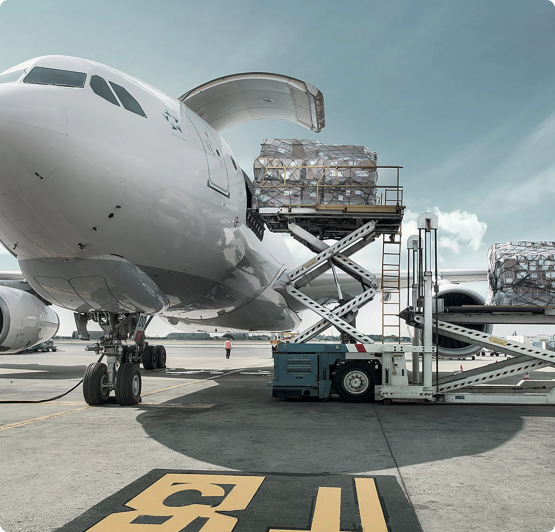
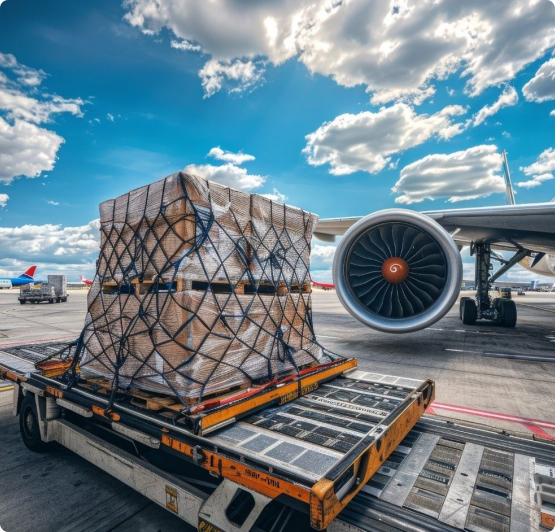
Air Freight Abu Dhabi to UK
When speed matters, our Abu Dhabi air freight services provide fast, secure and reliable transportation between Abu Dhabi and the United Kingdom.
We arrange air freight through Zayed International Airport (AUH), with UK arrivals through London Heathrow, London Stansted, Manchester Airport, Birmingham Airport and East Midlands Airport.

Our air freight solutions include:

  • Air freight from Abu Dhabi to the UK
  • Express and economy air cargo
  • Door to door delivery
  • Time critical shipments
  • Air freight from the UK to Abu Dhabi
  • Airport to airport services
  • Customs clearance support
  • High value and commercial cargo

Whether you need urgent delivery of industrial equipment, aerospace components, electronics, retail stock or commercial goods, our air freight specialists can provide the most efficient solution.
Logistics solutions
Sea Freight Abu Dhabi to UK
For larger shipments and cost-effective transportation, our sea freight services provide dependable shipping solutions between Abu Dhabi and the UK.
We regularly arrange cargo movements through Khalifa Port and Mina Zayed Port, with UK arrivals through Port of Felixstowe, Southampton, London Gateway, Liverpool, Tilbury and Immingham.

Our sea freight services include:

  • Full Container Load (FCL)
  • Port to port shipping
  • Customs documentation
  • Project cargo
  • Less than Container Load (LCL)
  • Door to door logistics
  • Cargo insurance
  • Oversized and heavy lift shipments

Whether shipping machinery, construction materials, industrial equipment, manufacturing equipment or commercial goods, we can tailor a sea freight solution to suit your budget and transit requirements.
Logistics solutions
Import from Abu Dhabi to the UK
Intercargo helps UK businesses import products and cargo from Abu Dhabi through a fully managed freight forwarding service.

Our import services include:

  • Supplier coordination
  • Air and sea freight transportation
  • Duty and VAT guidance
  • Final delivery throughout the UK
  • Collection from Abu Dhabi factories, warehouses and commercial premises
  • UK customs clearance
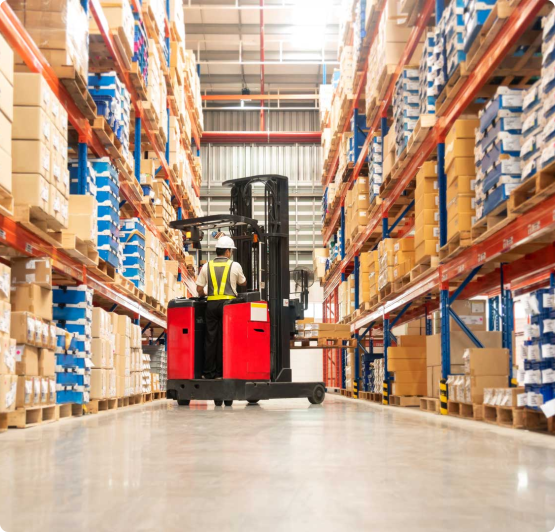
  • Warehousing and distribution

We regularly support imports including:

  • Petrochemical products
  • Machinery
  • Commercial goods
  • Plastics and polymers
  • Aluminium products
  • Industrial equipment
  • Manufacturing components
Our experienced team ensures your cargo moves efficiently from Abu Dhabi to the UK while remaining compliant with all customs and import requirements.
Logistics solutions
Export from the UK to Abu Dhabi
We also help UK businesses export goods to customers, distributors and partners throughout Abu Dhabi. Whether shipping to Abu Dhabi City, Khalifa Industrial Zone Abu Dhabi (KIZAD), Mussafah, Al Ain or other commercial and industrial locations across the Emirate of Abu Dhabi, our export specialists can arrange a seamless freight solution by air or sea.
Our export services include:

  • Air freight exports
  • Export documentation
  • Cargo insurance
  • Commercial and industrial shipments
  • Sea freight exports
  • Customs compliance
  • Door-to-door delivery

From single shipments to regular freight movements, we provide scalable logistics solutions designed around your business requirements.
Logistics solutions
Customs Clearance & Freight Forwarding
Successful international shipping depends on accurate customs documentation and compliance. Intercargo provides:

  • Import customs clearance
  • Commodity code guidance
  • Duty and tax assistance
  • End-to-end shipment visibility
  • Export customs clearance
  • Shipping documentation
  • Freight forwarding management

Our experienced freight forwarding team helps minimise delays and keeps your cargo moving smoothly between Abu Dhabi and the United Kingdom.
Logistics solutions
Why Choose Intercargo for Abu Dhabi Freight?
We support importers, exporters, manufacturers, distributors, retailers, construction companies and e-commerce businesses moving cargo between Abu Dhabi and the UK.
Air Freight And Sea Freight Specialists
Uk And Abu Dhabi Trade Lane Expertise
Import And Export Solutions
Customs Clearance Support
Door To Door Logistics
Dedicated Account Management
Global Carrier Network
Competitive Freight Rates
Get an Abu Dhabi Freight Quote

Looking for air freight from Abu Dhabi to the UK, sea freight from Abu Dhabi to the UK, or export services from the UK to Abu Dhabi?
Contact Intercargo today for a tailored freight forwarding quotation and expert advice on the most efficient shipping solution for your cargo.
Logistics solutions
Latest News & Updates

Capacity fears as US drayage rates are buoyed by converging trends

Concerns are rising in the US about drayage capacity and pricing, as a convergence of factors is producing signs of mounting strain. The situation has come to the fore in recent earnings calls of trucking and intermodal service providers. Jim filter, president and CEO of Schneider, claimed drayage was the "primary constraint" to pursuing opportunities of over-the-road conversions. "We elected not to chase growth that would have required expensive third-party dray when pricing was not yet supportive of the incremental cost," he said. And Brad Stewart, treasurer and SVP of investor relations at Knight-Swift, said: "While outside drayage service is affected by the constrained driver market, we outsource only a low single-digit percentage of our drayage needs, which should provide some insulation from the tightening in drayage capacity." The National Drayage Spot Market Index is 8.2% up year on year, and is expected to remain elevated this month, amid warnings of continued pressure on equipment availability, driver capacity, terminal turn times, and appointment flexibility. One factor in the equation is the peak season, which manifested itself in container dwell rates at the port complex of Los Angeles and Long Beach rising in August to their highest level in over 15 months. Brian Kobza, CCO of drayage and landside logistics provider IMC Logistics, which has stations at all major intermodal points in the US, described this year's peak as "plateaued" - more extended with less of a pronounced spike, which kicked off earlier than usual and is still going on. Some predictions see it running as far as China's Golden Week in early October. This year, volumes have received an additional boost from industrial traffic - largely AI-related shipments of hardware and materials for data centres, plus power equipment to meet the voracious need for electricity, noted Paul Brashier, VP of global supply chain at ITS Logistics. This has added to the number of ports that are dealing with elevated import volumes. Mr Brashier named Houston as a "big pain point". "The amount of freight we're moving from the port of Houston is phenomenal - retail, industrial, energy, projects," he said. Mr Kobza named a number of locations where he saw signs of congestion and elevated dwell times, including Chicago and Memphis (two notorious bottlenecks for rail freight), as well as Atlanta, Jacksonville, and Savannah. And traffic at Dallas/Fort Worth has been the busiest in years, according to Mr Brashier. However, at this point the stress points are relatively manageable, Mr Kobza said. "We're seeing stresses in supply chains, warning signs that it could get worse," he added. Dwell times for import containers waiting at ports for inland transport have climbed to 6-7 days on average, but at some terminals they are up to 14 days, he said. Strain on the network has been increased by more domestic intermodal traffic, a result of the rise in truckload pricing and the shrinkage of trucking capacity, precipitated by the federal government's clampdown on non-domiciled drivers and truckers with insufficient command of English, which is decimating the driver pool. This is exacerbating the situation in the drayage market, as some drivers have shifted to the truckload sector, Mr Kobza noted. Mr Brashier suggested this was not a novel phenomenon. Traditionally, peak seasons have caused some driver shifts from drayage to truckload, but this did not play out in recent years when trucking rates were depressed because of overcapacity and sluggish demand, he said. One additional factor that could impact the situation is the low water level of the Panama Canal which has triggered restrictions in daily transits, threatening backlogs on its west side, Mr Kobza noted. "The canal has the potential to become a larger issue, but at this point it's just another delay in the overall supply chain," he commented. He advises cargo owners to "build some float" into their supply chain schedules, to diversify their supplier base as much as possible, and to do due diligence on their drayage and landside providers. "Make sure you have emergency plans for access to dray capacity - and keep an eye on Houston," Mr Brashier said.

Source: theloadstar.com

Read more

DSV weighs early CargoWise move as WiseTech tackles pricing and ACCC scrutiny

In the first of a two-part interview with WiseTech CEO Zubin Appoo, The Loadstar looks at DSV's evolving relationship with CargoWise, the impact of its new pricing model, and the regulatory and operational challenges it faces. Tomorrow we examine WiseTech's plans to turn CargoWise into an AI 'system of execution' - and what that could mean for the future of the TMS DSV has held talks with WiseTech Global over a potentially move onto its new CargoWise commercial model before its current contract expires in two years, despite the forwarder's longer-term plans to migrate operations to its own Tango platform. WiseTech CEO Zubin Appoo told The Loadstar he had travelled to Copenhagen in May with the company's European sales head for talks with DSV CEO Jens Lund and his leadership team. The meeting, which lasted around half a day, covered both CargoWise's existing role within DSV's technology ecosystem, and what that role could look like in future. Crucially, Mr Appoo said, this included discussions over "what it might look like for them to roll onto CargoWise value packs (CVP) sooner than [the contract expiry date of] September 2028". He stressed that no agreement had been reached. "That's not to say that they're locked in. It is to say that there are positive conversations," he said, noting more "conversations" had taken place since May. The comments add another twist to the uncertainty surrounding one of CargoWise's largest customers. DSV has previously made clear that Tango, the system developed by DB Schenker, is intended to become its strategic operating platform. That had raised questions over the future of CargoWise within the enlarged DSV, although WiseTech sought to counter those concerns in July, revealing that DSV's CargoWise transaction volumes had actually increased some 20% over the preceding six months, against an increase of just 3% in user numbers. WiseTech has described DSV's contract as a "substantial financial commitment", but neither company has disclosed the value, although its importance to WiseTech is potentially considerable. In May, Jefferies analyst Roger Samuel estimated that DSV accounted for about 9% of WiseTech revenue and 10% of its EBITDA, while arguing that any complete migration away from CargoWise could take six years. (That estimate predates WiseTech's consolidation of e2open, which has substantially enlarged the group and therefore should not be applied to its current $1.4bn revenue base) CargoWise itself generated $756.9m in FY26 revenue, up 11% year on year. Mr Appoo said DSV was continuing to expand CargoWise usage as it integrated DB Schenker. "They are currently moving more and more of their DB Schenker users onto CargoWise," he said. He pointed to DSV's public statements that this was necessary to realise integration synergies and argued that the continuing deployment provided WiseTech with an opportunity to demonstrate the value of remaining on the platform. "We see it as an opportunity for us to continue to prove to DSV and other large customers the value that we deliver to them, the value we will continue to deliver through more and more AI agents, and the value that they may miss out on if they were to move off CargoWise." For DSV, the bigger question remains what adopting CVP before 2028 would mean for its longer-term technology strategy. Increasing CargoWise volumes and ongoing migration of DB Schenker users appear, at least in the short term, to run in parallel with its ambition to develop Tango as its strategic operating system. Another question is what role CargoWise might retain when Tango matures. An early switch to CargoWise Value Packs (CVP) would be interesting, because the model fundamentally changes how customers pay for the platform. Rather than charging primarily according to seats and cloud services, WiseTech has moved towards transaction-based pricing, which it says better reflects the value generated through automation and increased throughput. Around 95% of CargoWise customers have already migrated to CVP. Mr Appoo told The Loadstar the majority of CargoWise's 11% revenue growth in FY26 had come from the transition from its previous standard transaction licence (STL) commercial model to CVP, rather than underlying freight market growth alone. But WiseTech does not break out exactly how much growth came from increased customer volumes and how much from pricing. Mr Appoo acknowledged, however, that the company had expected the change to generate additional revenue. "We made this sort of change, knowing at the end of the day there would be incremental revenue for us, given our increased spend on R&D," he explained. The impact varies considerably by customer, he added, some paying approximately the same as previously, while "some pay more, some pay far more, some pay less, some pay far less". "Were they a very efficient business where they had less seats but more volume, or were they inefficient where they had a lot of seats but not much volume? It really depends on their usage." WiseTech also modified CVP during the second half after receiving customer feedback and observing how the model operated in practice. Mr Appoo said that, in some cases, WiseTech had found it was "capturing value too early", while in others it was taking a "disproportionate amount of value for a specific type of transaction". He clarified: "When I say disproportionate, I mean disproportionate compared with what we had planned. We didn't sit down and say we're going to take 10%, or we're going to take 50% or 40%. We decided we would charge between $2.63 and $19.95 per job, depending on the permutation or type of shipment. In some cases, there were refinements we made to the packaging. In most cases, it was about the time we would actually extract the value from the customer. When would we charge them the $2 or the $19? When does it make sense to charge them compared to when they charge their customer? So that was the crux of the refinements." The changes contributed to lower-than-initially-anticipated CargoWise revenue growth during the second half, but Mr Appoo argued they would encourage greater adoption over the longer term. The changes to CargoWise's commercial model come as WiseTech faces renewed scrutiny from Australia's competition regulator. On 19 August, the Australian Competition and Consumer Commission (ACCC) executed a search warrant at WiseTech, requiring it to produce documents and electronic data as part of an investigation into alleged contraventions of the Competition and Consumer Act. WiseTech's ASX announcement said the investigation related to the "supply of global logistics services and software", but gave no further details. Some industry sources have questioned whether the investigation could concern WiseTech's contractual arrangements, including restrictions in agreements with technology partners, although there is no indication from the ACCC that this forms part of its investigation. Asked by The Loadstar what conduct was under investigation, Mr Appoo declined to elaborate. "There's really not much we can say there, other than it's very early days in an ACCC investigation," he said. "We're obviously cooperating ... and we put an ASX announcement out when it happened." The latest investigation follows an earlier intervention by the ACCC over WiseTech's acquisition of Australian customs and forwarding software provider Expedient, which resulted in WiseTech agreeing to sell Expedient. Significantly, the ACCC said at the time that it considered WiseTech to have "substantial market power" in the supply of logistics software, and had received "significant concerns" from software users over the acquisition. The latest investigation comes amid a wider period of corporate and regulatory upheaval at WiseTech, although Mr Appoo rejected the suggestion that this was affecting customer confidence in the company. "I wouldn't say it's a distraction for customers," he said. "Most of them, first of all, aren't in Australia, and a lot of these regulatory issues we're facing are Australian regulatory issues." He pointed to increasing CargoWise customer signings as evidence that confidence had not been damaged. Mr Appoo also argued that WiseTech had responded to concerns over corporate governance. "On the governance front, we've listened very carefully to our investors and, basically, done everything they've asked us to do." He pointed to a board that now comprises five non-executive and two executive directors, the appointment of independent chair Raelene Murphy, and the appointment of a permanent CFO. Founder Richard White, meanwhile, himself in hot water over several allegations, remains closely involved. Although he resigned as executive chair, he remains on the board as an executive director and continues to serve in his operational capacity as WiseTech's chief innovation officer. "Richard continues to be very involved in the business and is very dedicated to the business," Mr Appoo said. The corporate changes have coincided with an equally dramatic restructuring of WiseTech's workforce. Some 1,700 roles have been removed across its earlier high-performance programme and subsequent AI transformation, an "incredibly hard decision", as WiseTech increasingly uses AI internally for software development and other functions. "We really lent into AI quite hard, quite early on, and we had the software development intelligence to see what this was going to do to the industry, and what this was going to do to Wise Tech." Mr Appoo said the changes had resulted in a 45% increase in software-development productivity per employee, as well as a roughly 20%-22% improvement in incident-resolution times. But the reductions have inevitably raised questions over whether WiseTech can maintain service and reliability with a substantially leaner workforce, particularly after CargoWise suffered a global outage earlier this year. Mr Appoo insisted "that outage actually had nothing to do with AI", adding: "All software ultimately has outages. We've had outages in the past as well." He said the incident remained within WiseTech's service level commitments, and argued that the company had maintained - and in some cases increased - the checks governing AI-assisted development, incuding code, design, and documentation reviews, user-acceptance testing, cyber-security and data-integrity checks, and reviews covering privacy and personally identifiable information. "The gates still exist, so it's not like we've just delegated the work to an agent and said 'we don't really care about quality anymore, go and write the code'," he said. "That's absolutely not what we've done. In fact, we've put even more gates in place, because we're rapidly learning where AI has limits."

Source: theloadstar.com

Read more

Africa-LatAm trade on the up - but is mainly one-way traffic

Brazilian forwarders appear optimistic about the way trade opportunities are shaping up in Africa, and it seems there is certainly an appetite on the other side of the Atlantic to foster stronger relations. However, desire notwithstanding, this has yet to translate into hard volumes. Latest data from Container Trades Statistics (CTS) indicates that after a strong start to 2026, volumes headed from Latin America to Sub-Saharan Africa have proved less consistent, with June figures down 4.6% year on year. Asked if they were concerned by the numbers, forwarders told The Loadstar Brazil painted a far better picture, one noting they shipped "more than 3,000 containers a month" of sugar on the routing. "This is an ongoing deal and we are moving that amount every month for the entire year. The problem we're having is that space is always a challenge due to being over-weight, but it is a firm business." The June blip follows a May in which LatAm-Africa volumes climbed 8.6%, year on year, which in turn followed a 10.2% April downturn. "Part of it is the war in Middle East and all the uncertainty," a source explained. In the other direction, June's Sub-Saharan Africa-LatAm volumes may have jumped 4%, but from a far lower base, hitting 2,700 teu, compared with the 37,500 teu that moved Latam-Africa in the period. "We don't really see much coming back," said a LatAm-based forwarder. Given its economic heft, sources said it was interesting to note that South Africa "still" had a "massive trade deficit" with Brazil, but one pointed out that efforts were being made to reduce this as part of the two countries' efforts to foster greater trade between them. And there are improving connections, with Latam Airlines having started a thrice-weekly Cape Town-São Paulo service, offering additional capacity for those looking to ship between the two countries.

Source: theloadstar.com

Read more

Privacy Preference Center

This website uses cookies and similar technologies, (hereafter “technologies”), which enable us, for example, to determine how frequently our internet pages are visited, the number of visitors, to configure our offers for maximum convenience and efficiency and to support our marketing efforts. These technologies incorporate data transfers to third-party providers based in countries without an adequate level of data protection (e. g. United States). For further information, including the processing of data by third-party providers and the possibility of revoking your consent at any time, please see your settings under “Consent Preferences” and our


Privacy Notice


Privacy Preference Center

Strickly Necessary Cookies
Always Active

Performance Cookies

Functional Cookies

Targeting Cookies