We understand the ever changing needs of our customers

we provide a high level of service dedicated to fulfilling all your shipping requirements

Watch Video
Road Freight

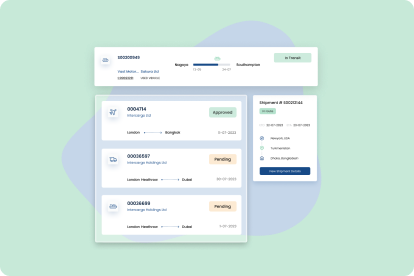
Keep all your data in one place which can be accessed from anywhere and anyplace

Let us help you 24/7 manage your supply chain needs

Back to Global Coverage

Australia Freight Forwarding Services
Air & Sea Freight Between Australia and the UK

Intercargo provides reliable freight forwarding services between Australia and the United Kingdom, helping businesses import and export cargo efficiently by air and sea.

Whether you are importing goods from Australia into the UK, exporting products from the UK to Australia, or managing regular international shipments, our experienced freight forwarding team provides complete end-to-end logistics solutions. From collection and customs clearance to final delivery, we manage every stage of the shipment process.

Logistics solutions
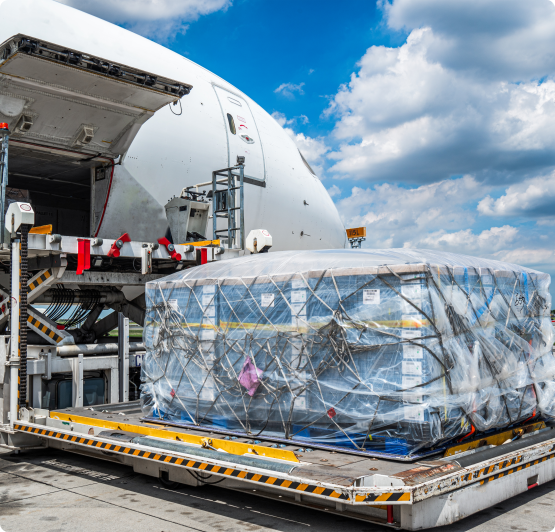
Air Freight Australia to UK
When speed matters, our Australia air freight services provide fast, secure and reliable transportation between Australia and the United Kingdom.
We arrange air freight through major Australian airports including Sydney Airport (SYD), Melbourne Airport (MEL), Brisbane Airport (BNE), Perth Airport (PER) and Adelaide Airport (ADL), with UK arrivals through London Heathrow, London Stansted, Manchester Airport, Birmingham Airport and East Midlands Airport.

Our air freight solutions include:

  • Air freight from Australia to the UK
  • Express and economy air cargo
  • Door to door delivery
  • Time critical shipments
  • Air freight from the UK to Australia
  • Airport to airport services
  • Customs clearance support
  • High value and commercial cargo

Whether you need urgent delivery of electronics, consumer goods, fashion products, industrial equipment or commercial cargo, our air freight specialists can provide the most efficient solution.
Logistics solutions
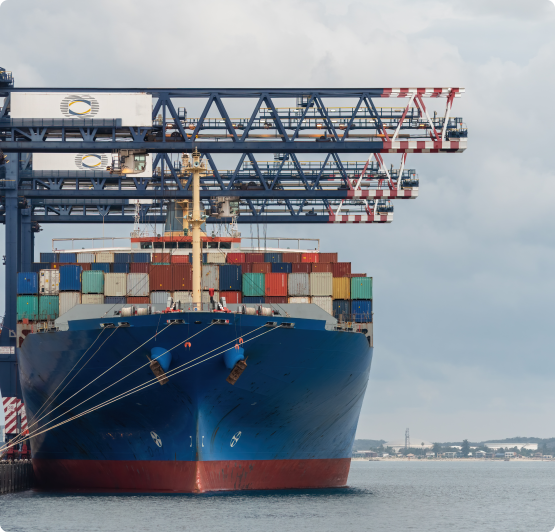
Sea Freight Australia to UK
For larger shipments and cost-effective transportation, our sea freight services provide dependable shipping solutions between Australia and the UK.
We regularly arrange cargo movements through major Australian ports including Port Botany (Sydney), Port of Melbourne, Port of Brisbane, Fremantle Port (Perth) and Port Adelaide, with UK arrivals through Port of Felixstowe, Southampton, London Gateway, Liverpool, Tilbury and Immingham.

Our air freight solutions include:

  • Full Container Load (FCL)
  • Port to port shipping
  • Customs documentation
  • Project cargo
  • Less than Container Load (LCL)
  • Door to door logistics
  • Cargo insurance
  • Oversized and heavy lift shipments

Whether shipping machinery, mining equipment, commercial products, manufacturing equipment or retail stock, we can tailor a sea freight solution to suit your budget and transit requirements.
Logistics solutions
Import from Australia to the UK
Intercargo helps UK businesses import products and cargo from Australia through a fully managed freight forwarding service.

Our import services include:

  • Supplier coordination
  • Air and sea freight transportation
  • Duty and VAT guidance
  • Final delivery throughout the UK
  • Collection from Australia factories, warehouses and commercial premises
  • UK customs clearance
  • Warehousing and distribution

We regularly support imports including:

  • Electronics and semiconductors
  • Medical devices
  • Manufacturing components
  • Industrial equipment
  • Consumer goods
  • Machinery
  • Food and beverage products
Our experienced team ensures your cargo moves efficiently from Australia to the UK while remaining compliant with all customs and import requirements.
Logistics solutions
Export from the UK to Australia
We also help UK businesses export goods to customers, distributors and partners throughout Australia. Whether shipping to Sydney, Melbourne, Brisbane, Perth, Adelaide, Canberra or Hobart, our export specialists can arrange a seamless freight solution by air or sea.
Our export services include:

  • Air freight exports
  • Export documentation
  • Cargo insurance
  • Commercial and industrial shipments
  • Sea freight exports
  • Customs compliance
  • Door-to-door delivery

From single shipments to regular freight movements, we provide scalable logistics solutions designed around your business requirements.
Logistics solutions
Customs Clearance & Freight Forwarding
Successful international shipping depends on accurate customs documentation and compliance. Intercargo provides:

  • Import customs clearance
  • Commodity code guidance
  • Duty and tax assistance
  • End-to-end shipment visibility
  • Export customs clearance
  • Shipping documentation
  • Freight forwarding management

Our experienced freight forwarding team helps minimise delays and keeps your cargo moving smoothly between Australia and the United Kingdom.
Logistics solutions
Why Choose Intercargo for Australia Freight?
We support importers, exporters, manufacturers, distributors, retailers and e-commerce businesses moving cargo between Australia and the UK.
Air Freight And Sea Freight Specialists
Uk And Australia Trade Lane Expertise
Import And Export Solutions
Customs Clearance Support
Door To Door Logistics
Dedicated Account Management
Global Carrier Network
Competitive Freight Rates
Get a Australia Freight Quote

Looking for air freight from Australia to the UK, sea freight from Australia to the UK, or export services from the UK to Australia? Contact Intercargo today for a tailored freight forwarding quotation and expert advice on the most efficient shipping solution for your cargo.
Logistics solutions
Latest News & Updates

Korean Air plans new cargo strategy for post Asiana merger era

Korean Air is preparing to reshape its cargo operation around a bigger passenger network, upgraded handling infrastructure, and what it sees as a growing transpacific flow of technology and data-centre equipment. The airline, due to complete its integration with Asiana Airlines on 17 December, told The Loadstar the enlarged passenger fleet would provide additional belly capacity, while its large-freighter network continued to handle heavier and more specialised cargo. Korean Air is also investing in its cargo infrastructure at Incheon and New York airports, with automation and temperature-controlled facilities aimed at increasing throughput and supporting more time- and temperature-sensitive shipments. At Incheon, Korean Air is working with Lödige Industries to introduce fully automated, driverless elevating transfer vehicles (ETVs) and automated guided vehicles (AGVs) for internal ULD movements. The airline is expanding ETV racking and adding dedicated bypass lines to increase throughput and reduce bottlenecks during peak periods. The work is due for completion next month. The carrier is also planning a further upgrade of its cargo terminal at JFK next year, a project that will incorporate additional automation and expanded temperature-controlled facilities. According to Korean Air, the two investments are intended to strengthen its ability to handle cargo requiring faster processing and tighter temperature control, with semiconductors and pharmaceuticals among the target traffic. The changes will also support a deliberate division of roles between belly capacity and freighters, added the airline. Following the merger, Korean Air plans to pair the additional passenger belly space with its freighter network, using the two capacity sources according to the characteristics of the freight. It said belly capacity would be particularly important on intra-Asia routes, where higher-frequency passenger services could support express and parcel traffic. Its main-deck freighters, meanwhile, would be used for heavier, outsize, and project cargo. The approach reflects the different roles the two networks can play, rather than simply adding capacity across the board. Passenger flights can provide frequency and connectivity for shipments where speed and schedule density are important, while dedicated freighters retain the flexibility required for cargo that cannot readily move in the belly hold. Korean Air has identified a growing opportunity in transpacific technology traffic, particularly as investment in data-centre infrastructure drives demand for high-value components. It is seeing increasing flows of AI server racks and semiconductor fabrication equipment between North America and Asian technology centres, as well as specialised components moving in the opposite direction, including server hardware from China and South-east Asia, advanced batteries from Japan, and power-supply equipment from Korea. The airline expects high-density electronic components associated with data-centre construction to become an important driver for its belly cargo capacity. This could give the expanded passenger network a role beyond simply adding capacity to established cargo routes. Korean Air said the higher frequency of the combined passenger network would help synchronise these fast-moving supply chains. The airline's cargo ambitions extend beyond physical capacity, however. Korean intends to build an AI-enabled operational ecosystem, incorporating smart tracking, IoT infrastructure, and API integration to provide greater visibility across the supply chain. That ambition highlights one of the less-visible challenges of expanding cargo operations: additional aircraft and terminal capacity do not necessarily translate into faster or more predictable shipments if the systems connecting airlines, forwarders, ground handlers, and customs authorities remain fragmented. Therefore, Korean Air is focusing on interoperability and standardised data exchange across the cargo ecosystem. The objective is to improve the flow of information between organisations operating with different IT environments and, ultimately, make the physical movement of cargo more efficient. This strategy marks a significant shift in the cargo implications of the Asiana integration. Asiana's dedicated freighter operation has been separated from the merger, leaving Korean Air to build its post-integration cargo growth around its own freighter fleet, expanded passenger belly capacity and upgraded infrastructure. Rather than replacing the Asiana freighter capacity with a like-for-like expansion, it appears Korean Air is positioning its combined operation around a mix of network frequency, main-deck capacity, automated handling, and digital connectivity. With the merger approaching, the focus will likely be on integrating the passenger network. For cargo, however, the more consequential changes may come from how Korean Air uses that enlarged network to capture technology-related trade, while upgrading the infrastructure needed to move it through Incheon and its international gateways.

Source: theloadstar.com

Read more

Air China Cargo offers air cargo capacity through cargo.one

Air China Cargo has initiated its first global digital distribution partnership by placing its air cargo capacity on cargo.one for freight forwarders to book instantly. From 27 August, forwarders using cargo.one in Europe and North America can quote, book and track cargo, including express, up to 5000 kg on Air China Cargo services to destinations including Shanghai Pudong, Beijing, Guangzhou, Shenzhen, Chengdu, Chongqing and Hangzhou. Additional markets and capacity products will become available on cargo.one in the months that follow. The combination of cargo.one's multimodal rate selection and its AI workers helps forwarders to quote faster and more accurately, as well as optimise their win rates and scale their operations more efficiently, said the airfreight booking portal. Lei Wang, general manager of sales and marketing at Air China Cargo, commented: "Launching global digital sales on cargo.one is an important milestone in Air China Cargo's growth strategy and digitalization journey. "As an innovative and proven partner, cargo.one helps to extend our presence to thousands more relevant freight forwarders worldwide, and continually guarantees the seamless end-to-end experience our customers rightly expect." Moritz Claussen, founder and co-chief executive of cargo.one, added: "We are proud to be selected as the partner-of-choice by Air China Cargo. "As Air China Cargo's first global digital sales partner, we provide freight forwarders a valuable new gateway to its sought-after capacity to and from China, fully integrated within our AI-native operating system."

Source: aircargonews.net

Read more

Carriers warn of 20-day delays as congestion crisis at Durban worsens

The congestion at Durban Gateway Terminal has worsened, with delays hitting 10 days, and there is little sign that a resolution is imminent creating more frustration among the forwarding community. Sources told The Loadstar the terminal's Pier 2 was "materially constrained", noting that while delays of 10 days were expected, "some individual services are further behind". One forwarder told The Loadstar: "Honestly, it is a shit show. ICTSI has taken over one of the terminals and, apparently, productivity at the gateway has worsened. As to getting goods moved, it's a crapshoot." ICTSI acquired 49% of the terminal in January after a contentious battle with APM Terminals, following South Africa's decision to allow private sector participation in its port operations. The deal with ICTSI was seen as necessary to contend with decades-long inadequacies in the port's equipment and congestion, with criticism that improvements were not happening fast enough. Also, the introduction of new systems necessitated retraining the workforce, which is adding to the delays, with some sources suggesting that there is no resolution in sight. One local forwarding source told The Loadstar that to clear the cargo backlog would "take at least a few weeks, probably more", and that was on the basis that the number of ships and containers waiting to be handled did not increase. Indeed, some carriers are now warning customers to expect delays of 20 days. The source added that "containers discharged on 11 August are still waiting in the terminal", and that while the number of free storage days had been extended today, there had been no update on what would happen, going forward. Part of the problem is that South Africa has struggled since the rerouting of vessels round the Cape from the Red Sea - an issue compounded by the closure of the Strait of Hormuz and now responsible for 9% of global port congestion, according to Linerlytica.

Source: theloadstar.com

Read more

Privacy Preference Center

This website uses cookies and similar technologies, (hereafter “technologies”), which enable us, for example, to determine how frequently our internet pages are visited, the number of visitors, to configure our offers for maximum convenience and efficiency and to support our marketing efforts. These technologies incorporate data transfers to third-party providers based in countries without an adequate level of data protection (e. g. United States). For further information, including the processing of data by third-party providers and the possibility of revoking your consent at any time, please see your settings under “Consent Preferences” and our


Privacy Notice


Privacy Preference Center

Strickly Necessary Cookies
Always Active

Performance Cookies

Functional Cookies

Targeting Cookies