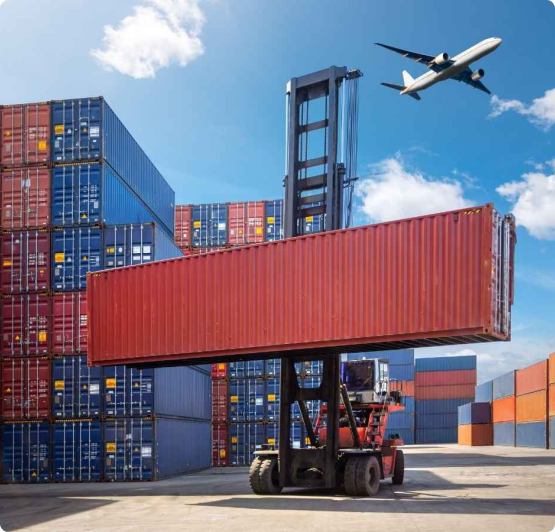
We understand the ever changing needs of our customers

we provide a high level of service dedicated to fulfilling all your shipping requirements

Watch Video
Road Freight

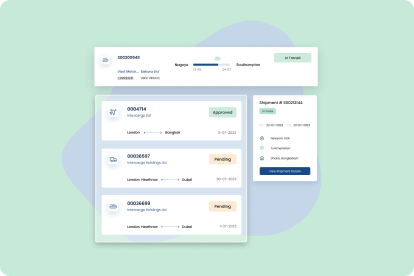
Keep all your data in one place which can be accessed from anywhere and anyplace

Let us help you 24/7 manage your supply chain needs

Back to Global Coverage

Qatar Freight Forwarding Services
Air & Sea Freight Between Qatar and the UK

Intercargo provides reliable freight forwarding services between Qatar and the United Kingdom, helping businesses import and export cargo efficiently by air and sea.

Whether you are importing goods from Qatar into the UK, exporting products from the UK to Qatar, or managing regular international shipments, our experienced freight forwarding team provides complete end-to-end logistics solutions. From collection and customs clearance to final delivery, we manage every stage of the shipment process.
Logistics solutions
Air Freight Qatar to UK
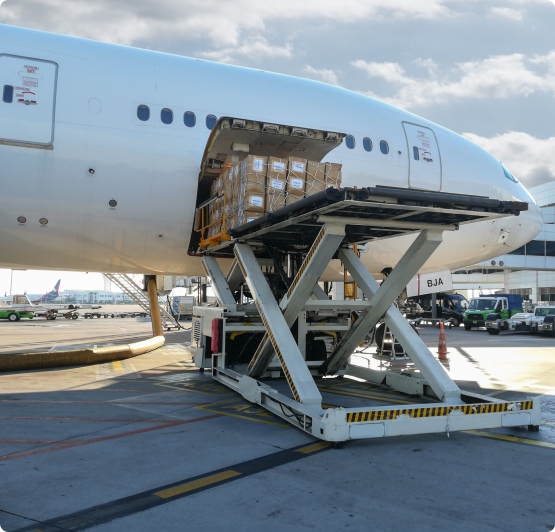
When speed matters, our Qatar air freight services provide fast, secure and reliable transportation between Qatar and the United Kingdom.
We arrange air freight through Hamad International Airport (DOH) in Doha, with UK arrivals through London Heathrow, London Stansted, Manchester Airport, Birmingham Airport and East Midlands Airport.

Our air freight solutions include:

  • Air freight from Qatar to the UK
  • Express and economy air cargo
  • Door to door delivery
  • Time critical shipments
  • Air freight from the UK to Qatar
  • Airport to airport services
  • Customs clearance support
  • High value and commercial cargo

Whether you need urgent delivery of industrial equipment, aviation components, electronics, retail stock or commercial goods, our air freight specialists can provide the most efficient solution.
Logistics solutions
Sea Freight Qatar to UK
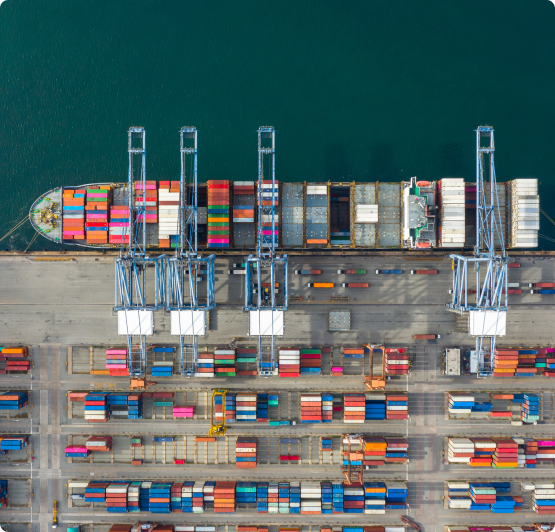
For larger shipments and cost-effective transportation, our sea freight services provide dependable shipping solutions between Qatar and the UK.
We regularly arrange cargo movements through Hamad Port, with UK arrivals through Port of Felixstowe, Southampton, London Gateway, Liverpool, Tilbury and Immingham.

Our air freight solutions include:

  • Full Container Load (FCL)
  • Port to port shipping
  • Customs documentation
  • Project cargo
  • Less than Container Load (LCL)
  • Door to door logistics
  • Cargo insurance
  • Oversized and heavy lift shipments

Whether shipping machinery, construction materials, commercial products, manufacturing equipment or retail stock, we can tailor a sea freight solution to suit your budget and transit requirements.
Logistics solutions
Import from Qatar to the UK
Intercargo helps UK businesses import products and cargo from Qatar through a fully managed freight forwarding service.

Our import services include:

  • Supplier coordination
  • Air and sea freight transportation
  • Duty and VAT guidance
  • Final delivery throughout the UK
  • Collection from Qatari factories, warehouses and commercial premises
  • UK customs clearance
  • Warehousing and distribution

We regularly support imports including:

  • Petrochemical products
  • Machinery
  • Commercial goods
  • Plastics and polymers
  • Aluminium products
  • Industrial equipment
  • Manufacturing components
Our experienced team ensures your cargo moves efficiently from Qatar to the UK while remaining compliant with all customs and import requirements.
Logistics solutions
Export from the UK to Australia
We also help UK businesses export goods to customers, distributors and partners throughout Qatar. Whether shipping to Doha, Al Rayyan, Al Wakrah, Lusail, Mesaieed or other commercial and industrial locations across Qatar, our export specialists can arrange a seamless freight solution by air or sea.
Our export services include:

  • Air freight exports
  • Export documentation
  • Cargo insurance
  • Commercial and industrial shipments
  • Sea freight exports
  • Customs compliance
  • Door-to-door delivery

From single shipments to regular freight movements, we provide scalable logistics solutions designed around your business requirements.
Logistics solutions
Customs Clearance & Freight Forwarding
Successful international shipping depends on accurate customs documentation and compliance. Intercargo provides:

  • Import customs clearance
  • Commodity code guidance
  • Duty and tax assistance
  • End-to-end shipment visibility
  • Export customs clearance
  • Shipping documentation
  • Freight forwarding management

Our experienced freight forwarding team helps minimise delays and keeps your cargo moving smoothly between Qatar and the United Kingdom.
Logistics solutions
Why Choose Intercargo for Qatar Freight?
We support importers, exporters, manufacturers, distributors, retailers and e-commerce businesses moving cargo between Qatar and the UK.
Air Freight And Sea Freight Specialists
Uk And Qatar Trade Lane Expertise
Import And Export Solutions
Customs Clearance Support
Door To Door Logistics
Dedicated Account Management
Global Carrier Network
Competitive Freight Rates
Get a Qatar Freight Quote

Looking for air freight from Qatar to the UK, sea freight from Qatar to the UK, or export services from the UK to Qatar? Contact Intercargo today for a tailored freight forwarding quotation and expert advice on the most efficient shipping solution for your cargo.
Logistics solutions
Latest News & Updates

Kühne Foundation 30% stake in Hapag-Lloyd coming up for grabs?

Klaus-Michael Kühne's death last week may present something of an opportunity for those keen to get in on the Hapag-Lloyd bandwagon, with suggestions rumbling around the Kühne Foundation's 30% stake in the German liner giant. Swiss corporate lawyer Thomas Staehelin is now to take over the running of the foundation. It has some $37bn swilling around, thanks in large part to a series of strategic investments over the years - not least that Hapag stake. Efforts to contact the foundation have so far proved fruitless, The Loadstar being keen to get a sense of whether the sale of the Hapag-Lloyd shares is being considered, and whether that is even possible under the structure of the foundation. Alphaliner has one take on the matter, claiming Mr Kühne "deliberately structured the foundation's statutes to ensure that its core holdings, including the 30% stake in Hapag-Lloyd, are preserved as strategic core assets". Nonetheless, citing "economic experts", it added that "the foundation and holding structures are legally flexible enough that future portfolio adjustments cannot be entirely ruled out for ever", providing some wiggle room should Mr Staehelin step down. Short-term, the sentiment seems to be that any such sale is not in the offing, with Alphaliner's view being that, as a "long-standing confidant of Mr Kühne", Mr Staehelin will maintain a sense of continuity - an opinion shared by Loadstar Premium's Ale Pasetti. He told The Loadstar that while he agreed a sale was "unlikely", he added that he was only prepared to make this claim for the "short-term", noting that "if such a large stake in Hapag was made available Maersk could take over". Having spent the past two years discussing the idea of a Maersk-Hapag-Lloyd tie-up as "a base-case shipping M&A at the top of the league tables to challenge MSC", Mr Pasetti suggested the Danish liner was an obvious bedfellow for the Kühne Foundation stake. But did not rule out a bidding war, with obvious candidates including the likes of CMA CGM, alongside behemoth MSC, but for Mr Pasetti, given that "Hapag and Maersk are on friendly terms", this seemed the obvious fit. One issue not mentioned is whether there would be any ramifications for the looming - will they, won't they - marriage between Hapag-Lloyd and Zim, but for Mr Pasetti, that deal has "bigger problems" that are likely to see any deal scuppered long before the aisle.

Source: theloadstar.com

Read more

Against the odds air cargo growth shows the value of forwarders

Few would deny this is a difficult time for the global economy. Conflict in the Middle East, tariffs and trade uncertainty, volatile fuel costs, and disrupted transport corridors are creating challenges with no respect for borders. Yet air cargo demand is growing. IATA reported an 8.5% year on year increase in global air cargo demand in June 2026, compared with a 4.4% increase in capacity and 5.2% growth in global trade. Importantly, this was not simply the result of a broad-based surge in global exports. IATA noted that export orders remained weak, with growth concentrated in particular trade lanes supported by high-value technology products and urgent shipments. That makes the forwarder's role even more consequential: knowing where capacity exists, anticipating disruption, and quickly assembling workable alternatives. For me, the figures underline something the freight forwarding community has demonstrated repeatedly in recent years: disruption does not remove the need to move goods. It makes the ability to adapt even more important. At the Airforwarders Association, I see every day the value forwarders bring to the economy and our daily lives. When capacity tightens, routes become unavailable, or regulations change, forwarders find alternatives. They bring together carriers, airports, handlers, customs authorities, and customers to keep cargo moving. That work has helped strengthen supply chain resilience. After years of shocks, alternative routings, contingency planning, and the ability to respond quickly are no longer exceptional measures. They are part of how this industry operates. New sources of demand There is another side to the story. While forwarders are managing uncertainty, new sources of demand are creating significant opportunities. Artificial intelligence is one of them. Building the infrastructure required to support AI means moving servers, semiconductors, memory chips, and other sensitive, high value equipment quickly and reliably. Some estimates suggest US data center capacity to double over the next three years. For forwarders, this is about much more than booking airfreight capacity. Data center projects require storage, staging, sequencing, final mile delivery, installation support, vendor management, and, as facilities enter operation, spare parts and service logistics. That gives forwarders an opportunity to apply their expertise across far more of the supply chain. E-commerce also continues to generate demand, while other cargo demonstrates the wider importance of the sector. Humanitarian relief needs to reach disaster zones quickly. Fresh produce has a limited shelf life. Pharmaceuticals depend on precise temperatures, secure handling, and reliable delivery. These are very different shipments, but they have something in common: their value depends on getting the logistics right. The global economy remains unpredictable, and nobody in freight forwarding can afford to underestimate the risks ahead. But rising air cargo demand shows that trade is continuing to move through that uncertainty. Forwarders are helping make that possible, while the next generation of cargo is giving them new opportunities to show just how much value they can add.

Source: aircargonews.net

Read more

Congestion and ship delays take 2.3m teu capacity off the market

Container shipping's deteriorating schedule reliability has effectively taken 2.3m teu of vessel capacity out of the market. According to Sea-Intelligence's latest Global Liner Performance data, schedule reliability fell to 56.4% in July, its lowest level since February 2025 and the weakest performance since the current alliance structure was introduced. The average delay for vessels arriving late extended to more than six days - excluding the immediate aftermath of the Red Sea crisis in January 2024, delays of this length have only occurred during the worst of the pandemic disruption. According to the analyst, all this means 6.6% of the global container fleet is unavailable to the market, equivalent to around 2.3m teu, the capacity of the world's sixth-largest carrier, Sea-Intelligence said. It noted that pre-pandemic, vessel delays typically absorbed about 2.2% of global capacity, so the current figure represents more than four percentage points above the structural baseline. The immediate cause is largely seasonal, a succession of typhoons disrupting major Asian ports. And Sea-Intelligence estimates that, based on the experience of the pandemic and Red Sea crisis, it could take between 4.5 and six months to bring congestion back to the low point recorded in June 2025. Returning to end-2025 levels could take two to 3.5 months. And consultancy Braemar suggested the current congestion issue was largely localised, and not global. It noted that Shanghai and Ningbo were under pressure, with Santos another hotspot, but northern European gateways were generally seeing vessel waiting times measured in hours, or a few days, rather than pandemic-style queues. Further, Braemar noted that congestion did not automatically equal lost capacity, as cargo could be shifted to another sailing, service, or carrier, particularly across the six major east-west trades, which together deploy around 1,378 vessels, with 15.7m teu of capacity. For now, it said, the evidence pointed to pockets of congestion, rather than a global capacity squeeze. But as newbuilds from the growing orderbook enter service, Braemar warned, the relationship between ship size and port infrastructure could become increasingly important. The global container fleet represents roughly 1,500 km of vessel length, while the orderbook adds 419 km - almost 28% of the existing fleet length, as much of the new capacity is on larger ships. Braemar warned that the industry was, therefore, adding not only capacity but vessel length, increasing demand for berths, cranes, and yard capacity. Sea Intelligence summarised: "Normalisation of the Red Sea will create a sharp drop in demand, when distance is taken into account. A gigantic orderbook is about to be delivered as well. The numbers essentially show that this does not add up. "Not that the market might crash, but we will get a downturn, even as the carriers will attempt to stem the tide. "At the top of every market cycle, we always hear arguments from carriers as to why the orderbook is not a problem. How they have become more disciplined, such that they will not allow rates to go below cost. How - this is the new pitch - port congestion will be permanent. How 'this time is different'. Yet, in every previous cycle, for the past decades, it was never different. "Of course, this time might be different indeed. But when we look at the numbers, we get a distinct feeling of déjà vu," the analyst concluded.

Source: theloadstar.com

Read more

Privacy Preference Center

This website uses cookies and similar technologies, (hereafter “technologies”), which enable us, for example, to determine how frequently our internet pages are visited, the number of visitors, to configure our offers for maximum convenience and efficiency and to support our marketing efforts. These technologies incorporate data transfers to third-party providers based in countries without an adequate level of data protection (e. g. United States). For further information, including the processing of data by third-party providers and the possibility of revoking your consent at any time, please see your settings under “Consent Preferences” and our


Privacy Notice


Privacy Preference Center

Strickly Necessary Cookies
Always Active

Performance Cookies

Functional Cookies

Targeting Cookies