We understand the ever changing needs of our customers

we provide a high level of service dedicated to fulfilling all your shipping requirements

Watch Video
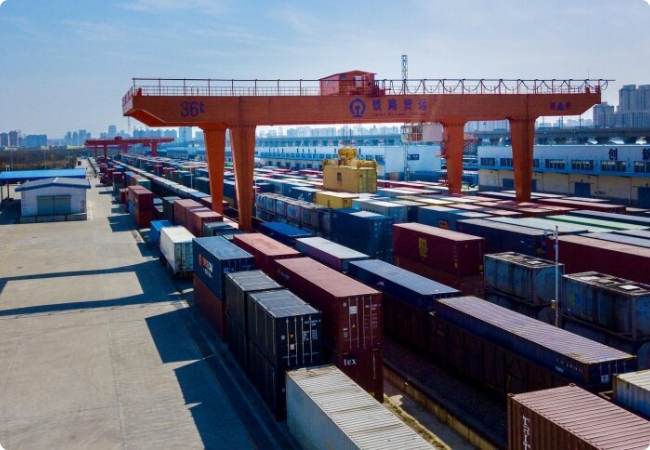
Road Freight

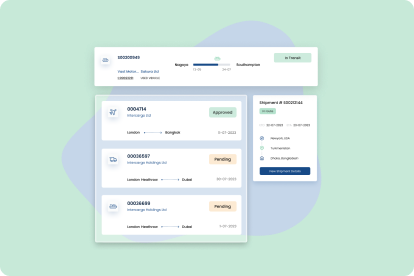
Keep all your data in one place which can be accessed from anywhere and anyplace

Let us help you 24/7 manage your supply chain needs

Back to Global Coverage

China Freight Forwarding Services
Air & Sea Freight Between China And The UK

Intercargo provides reliable freight forwarding services between China and the United Kingdom, helping businesses import and export cargo efficiently by air and sea.

Whether you are importing goods from China into the UK, exporting products from the UK to China, or managing regular international shipments, our experienced freight forwarding team provides complete end-to-end logistics solutions. From supplier collection and customs clearance to final delivery, we manage every stage of the shipping process with efficiency and care.
Logistics solutions
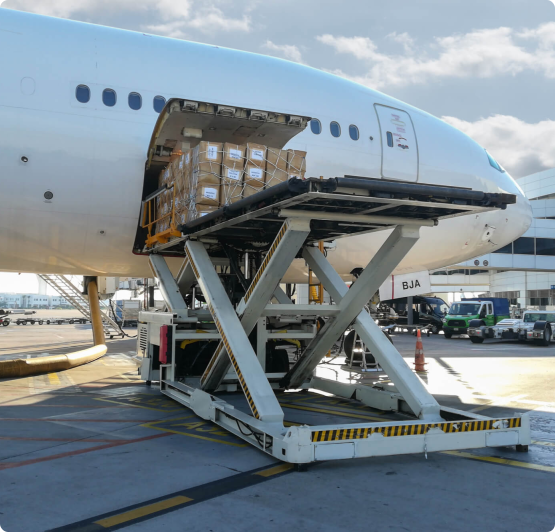
Air Freight China to UK
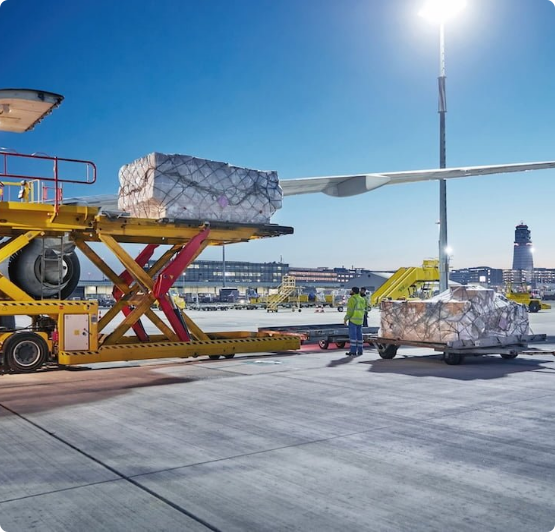
When speed is essential, our China air freight services provide fast, secure and reliable transportation between China and the United Kingdom.

We arrange air freight through major Chinese airports including Shanghai Pudong International Airport (PVG), Beijing Capital International Airport (PEK), Guangzhou Baiyun International Airport (CAN), Shenzhen Bao'an International Airport (SZX) and Hong Kong International Airport (HKG), with UK arrivals through London Heathrow, London Stansted, Manchester Airport, Birmingham Airport and East Midlands Airport.

Our air freight solutions include:

  • Air freight from China to the UK
  • Express and economy air cargo
  • Door-to-door delivery
  • Time-critical shipments
  • Air freight from the UK to China
  • Airport-to-airport services
  • Customs clearance support
  • High-value and commercial cargo

Whether you need urgent delivery of electronics, manufacturing components, retail stock, machinery or commercial goods, our air freight specialists can provide the most efficient solution.
Logistics solutions
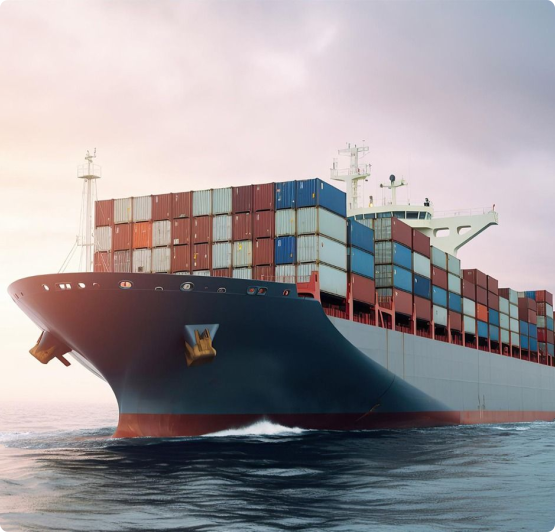
Sea Freight China to UK
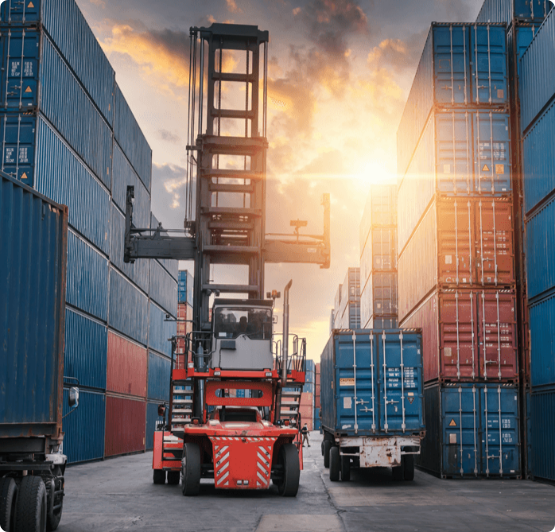
For larger shipments and cost-effective transportation, our sea freight services provide dependable shipping solutions between China and the United Kingdom.
We regularly arrange cargo movements through major Chinese ports including Shanghai Port, Ningbo-Zhoushan Port, Shenzhen Port, Qingdao Port, Tianjin Port, Xiamen Port and Guangzhou Port, with UK arrivals through the Port of Felixstowe, Southampton, London Gateway, Liverpool, Tilbury and Immingham.

Our sea freight services include:

  • Full Container Load (FCL)
  • Port-to-port shipping
  • Customs documentation
  • Project cargo
  • Less than Container Load (LCL)
  • Door-to-door logistics
  • Cargo insurance
  • Oversized and heavy-lift shipments

Whether you are shipping machinery, consumer products, electronics, industrial equipment, retail stock or manufacturing materials, our sea freight specialists deliver reliable, flexible and cost-effective shipping solutions between China and the UK.
Logistics solutions
Import from China to the UK
Intercargo helps UK businesses import products and cargo from China through a fully managed freight forwarding service.

Our import services include:

  • Supplier coordination
  • Air and sea freight transportation
  • Duty and VAT guidance
  • Final delivery throughout the UK
  • Collection from Chinese factories, warehouses and commercial premises
  • UK customs clearance
  • Warehousing and distribution

We regularly support imports including:

  • Electronics
  • Consumer goods
  • Automotive parts
  • Industrial equipment
  • Machinery
  • Construction materials
  • Retail stock
  • Textiles & garments
  • Commercial products
Our experienced freight forwarding team ensures your imports from China arrive efficiently, remain fully compliant with UK customs regulations and are delivered on time.
Logistics solutions
Export from the UK to China
We also help UK businesses export goods to customers, distributors and partners throughout China.
Whether shipping to Shanghai, Beijing, Guangzhou, Shenzhen, Ningbo, Qingdao, Tianjin, Chengdu or Hong Kong, our export specialists can arrange a seamless freight solution by air or sea.
Our export services include:

  • Air freight exports
  • Export documentation
  • Cargo insurance
  • Commercial & industrial shipments
  • Sea freight exports
  • Customs compliance
  • Door-to-door delivery

From single shipments to regular freight movements, we provide scalable logistics solutions designed around your business requirements.
Logistics solutions
Customs Clearance & Freight Forwarding
Successful international shipping depends on accurate customs documentation and compliance.

  • Import customs clearance
  • Commodity code guidance
  • Duty and tax assistance
  • End-to-end shipment visibility
  • Export customs clearance
  • Shipping documentation
  • Freight forwarding management

Our experienced freight forwarding team helps minimise delays and keeps your cargo moving smoothly between Dubai and the United Kingdom.
Logistics solutions
Why Choose Intercargo for China Freight?
We support importers, exporters, manufacturers, distributors, retailers and e-commerce businesses moving cargo between China and the UK.
Air Freight And Sea Freight Specialists
Uk And China Trade Lane Expertise
Import And Export Solutions
Customs Clearance Support
Door To Door Logistics
Dedicated Account Management
Global Carrier Network
Competitive Shipping Rates
Get a China Freight Quote

Looking for air freight from China to the UK, sea freight from China to the UK, or export services from the UK to China?

Contact Intercargo today for a tailored freight forwarding quotation and expert advice on the most efficient shipping solution for your cargo.
Logistics solutions
Latest News & Updates

MSC - M&A hungry and on the prowl

As Ian Fleming wrote in his 1959 novel Goldfinger: "Once is happenstance. Twice is coincidence. Three times is enemy action." Apply that to the current M&A-prone landscape for shipping lines and... Now What's known: Mediterranean Shipping Company (MSC) is - directly or indirectly; more below - readying to pull the trigger, as "urgency is felt to close deals", including those where 100% ownership must be achieved in various ventures. Kind of... in line with the post-Covid narrative for MSC, and so: sourced from ...

Source: theloadstar.com

Read more

Korean Air plans new cargo strategy for post Asiana merger era

Korean Air is preparing to reshape its cargo operation around a bigger passenger network, upgraded handling infrastructure, and what it sees as a growing transpacific flow of technology and data-centre equipment. The airline, due to complete its integration with Asiana Airlines on 17 December, told The Loadstar the enlarged passenger fleet would provide additional belly capacity, while its large-freighter network continued to handle heavier and more specialised cargo. Korean Air is also investing in its cargo infrastructure at Incheon and New York airports, with automation and temperature-controlled facilities aimed at increasing throughput and supporting more time- and temperature-sensitive shipments. At Incheon, Korean Air is working with Lödige Industries to introduce fully automated, driverless elevating transfer vehicles (ETVs) and automated guided vehicles (AGVs) for internal ULD movements. The airline is expanding ETV racking and adding dedicated bypass lines to increase throughput and reduce bottlenecks during peak periods. The work is due for completion next month. The carrier is also planning a further upgrade of its cargo terminal at JFK next year, a project that will incorporate additional automation and expanded temperature-controlled facilities. According to Korean Air, the two investments are intended to strengthen its ability to handle cargo requiring faster processing and tighter temperature control, with semiconductors and pharmaceuticals among the target traffic. The changes will also support a deliberate division of roles between belly capacity and freighters, added the airline. Following the merger, Korean Air plans to pair the additional passenger belly space with its freighter network, using the two capacity sources according to the characteristics of the freight. It said belly capacity would be particularly important on intra-Asia routes, where higher-frequency passenger services could support express and parcel traffic. Its main-deck freighters, meanwhile, would be used for heavier, outsize, and project cargo. The approach reflects the different roles the two networks can play, rather than simply adding capacity across the board. Passenger flights can provide frequency and connectivity for shipments where speed and schedule density are important, while dedicated freighters retain the flexibility required for cargo that cannot readily move in the belly hold. Korean Air has identified a growing opportunity in transpacific technology traffic, particularly as investment in data-centre infrastructure drives demand for high-value components. It is seeing increasing flows of AI server racks and semiconductor fabrication equipment between North America and Asian technology centres, as well as specialised components moving in the opposite direction, including server hardware from China and South-east Asia, advanced batteries from Japan, and power-supply equipment from Korea. The airline expects high-density electronic components associated with data-centre construction to become an important driver for its belly cargo capacity. This could give the expanded passenger network a role beyond simply adding capacity to established cargo routes. Korean Air said the higher frequency of the combined passenger network would help synchronise these fast-moving supply chains. The airline's cargo ambitions extend beyond physical capacity, however. Korean intends to build an AI-enabled operational ecosystem, incorporating smart tracking, IoT infrastructure, and API integration to provide greater visibility across the supply chain. That ambition highlights one of the less-visible challenges of expanding cargo operations: additional aircraft and terminal capacity do not necessarily translate into faster or more predictable shipments if the systems connecting airlines, forwarders, ground handlers, and customs authorities remain fragmented. Therefore, Korean Air is focusing on interoperability and standardised data exchange across the cargo ecosystem. The objective is to improve the flow of information between organisations operating with different IT environments and, ultimately, make the physical movement of cargo more efficient. This strategy marks a significant shift in the cargo implications of the Asiana integration. Asiana's dedicated freighter operation has been separated from the merger, leaving Korean Air to build its post-integration cargo growth around its own freighter fleet, expanded passenger belly capacity and upgraded infrastructure. Rather than replacing the Asiana freighter capacity with a like-for-like expansion, it appears Korean Air is positioning its combined operation around a mix of network frequency, main-deck capacity, automated handling, and digital connectivity. With the merger approaching, the focus will likely be on integrating the passenger network. For cargo, however, the more consequential changes may come from how Korean Air uses that enlarged network to capture technology-related trade, while upgrading the infrastructure needed to move it through Incheon and its international gateways.

Source: theloadstar.com

Read more

ILT fines DHL, El Al, and Turkish Airlines over aircraft noise at night

DHL, El Al, and Turkish Airlines have been issued with financial penalties over night flights involving noisy aircraft at Amsterdam Schiphol Airport. The Aviation Authority of the Human Environment and Transport Inspectorate (ILT-Aviation Authority) in the Netherlands imposed the penalties in the last 10 months, said a press release issued by the Human Environment and Transport Inspectorate on 26 August. The airlines did not comply with the rules at Schiphol Airport to limit noise, which restrict the number of flights at night, between the hours of 11pm and 7am, and include a ban on certain older freighters from operating during these hours. DHL, El Al, and Turkish Airlines did not abide by the rules, despite a prior warning. "In the first half of the operating year (1 November 2025 to 1 June 2026), the aviation authority of the Human Environment and Transport Inspectorate (ILT-Aviation Authority) found that three airlines violated this prohibition, despite a prior warning. These are DHL, El Al, and Turkish Airlines. For this, these airlines have been issued a Penalty Payment Order (LOD)," said the Inspectorate. In the event of future infractions, the airlines will be required to pay €17,000 per violation, up to a maximum of €170,000. The restrictions on night flights and noisy aircraft are intended to limit nighttime noise disturbance for residents living near Schiphol. From 1 November 2025, the Dutch government introduced a limit of 478,000 annual aircraft movements, including a maximum of 27,000 night movements. But in March this year, the Dutch Council of State annulled the amended Airport Traffic Decree (LVB) that had imposed the annual flight cap. Since 1 November 2025, an aircraft may not take off from or land at Schiphol between 23:00 and 07:00 if it is a Chapter 3, 4 or 14 aircraft with a cumulative noise margin below -13 EPNdB. Aircraft primarily affected include versions of older cargo and passenger aircraft such as the Boeing B737-800, B737-900, or B747-400 and the Airbus A320, A321, or A330-200.

Source: aircargonews.net

Read more

Privacy Preference Center

This website uses cookies and similar technologies, (hereafter “technologies”), which enable us, for example, to determine how frequently our internet pages are visited, the number of visitors, to configure our offers for maximum convenience and efficiency and to support our marketing efforts. These technologies incorporate data transfers to third-party providers based in countries without an adequate level of data protection (e. g. United States). For further information, including the processing of data by third-party providers and the possibility of revoking your consent at any time, please see your settings under “Consent Preferences” and our


Privacy Notice


Privacy Preference Center

Strickly Necessary Cookies
Always Active

Performance Cookies

Functional Cookies

Targeting Cookies