We understand the ever changing needs of our customers

we provide a high level of service dedicated to fulfilling all your shipping requirements

Watch Video
Road Freight

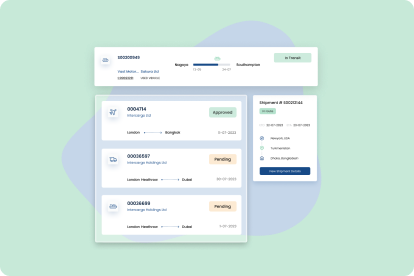
Keep all your data in one place which can be accessed from anywhere and anyplace

Let us help you 24/7 manage your supply chain needs

Back to Global Coverage

Dubai Freight Forwarding Services
Air & Sea Freight Between Dubai and the UK

Intercargo provides reliable freight forwarding services between Dubai, the United Arab Emirates and the United Kingdom, helping businesses import and export cargo efficiently by air and sea.

Whether you are importing goods from Dubai into the UK, exporting products from the UK to Dubai, or managing regular international shipments throughout the UAE, our experienced freight forwarding team provides complete end-to-end logistics solutions. From collection and customs clearance to final delivery, we manage every stage of the shipment process.
Logistics solutions
Air Freight Dubai to UK
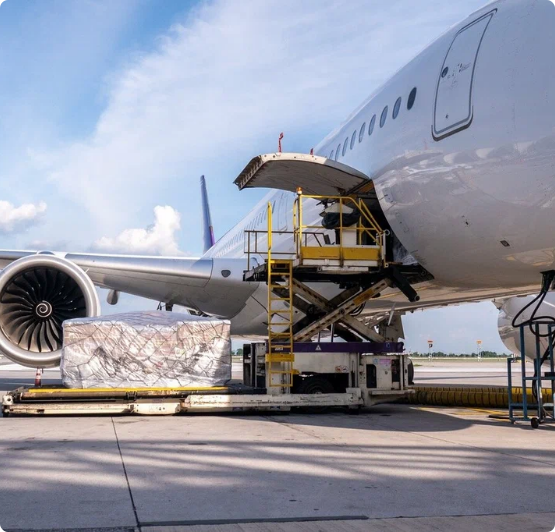
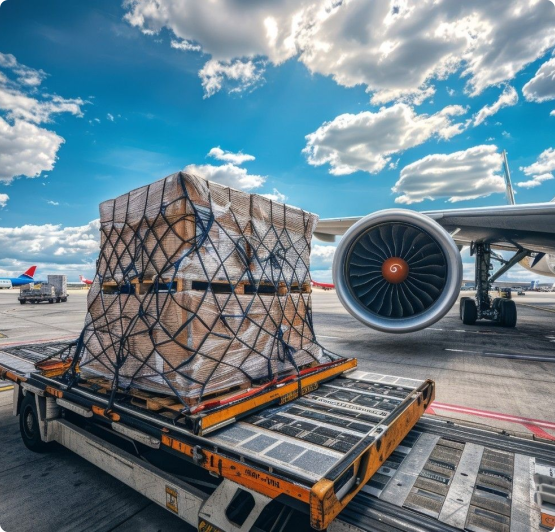
When speed matters, our Dubai air freight services provide fast, secure and reliable transportation between Dubai and the United Kingdom. We arrange air freight through major UAE airports including Dubai International Airport (DXB), Al Maktoum International Airport (DWC), Abu Dhabi International Airport (AUH) and Sharjah International Airport (SHJ), with UK arrivals through London Heathrow, London Stansted, Manchester Airport, Birmingham Airport and East Midlands Airport.
Our air freight solutions include:

We understand the intricacies of the requirements when importing in to Dubai and have dealt with all sectors ranging from the automotive industry, through to construction, oil and food, Intercargo has covered them all and in the process, our Middle East personnel have become what we call ‘geniuses’ in what they do and we are proud to have them on board.

  • Air freight from Dubai to the UK
  • Express and economy air cargo
  • Door to door delivery
  • Time critical shipments
  • Air freight from the UK to Dubai
  • Airport to airport services
  • Customs clearance support
  • High value and commercial cargo

Whether you need urgent delivery of electronics, retail products, machinery, automotive parts or commercial goods, our air freight specialists can provide the most efficient solution.
Logistics solutions
Sea Freight Dubai to UK
For larger shipments and cost-effective transportation, our sea freight services provide dependable shipping solutions between Dubai and the UK.
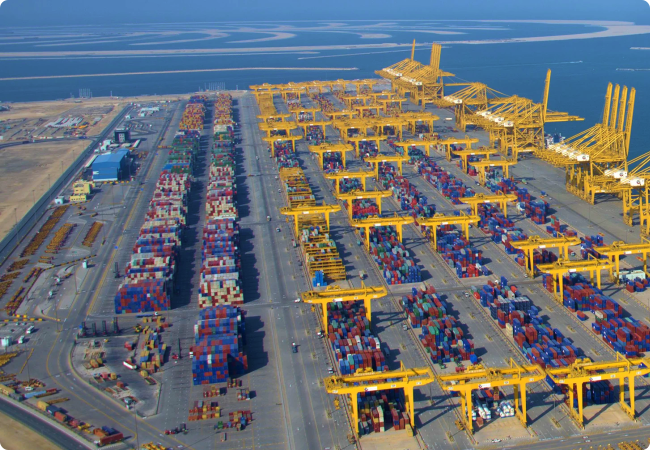
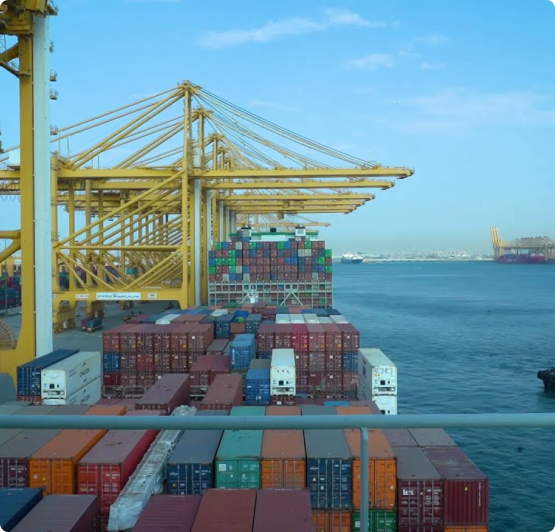
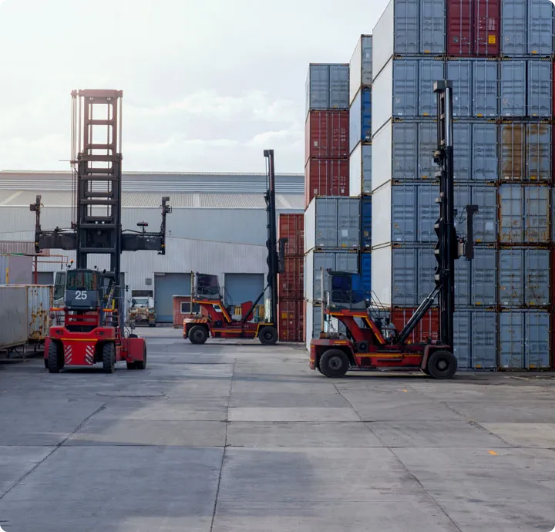
We regularly arrange cargo movements through major UAE ports including Jebel Ali Port, Port Rashid, Khalifa Port Abu Dhabi, Port of Sharjah and Khor Fakkan Port, with UK arrivals through Port of Felixstowe, Southampton, London Gateway, Liverpool, Tilbury and Immingham.

  • Full Container Load (FCL)
  • Port to port shipping
  • Customs documentation
  • Project cargo
  • Less than Container Load (LCL)
  • Door to door logistics
  • Cargo insurance
  • Oversized and heavy lift shipments

Whether shipping machinery, commercial products, manufacturing equipment, retail stock or industrial cargo, we can tailor a sea freight solution to suit your budget and transit requirements.
Logistics solutions
Import from Dubai to the UK
Intercargo helps UK businesses import products and cargo from Dubai and the wider UAE through a fully managed freight forwarding service. Our import services include:

  • Supplier coordination
  • Air and sea freight transportation
  • Duty and VAT guidance
  • Final delivery throughout the UK
  • Collection from UAE warehouses and commercial premises
  • UK customs clearance
  • Warehousing and distribution

We regularly support imports including:

  • Electronics
  • Automotive parts
  • Construction materials
  • Consumer goods
  • Industrial equipment
  • Commercial products
  • Retail stock
  • Machinery
Our experienced team ensures your cargo moves efficiently from Dubai to the UK while remaining compliant with all customs and import requirements.
Logistics solutions
Export from the UK to Dubai
We also help UK businesses export goods to customers, distributors and partners throughout Dubai and the UAE.
Whether shipping to Dubai, Abu Dhabi, Sharjah, Ajman, Ras Al Khaimah, Fujairah or Al Ain, our export specialists can arrange a seamless freight solution by air or sea.
Our export services include:

  • Air freight exports
  • Export documentation
  • Cargo insurance
  • Commercial and industrial shipments
  • Sea freight exports
  • Customs compliance
  • Door-to-door delivery

From single shipments to regular freight movements, we provide scalable logistics solutions designed around your business requirements.
Logistics solutions
Customs Clearance & Freight Forwarding
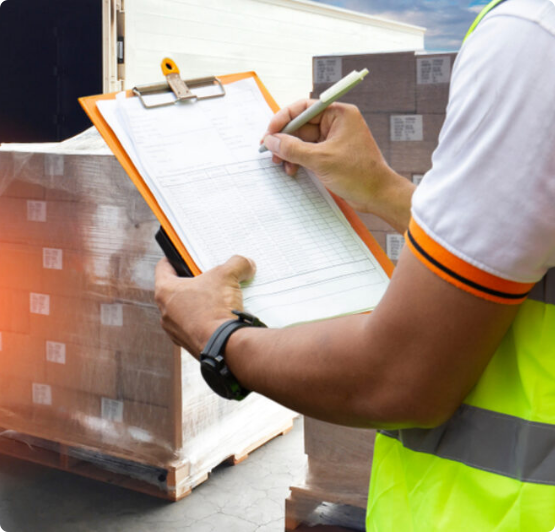
Successful international shipping depends on accurate customs documentation and compliance. Intercargo provides:

  • Import customs clearance
  • Commodity code guidance
  • Duty and tax assistance
  • End-to-end shipment visibility
  • Export customs clearance
  • Shipping documentation
  • Freight forwarding management

Our experienced freight forwarding team helps minimise delays and keeps your cargo moving smoothly between Dubai and the United Kingdom.
Logistics solutions
Why Choose Intercargo for Dubai Freight?
We support importers, exporters, manufacturers, distributors, retailers and e-commerce businesses moving cargo between Dubai and the UK.
Air Freight And Sea Freight Specialists
Uk And Uae Trade Lane Expertise
Import And Export Solutions
Customs Clearance Support
Door To Door Logistics
Dedicated Account Management
Global Carrier Network
Competitive Freight Rates
Get a Dubai Freight Quote

Looking for air freight from Dubai to the UK, sea freight from Dubai to the UK, or export services from the UK to Dubai? Contact Intercargo today for a tailored freight forwarding quotation and expert advice on the most efficient shipping solution for your cargo.
Logistics solutions
Latest News & Updates

CargoWise is becoming the AI that runs freight - so what happens to the TMS?

In the second of a two-part interview with WiseTech CEO Zubin Appoo, The Loadstar examines WiseTech's plans to turn CargoWise into an AI 'system of execution' - and what that could mean for the future of the TMS. Yesterday: DSV's evolving relationship with CargoWise, the impact of its new pricing model, and the regulatory and operational challenges it faces For more than two decades, CargoWise has been the place where freight forwarders record and manage their operations. WiseTech Global now wants it to become the software that increasingly does the work itself. CEO Zubin Appoo told The Loadstar the company was increasingly moving away from describing CargoWise simply as a "system of record", as artificial intelligence and automated workflows begin taking over tasks previously performed by forwarding staff. "Over the past six months or so, we have been talking much more about CargoWise Next being a system of execution or a system of intelligence," he said. If software can decide what needs to happen next in a shipment, and then execute that decision, the valuable part of the technology could shift from the system in which transactions are recorded, to the layer making those decisions. WiseTech's answer appears to be to put that layer inside CargoWise itself. Mr Appoo said this would combine data held by customers, industry datasets WiseTech had accumulated and refined over more than 30 years, AI agents, and automated workflows. "This is a system that our customers run their businesses on day in, day out," he added. Some of what that means operationally is beginning to emerge. WiseTech had four agentic AI capabilities available when it introduced CargoWise Value Packs, has since added another two, with two further capabilities described by Mr Appoo as "imminent". One is SARA, its Smart Auto Request Agent, designed to take over the often labour-intensive exchange of information between forwarders and their customers. It can examine an email and accompanying documents, identify missing or illegible information, request additional documents or clarification from the importer or exporter, and return the completed information to the operator. "The smart auto request agent takes humans out of that process entirely," said Mr Appoo. That will be followed by an Auto Job Creation Agent. Once the necessary information has been gathered, it can automatically register the job in CargoWise Next, ingest electronic documents and commercial invoice lines, and initiate other processes, including AI-assisted classification and compliance checks. By the time an operator gets involved, much of the administrative work will already have been completed. WiseTech is targeting up to 50% labour cost savings for logistics service providers through AI, automation, and its other capabilities - although Mr Appoo declined to reveal how much of that saving customers could achieve today. "We have made solid progress on that since we've built our agents," he said. Whether forwarders ultimately cut staff, redeploy them, or use the productivity gains to process more freight was for individual customers to decide, he added. And WiseTech also intends to capture some of the economic value created. As part of its explanation of how CargoWise could achieve forecast revenue growth of 12%-20% in FY27, Mr Appoo pointed to increasing efficiency savings delivered through AI and other features and, specifically, "monetising agentic AI capability". That helps explain the strategic importance of CargoWise's shift from seat-based licensing towards its Value Pack model, under which pricing is increasingly linked to transactions and the value WiseTech says its technology delivers. But there are limits to how autonomous WiseTech believes freight operations can become, particularly where regulatory risk is involved. Asked who would carry the liability if a CargoWise AI agent made an incorrect operational or compliance decision, Mr Appoo was clear. "It is ultimately the forwarder or the broker," he said. That is why WiseTech describes its classification product as an AI "assistant", he explained. The intention is for AI to perform much of the legwork, while an experienced operator reviews the audit trail and ultimately approves or corrects its decisions. The heavily regulated nature of logistics also means WiseTech is being cautious about releasing agents simply to increase their number, he added. "It's not just about saying to the market we've now got 18 agents or 29 agents. That's meaningless if the agents don't actually do their job very well." The emergence of increasingly capable AI software has also prompted questions over whether the barriers to building alternatives to established TMS platforms, such as CargoWise, are beginning to fall. Mr Appoo disagrees. He said CargoWise's biggest competitor remained the in-house legacy systems operated by some of the world's largest forwarders, rather than a new generation of AI-native challengers. "I don't subscribe to the view that AI is a threat to us. I say AI is an accelerant to us, because it's not like you can vibe code CargoWise." He argued that the platform's competitive advantage went considerably beyond its software code, pointing to integrations with some 400 airlines, 160 shipping lines, and a number of Class I North American railroads and customs authorities around the world. "That's not source code. That's sort of commercial relationships, deep domain expertise, and none of that can be replicated by AI." But WiseTech itself is also becoming considerably more than simply CargoWise. The $2.1bn acquisition of e2open last year expanded the company's reach beyond its traditional forwarder customers into manufacturers, retailers, importers, exporters, and beneficial cargo owners. WiseTech's FY26 results describe an ambition to build a "mission-critical operating system" spanning five markets: logistics and transport, through CargoWise; connected supply chain orchestration, through e2open; trade finance and banking; customs and government; and verified identity, trust and data, through VerifyWise. Mr Appoo rejected the suggestion that expanding into the shipper market could ultimately put WiseTech in competition with the forwarders on which CargoWise was built. "That's not because there's any view about disintermediating freight forwarders," he said. He argued that, while around half of ocean freight went through forwarders, the remainder included large manufacturers dealing directly with shipping lines - a market CargoWise had not traditionally captured. "E2open is a market or a TAM expansion for us, but it doesn't change our very deep and very loyal, I think, focus on logistics service providers." And acquisitions will remain part of that expansion. WiseTech acquired supply chain risk and compliance intelligence provider FRDM.ai in July for up to $24.3m, with its technology being used as a building block for VerifyWise. The product maps and verifies multi-tier supply chains against increasingly demanding requirements, covering areas including modern slavery, forced labour, sanctions, and other compliance obligations. Mr Appoo said there was plenty of work still to do integrating e2open, a process WiseTech expects to span several years, but ruled out any move away from acquisitions. "M&A has, for many years, been part of our strategy and we'll continue to use M&A where there's an opportunity for us to expand our reach in the supply chain and deliver more value to our customers." The result is a WiseTech proposition that is no longer simply a TMS. Its stated ambition is now to become the "operating system for global trade and logistics", connecting not only forwarders but carriers, shippers, manufacturers, banks, and governments. And if AI does shift the value in forwarding software away from recording transactions and towards deciding and executing what happens next, Mr Appoo appears determined that CargoWise should own that layer too. "What we are doing is essentially making CargoWise into an AI system of execution." So, is AI killing the TMS - or is the TMS simply becoming the AI? Part one of this interview: DSV weighs early CargoWise move as WiseTech tackles pricing and ACCC scrutiny

Source: theloadstar.com

Read more

Expert knowledge remains foundation of charter broker businesses

Hard work and a can-do attitude are what makes for a successful air charter broker, says Dan Morgan-Evans, head of cargo at broker Air Charter Service. Why on earth should a job for an aviation graduate trainee be advertised in Farmers Weekly magazine? Morgan-Evans spotted the position while looking for a position after completing his agricultural degree, the idea being that he would eventually work in the family business. The young Morgan-Evans asked the question of chairman of Coventry-based Air Atlantique, after successfully securing his first job, back in 1999. "That's easy," said the chairman. "Farming children are hard working and well-rounded." Whether that premise about farming folk is true, we'll leave others to judge, but those two qualities are certainly essential in the tough and fast-moving world of air cargo brokerage. At Air Atlantique, Morgan-Evans worked in all aspects of the business for two years. Then came a move to London, to a company called AFX which operated two 747 freighter aircraft based at Heathrow Airport. The day he moved there was 11 September, 2001, not an auspicious time in the air industry and the company went out of business not long afterwards. But there was a silver lining; he joined Air Charter Service (ACS) on 2002 as a trainee broker, and has been there ever since. At the time, ACS was a much smaller company. It employed just 20 people at two offices, one of them in London and the other in Moscow. (There was a brisk trade in charters to Russia at that time; ACS closed its operations in the country following the invasion of Ukraine.) Since then, ACS has opened an average of two offices a year, bringing the total to around 40 worldwide and ACS employs the lion's share of the 1,000-strong workforce employed by parent company the Mountfitchet aviation and travel group. Then, as now, ACS owner and founder Chris Leach takes a strong interest in activities and can often be found in the office. From 2011, Morgan-Evans headed the London cargo department for six years until 2017, when he became head of global cargo, essentially the post he holds today. His full titles are deputy chief commercial officer at ACS and global cargo director and he also oversees the company's Time Critical Services arm. "It's always interesting in airfreight," he says. "It has ups and downs, like any other industry, but there has been a general upward trajectory. As a company hits a global critical mass, things tend to get ironed out between the different regions and sectors; you're not relying on a boom in any one sector, any more." While the company has become much bigger, the formula for its success has remained the same, though: "The secret to its success is replicating what it does well - its ethos and dedication to training - around the globe. And it seems to work." Airfreight broking is, at heart, a knowledge business. "We have to add value for our customers. When I started at ACS, the Internet was still quite rudimentary and the traditional unique selling point of brokers was their knowledge of aircraft and airlines," says Morgan-Evans. "Today, anyone can find much of that information online. Now, it's about knowing the right aircraft, and the right airport for the task; we have to be customer-focussed. It's why our training programme for brokers lasts for six or seven months." Air charter brokers need to be able to think fast, and think on their feet. They need to be attuned to what the market, and the wider world is doing, says Morgan-Evans. "There will always be natural disasters, geopolitical situations. And in a lot of the things that happen in the world, our industry will always be at the forefront. However, you can put things in place, to be prepared, or as prepared as you can be." Modern communications means that the flow of information is faster, and in that respect at least, new technology has made the broker's job easier. However, rules and regulations remain an important part of the air broker's task and these are not getting any simpler. ACS needs to work in all corners of the world, and disasters don't always conveniently take place in places where the trading and commercial environment is straightforward. Take the recent earthquake in Venezuela; the country is subject to severe international sanctions and just because a disaster has occurred, these are not automatically eased. "That's why we have a compliance team to make sure that we're not breaking any rules," says Morgan-Evans. Ben Dinsdale is now heading up humanitarian operations at ACS which takes some of the immediate day-to-day pressure off Morgan-Evans' shoulders. In fact, while flying aid to earthquake and war zones may capture the headlines, "if you break down the figures, 'special events' are only a very small fraction of the work that we do at ACS. The mainstay of our business has always been automotive, oil and gas and so on." Costs are currently one of the main headaches in the industry. "Demand for aircraft has been high at times, and availability can be tough, so prices can go up. We need to try to manage customer expectations, and that is where our specialist knowledge comes in." While there have been 'needs must' situations, notably during the Covid pandemic, all customers have a price point and there rates that customers - even in sectors like oil and gas - will just not accept. The supply side of the equation - availability of aircraft, or lack thereof - varies of course. It tightened during the latest Middle East crisis, but now, during the traditional low season, that has since eased somewhat. But no one is prediction that that will continue into the later part of the year. "But overall, we have had a very good year," Morgan-Evans enthuses. "Last July, we had a very big ongoing project, so I wasn't expecting to beat that figure this year, but we have." One hardy perennial that he is always quizzed on is the future of the Antonov An-124 fleet and what, if anything, will replace it. "I was asked about that 15 years ago, and while pricing is way higher than it used to be, there's still availability of aircraft. It's not a part of the market that we're struggling in." As for the replacement for the An-124, he suspects that the existing aircraft will still be soldiering on long after he retires. "After all, in my first job at Air Atlantique, we were operating DC6s, Lockheed Electras and DC3s - one of which had taken part in the Berlin Airlift." In aircraft, as with people, age is just a number, it would seem. ACS will continue to expand its office network, he predicts, following this year's opening of new outlets in Brussels and Monaco, and Perth last year. Expansion of the Time Critical division is also on the agenda, following the opening of bases in Frankfurt and Houston; Asia-Pacific could well be the next target, he says. The need to find the right people to work in the business remains a constant issue, meanwhile. Is it easy to get suitable people? "Yes and no. People do want to work in this industry, but it's harder to find the right people with the right attitude as well as aptitude. This is a business that you've got to live and breathe. It's 24-hour, it's global and to be one of our consultants, you've got to love what you do, to be available when your customers need you, and not everyone is cut out to work here. It's not an easy job, but it is one in which you can really make a difference."

Source: aircargonews.net

Read more

Air cargo demand rises again in July but growth eased

Air cargo demand growth in July was backed by strong performances by airlines in Asia-Pacific, Europe and North America, but gains eased from earlier in the year. Total demand, measured in cargo tonne-kilometers (CTK), increased by 3.9% compared to July 2025. "The broad advance showed that cargo demand held firm across the main trading blocs. Growth nonetheless eased from stronger rates recorded earlier in the year, pointing to sustained expansion with less momentum," said IATA. Capacity, measured in available cargo tonne-kilometers (ACTK), increased by 1.7% year on year. This tighter supply-demand balance lifted the global cargo load factor (CLF) by 1 percentage point to 46%, noted the trade body. Average air cargo yields in July 2026 remained well above their July 2025 levels. The global operating environment was broadly supportive of air cargo demand, said IATA. Global trade increased by 7.5% year on year, while global manufacturing activity eased slightly in June but remained supportive and export orders reached their highest level in three months. The Global Manufacturing Output Purchasing Managers' Index (PMI) fell 0.3 points to 52.7, while the New Export Orders Index rose to 50.0. Meanwhile, jet fuel prices rose by 12.2% month-on-month in July and were 56.9% higher than a year earlier. "Air cargo demand grew 3.9% year-on-year in July. While all regions recorded growth, airlines in Asia-Pacific, Europe and North America accounted for more than 90% of the overall increase," said Marie Owens Thomsen, IATA's senior vice president sustainability and chief economist. "Dedicated freighters gained market share as belly-hold traffic declined, possibly reflecting demand for larger or specialist shipments and the operational flexibility that freighters can provide. "Looking ahead, the outlook remains broadly positive, supported by manufacturing activity, export orders and global trade. However, higher fuel prices, geopolitical tensions and tariff uncertainty will need to be watched carefully." Regional performance Air cargo performance diverged across major trade lanes in July. Asia-North America recorded the strongest growth, followed by Europe-Asia, and Europe-North America. In contrast, Gulf-linked corridors remained disrupted by the conflict in the Middle East. North American carriers saw a 4.8% year-on-year increase in air cargo demand in July, the strongest performance of all regions. Capacity decreased by 1.5% year on year. European carriers had a 4.4% increase in demand and capacity increased by 1.3%. Growth for Asia Pacific airlines was 4.1% year on year. Capacity increased by 3%. Latin American and Caribbean carriers also saw a 4.1% increase in demand, though capacity increased by 7%. Growth for Middle Eastern carriers was 1.7% and capacity increased by 4%. Finally, African airlines saw a 1.1% increase, the weakest performance of all regions. Capacity increased by 4.1%.

Source: aircargonews.net

Read more

Privacy Preference Center

This website uses cookies and similar technologies, (hereafter “technologies”), which enable us, for example, to determine how frequently our internet pages are visited, the number of visitors, to configure our offers for maximum convenience and efficiency and to support our marketing efforts. These technologies incorporate data transfers to third-party providers based in countries without an adequate level of data protection (e. g. United States). For further information, including the processing of data by third-party providers and the possibility of revoking your consent at any time, please see your settings under “Consent Preferences” and our


Privacy Notice


Privacy Preference Center

Strickly Necessary Cookies
Always Active

Performance Cookies

Functional Cookies

Targeting Cookies