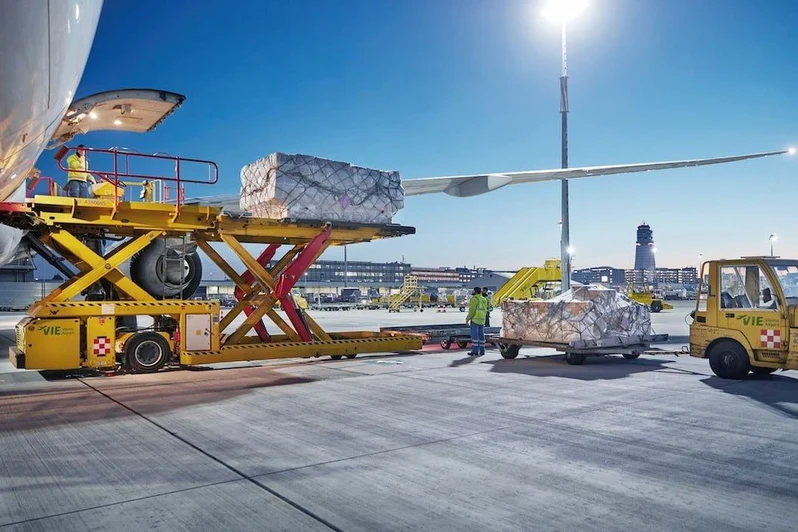
Saudi disruption squeezes air cargo capacity as peak looms
Riyadh's international outbound air cargo capacity has fallen by a third as attacks on Saudi airports prompt airlines to suspend services, removing both freighter lift and bellyhold space.
Rotate data captured this morning shows Riyadh's outbound capacity on freighters and widebody passenger aircraft fell 34% over 24 hours, to 848 tonnes, and 26% over 72 hours, compared with the equivalent periods a week earlier.
Freighter-only capacity fell 10% outbound and 77% inbound over 24 hours. Over 72 hours, the declines were 32% and 38%, respectively.
The sudden drop will be a challenge for the country: Riyadh's King Khalid International Airport handled 576,600 tonnes of cargo in 2025, according to GACA figures, making it the kingdom's busiest cargo airport, ahead of Jeddah's 458,900 tonnes.
Saudi authorities said three citizens had been killed and others injured in two attacks on Riyadh Airport on Thursday. Saudia Group confirmed one of its aircraft was damaged on the ground, with no passengers aboard, and identified one of its captains as among the dead.
The Houthis claimed responsibility. Saudia Group said airport operational activities had returned to normal by 6pm local time on Thursday.
However, the airport's reopening has not brought a full restoration of airline services, with several carriers, including Lufthansa and Air India, having suspended services.
Elsewhere in Saudi Arabia, Najran and Jazan airports are closed until 15 October, while Abha is restricted to daytime operations following attacks this week. FAA notices showed restrictions on stands and taxiways at Riyadh, but no current airport-wide closure.
The wider Middle East disruption is already forcing cargo airlines to adapt their networks.
Cathay Cargo director Dominic Perret said this week that suspended Middle East services had affected European freighter operations, which had used Dubai as an intermediate stop.
"Flying direct meant payload penalties," he said, although noting that Cathay has found alternative stops, including a summer operation in Astana, to maintain cargo lift.
Yet the carrier remains upbeat about demand as the industry approaches its year-end peak. Mr Perret said demand to the Americas remained strong, while Europe continued to adjust to EU tariffs on ecommerce imports.
Demand from key Asian markets was also being supported by high-value technology shipments for AI and data centre infrastructure.
"We are anticipating a strong peak season," said Mr Perret, "in fact, one of our main challenges is having sufficient capacity to meet demand."
Cathay has added transpacific capacity and expects an A330 freighter, operated by subsidiary Air Hong Kong, to provide additional regional lift next month.
Cargo Facts Consulting reported that Asia-North America freighter capacity increased 3.5% month on month in July, and a further 2.9% in August. Meanwhile, Asia-Europe freighter capacity contracted in June, July, and August.
Europe's new customs duty on low-value imports has hit ecommerce flows, with a 24% decline in ecommerce volumes in July, according to Rotate, alongside a 28% fall in freighter capacity to Europe - a capacity reduction equivalent to some 5,000 freighter flights a year.
Nevertheless, the global Baltic Air Freight Index rose 5% in the week to 5 October, taking its year-on-year increase to 25.5%, as China entered the Golden Week holiday.
By early October, spot rates from India were around 70% higher year on year to the US, and more than 80% higher to Europe, according to TAC index data.
Meanwhile, average jet fuel prices were up 108% year on year by 2 October. TAC Index commentary said carriers had sought to prepare for fuel shocks by securing supplies early. By late September, however, sources expected a greater impact on rates within a week or so, potentially also favouring more fuel-efficient twin-engine aircraft over those with four engines.