
Solutions
About Us
My Intercargo
Support
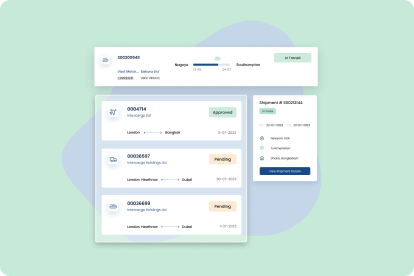
Keep all your data in one place which can be accessed from anywhere and anyplace
Let us help you 24/7 manage your supply chain needs
Latest News & Updates

Start-up Cherry's Logistics ripe for growth with AI - and a human touch
There are not many opportunities in life to start again with a completely blank sheet of paper - particularly when the people holding the pen have decades of experience behind them. But that is precisely what the founders of newly launched Cherry's Logistics are attempting to do. The Hamburg-headquartered forwarder began operations this month (after a slight delay caused by "German bureaucracy") founded by former Senator International executives Tim Kirschbaum and Sandra Bufe, and Kuehne+Nagel veteran Marc-Henrik Schmitz, with an initial team of seven, plus Mr Kirschbaum. And while technology, particularly AI, sits at the heart of the new venture, the founders are adamant that Cherry's is not intended to remove the human element from forwarding. In fact, they want to do almost the opposite. Mr Schmitz told The Loadstar customers increasingly wanted someone prepared to take responsibility for their business, rather than being directed towards another email address, Teams message or automated interface. "We put the technology in the back and put the human beings against the human beings again," he said. That philosophy comes partly from the founders' experience of watching forwarding companies become larger and more complex. Ms Bufe said considerable time and energy in large organisations became focused internally, particularly following acquisitions, rather than on customers. "We saw there was still a need and a niche," she explained. "We need to take those values up to the front again, to the customer, focus on the customer's needs and get rid of all the politics and internal arguments." The opportunity, she added, was to combine that approach with technology without first having to untangle decades of legacy systems, processes and data. And there is a certain symmetry to the new venture for Mr Kirschbaum, whose surname, which means 'cherry tree' in English, sparked the idea for the company name. His father founded Senator International in 1984 with eight people, before growing the company largely organically into one of Germany's best-known international forwarders. Senator was eventually acquired by Maersk in 2021. Cherry's is beginning at almost exactly the same scale. Mr Kirschbaum said the intention was again to grow organically, often following customers into new markets rather than drawing up a map of offices that had to be opened. "In the past, we have grown with the customer," he said. "The customer basically told us, 'if you want to get into this lane, you need to be there', and then we established offices there." There is deliberately no five-year target for headcount, revenue or geography. "I basically hated it in the past when people asked me, 'where will you be in five years or three years?'" Mr Kirschbaum said. "I said, 'I don't know'. Time will tell." He acknowledged that expansion did not always work, pointing to Senator's decision to open an office in Switzerland which "was never a real success" and was eventually abandoned. For now, Cherry's has offices in Hamburg and Frankfurt and will use established partners to provide international coverage, particularly in Asia and the US. It also intends to join forwarding networks, although discussions are ongoing. The business is currently funded entirely by its shareholders, with Mr Kirschbaum noting that freight forwarding can require considerable working capital, as operators typically have to pay carriers and other suppliers before being paid by their customers. "You are basically playing bank," he said. For now, however, Cherry's intends to remain as lean as possible, with technology expected to reduce its administrative costs. And that is where the second part of Cherry's experiment becomes particularly interesting. At its centre is what the company calls "Cherry's Brain" - its own secure data and knowledge environment, which the founders envisage eventually becoming the technological centre of the business. Rather than treating its transport management system as the company's principal technology platform, Mr Schmitz said Cherry's intended eventually to place its own environment at the centre, connecting its TMS, accounting and CRM systems to it. "Our ERP at a certain point will be the Cherry's Brain," he explained. The company has nevertheless selected CargoWise as its TMS, partly because of its founders' previous experience with it, its scalability and API connectivity. But Cherry's wants to retain control of its data and, potentially, its technological independence. "At a later stage we would be able to exist without a TMS," said Ms Bufe. Initially, she explained, Cherry's Brain is effectively an empty system that must be fed with operational information and knowledge as the company grows. The objective is not simply automation. It is also to capture the knowledge normally held by individual forwarders and make it available throughout the organisation. Mr Schmitz gave the example of a colleague taking over a customer while their usual contact was on holiday. Rather than having to piece together the history of the account, Cherry's Brain should give them immediate access to the accumulated knowledge, allowing them to pick up where their colleague left off without disrupting the customer. The founders are careful not to claim they already know exactly what the technology will ultimately be capable of doing. Ms Bufe described Cherry's Brain as a "little baby" that still needed to be fed, while acknowledging that both the company and its developers would learn what could be automated as the system evolved. But their longer-term vision could have significant implications for the traditional economics of forwarding. Where once the size of an office and number of employees were badges of corporate strength, Ms Bufe suggested the forwarder of the future could look quite different. "You may not have 100 people in Hamburg, but maybe 30, and then you have your 30 or 40 virtual colleagues working together with you," she said. "I believe that is the new structure of an organisation." That does not mean handing the business over to AI. Mr Schmitz said processes such as invoice reconciliation could eventually be fully automated, but Cherry's intended to retain human oversight rather than allowing its systems to "fly on autopilot". And that philosophy is also shaping recruitment. Cherry's is already talking to potential recruits, with hiring expected to follow the pace at which new business arrives. But Mr Schmitz said the company was looking for a particular type of forwarder: people who know the business and have a passion for it, but are not afraid to work closely with AI. "We need the people who are willing to work with digital, but still have the human face to the customer," he said. For now, the operation is deliberately hands-on. Ms Bufe said all seven members of the initial team were capable of executing a shipment file, with everyone expected to "roll up the sleeves" as volumes built. The first customer orders have already arrived, including business involving India, and further recruitment will depend on how quickly volumes grow. The company is not restricting itself to particular verticals, although its founders bring considerable experience in automotive, pharmaceuticals, perishables and dangerous goods. And despite all the discussion about AI, data architecture and virtual colleagues, Mr Schmitz believes one part of the forwarding business is unlikely to disappear. "Sitting together with a coffee, with a customer and talking about business, is something AI most probably will never do," he said. "It's still a people business, and I think it will remain a people business." Mr Kirschbaum, meanwhile, appeared simply pleased to be back. "We are definitely looking forward to being back in the industry, to meeting all our customers that we have been working for in the past," he said. "We're also looking forward to refreshing our relationships with airlines, ocean carriers and so on. "We're just happy to be back, and we hope that the industry is somehow taking us with open arms. "For sure, not our competitors - but at least the shipping industry." Check out today's News in Brief podcast featuring Stephanie Loomis, Noatum Logistics, talking about the Transpacific, plus a look into changing airfreight flows!
Source: theloadstar.com
Read more
Cargojet ups freighter flights to Liege
Cargojet will increase its capacity between North America and Europe this month with the launch of an additional service to Liège, Belgium. The Canadian freighter operator said the new Wednesday service beginning 23 September builds on its established weekend service. This new service to the Belgian freighter hub will be operated with a Boeing 767 freighter on the Hamilton - Halifax - Liège - Hamilton route. Cargojet said the service advances its One Network strategy by integrating domestic overnight, ACMI and charter operations across an expanding network of international markets. "This expansion demonstrates the power of our One Network strategy -- connecting our domestic overnight network with our international operations to deliver greater reach, flexibility and value for our customers," said Pauline Dhillon, chief executive, Cargojet. "Growing demand from customers across Central and Western Europe for our weekend Liège service created an opportunity to add mid-week capacity and provide customers with a more seamless, fully connected solution between Canada, Europe and beyond." The carrier entered the scheduled European market with the launch of a Liege connection last year. Previously, Cargojet only offered a charter operation to Europe. According to Planespotters, Cargojet has a fleet comprising 16 757Fs, 25 767Fs, mostly passenger to freighter (P2F) conversions. Cargojet saw both its revenues and profits grow in the second quarter of the year as higher fuel prices, contractual price increases and new charter opportunities affected performance.
Source: aircargonews.net
Read more
FedEx ramps up SAF procurement for use at five US airports
FedEx has struck agreements to secure more than 20m gallons of neat sustainable aviation fuel (SAF) across five US airports until the end of 2027. The agreements span FedEx operations at Newark Liberty International Airport, Oakland International Airport, Miami International Airport, John F. Kennedy International Airport, and Dallas Fort Worth International Airport. These agreements are expected to deliver SAF at blend ratios ranging from 30% to 50%, depending on location. According to FedEx, since last year, it has secured approximately 5m gallons of neat SAF through agreements that resulted in the deployment of 16.5m gallons of blended SAF across five US airports. In May last year, Neste announced it would supply 8,800 metric tons (more than 3m gallons) of SAF to FedEx at Los Angeles International Airport. This was the first major US SAF deployment by FedEx. Then in October, FedEx began to take delivery of SAF at Chicago-O'Hare Airport and Miami International Airport for the first time. FedEx is working toward its goal to source 30% of jet fuel blended from alternative sources by 2030, while expanding the use of SAF across its US air network. "The latest agreements represent an expansion of SAF within the FedEx air network enabled, in part, by state and federal level incentives," said Greg Paulus, vice president of enterprise sourcing at FedEx. "SAF is one of the most impactful decarbonization solutions available to aviation today and an important part of our approach to reducing emissions," added Karen Blanks Ellis, chief sustainability officer and vice president of environmental affairs at FedEx. "For the market to grow, supply needs to be reliable, affordable, and sustainable. Expanding our procurement allows us to employ more SAF in our network while bolstering the demand for greater production and scale."
Source: aircargonews.net
Read more
Privacy Preference Center
This website uses cookies and similar technologies, (hereafter “technologies”), which enable us, for example, to determine how frequently our internet pages are visited, the number of visitors, to configure our offers for maximum convenience and efficiency and to support our marketing efforts. These technologies incorporate data transfers to third-party providers based in countries without an adequate level of data protection (e. g. United States). For further information, including the processing of data by third-party providers and the possibility of revoking your consent at any time, please see your settings under “Consent Preferences” and our
Privacy Notice