
Solutions
About Us
My Intercargo
Support
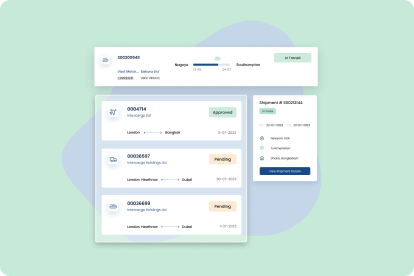
Keep all your data in one place which can be accessed from anywhere and anyplace
Let us help you 24/7 manage your supply chain needs
Latest News & Updates

OceanX Radar: Logistics is a people thing; fuel fears; relentless rate rises
Another crazy week passed. Fuel prices moved up a notch again, which makes clear that things in the Middle East are getting worse rather than better. Even US VP Vance warns of a potential "worldwide energy crisis". And with the Houthies back in action, there is a second front on. However, so far no attacks on non-Saudi ships in the Red Sea - let's see how long that lasts. We continue muddling through the fog of uncertainty. Let's look at some ...
Source: theloadstar.com
Read more
How a team learns to trust a quote it did not build
Four in five of the AI-built quotes on cargo.one go out without a person touching them. Every team running at that number started at zero, with a person reading every quote, trusting none of them. What happened in between was not a leap of faith, and it was not simply time. Trust is a process, and like any process in a forwarding operation, it can be designed, run, and improved systematically. We have run enough of these deployments to see the same six patterns emerge. Where all six are in place, teams move fast. Where one or more are missing, adoption stalls, however well-designed the AI workers may be. 1 - Every decision is inspectable. A quote is a chain of decisions: which rate, which charges, which margin. The AI worker shows all of it: every quote traces back to the rate it chose and the rule that chose it. The first thing a skeptic does is rebuild a few quotes by hand and compare. Let them. A skeptic who can verify becomes an advocate and someone who ends up defending it 2 - High quality & trusted inputs. The AI worker builds from the same rate sources the team already searches on cargo.one, in the system it already works in. Look behind any AI-built quote and you recognize everything in it. People extend trust to a tool that works from the same facts they do. 3 - Authority is yours. Any quote can be adjusted or overwritten on the platform, by anyone on the team (with the right permissions), before it leaves. That safety valve is what makes every next step possible: nobody hands over a workflow they cannot take back. 4 - Autonomy arrives in steps. First a person reviews everything the worker builds. Then it sends on its own inside a narrow scope - general cargo under a set weight, on named lanes - while everything unusual routes to a person. Then the scope widens as evidence accumulates. Three levels, and the team decides when to climb: * Assisted: a person reviews every quote before it leaves * Supervised: the worker sends on its own inside a scope the team has drawn; everything unusual routes to a person. * Autonomous: the worker handles the flow end-to-end; the team manages by exception. 5 - Feedback is visible. When the team corrects a quote, the correction becomes a rule, and after review, gets added to the AI worker, so the next thousand quotes follow it. This is the most underestimated of the six: people keep investing in a system they can watch getting smarter. 6 - Someone watches the full system. What really counts is the picture across thousands of quotes, including margins by lane, win rates by customer, and the outliers worth a closer look. Monitoring is set up with the team during deployment, with a path from any number down to the single quote behind it. A supervisor steers AI workers much the way they steer people: watch the numbers, sample the work, look into the outliers. Buy-in by design Every one of these six aspects leaves a decision with the team. The rates are their own, the rules are the ones they wrote, and they are involved in the pace-setting. That changes something no metric captures. Six months in, the AI worker doesn't feel like software that was rolled out to the team. It feels like something they co-built, and teams treat it that way. They argue about its rules, show it off to other branches, and notice when it gets smarter, because they made it smarter. Put simply, trust converts. Where the AI worker runs well, the mechanic is the same. Quotes go out in minutes, not hours. Volume jumps, because every request gets an answer. Faster answers win more business. The freed-up hours go where they earn most: business development and the complex shipments that need a human. More requests come in, and the AI worker quotes those too. Here is the part that matters most: every gain in that cycle depends on trust. A team that still checks every quote caps its own volume at human speed. That is why the six patterns are not the soft part of the rollout: they are what releases the return. Getting there takes two to four weeks, from kickoff to an AI worker quoting your first lanes, with a defined scope, a named team on both sides, and your number attached: the hours back, the quotes that stop going unanswered, the win rate on your lanes. It all starts with a working session on how your team prices today. Reach out to me or the team at cargo.one.
Source: theloadstar.com
Read more
L'Imad's Atlas Air interest could give Apollo a valuable price marker
Abu Dhabi sovereign investor L'Imad Holding's reported interest in taking a stake in Atlas Air Worldwide could offer the US freighter operator's owners something almost as valuable as a sale: validation of its ambitious valuation. Bloomberg has reported that L'Imad is considering a bid for a stake in Atlas, in a transaction that could value the company at $10bn or more. Discussions are said to be at an early stage and may not result in an offer. But the numbers are interesting. Apollo Global Management and its investment partners acquired Atlas in 2023 at an enterprise value of around $5.2bn. Reports emerged late last year that Apollo was considering selling the business, at a possible valuation of more than $12bn including debt, which certainly raised eyebrows. And Atlas CEO Miachel Steen told The Loadstar earlier this year that "we may see changes in our ownership structure". Something looks likely to happen, but finding a buyer for the entire company at anything approaching that price would be no small task. Selling a minority stake at a valuation of $10bn or more, however, could be a rather different proposition. It would allow Atlas's owners to realise some of the considerable increase in the company's value while retaining control and exposure to further growth. Just as importantly, an outside investor prepared to put substantial capital into Atlas at something close to that valuation would establish a useful external benchmark for the business. That could prove valuable in any subsequent refinancing, further stake sale or eventual exit. And L'Imad is not an entirely surprising candidate. The Abu Dhabi government consolidated L'Imad and ADQ's assets under the L'Imad umbrella earlier this year, creating a group encompassing 25 investment companies and platforms and more than 250 subsidiaries. Its holdings include Etihad Airways, Etihad Rail and AD Ports, alongside businesses including TAQA, PureHealth, Modon, McLaren and Louis Dreyfus. Transport and logistics are clearly part of its ambitions. L'Imad's investment framework identifies both aviation and ports among its strategic sectors, while the group describes itself as an active investor and shareholder seeking to build and scale its portfolio companies. L'Imad is also seeking to increase its exposure to AD Ports, having launched an offer through ADQ in August to acquire the shares it did not already own. Against that backdrop, an investment in one of the world's largest providers of outsourced freighter capacity would not look particularly out of place. There is also a connection with Etihad - Etihad Cargo and Atlas have worked together since 2012, and last year signed a new long-term agreement under which Atlas operates a dedicated 777 freighter for the Abu Dhabi carrier. There is also a notable personnel connection: Atlas chief strategy and transformation officer Martin Drew previously ran Etihad Cargo. The Atlas aircraft was added as Etihad sought more main-deck capacity ahead of the arrival of its new-generation freighters. It currently has five of its own 777Fs and has ordered 10 A350Fs as it looks to expand its dedicated cargo operation. There is no suggestion that L'Imad's reported interest in Atlas is driven by Etihad's requirements. But Atlas would at least be a familiar business: one already providing strategic freighter capacity to one of L'Imad's major aviation holdings. A minority transaction also makes sense because Atlas is a US airline. Foreign ownership and control restrictions limit what overseas strategic investors can do, considerably reducing the pool of potential outright buyers. A minority investment opens the door to sovereign funds and international transport and logistics groups that could not simply acquire control of the airline. Meanwhile, Atlas itself continues to expand. It last month completed its acquisition of 49% of Air Atlanta, giving it access to the Icelandic ACMI operator's Icelandic and Maltese operating platforms, while subsidiary Titan Aviation is separately acquiring Air Atlanta's owned aircraft. So Apollo and its partners face an interesting choice. They could seek an outright buyer capable of swallowing Atlas at a valuation roughly twice that paid just three years ago. Or they could sell a slice of it, return some capital and retain most of their exposure to a business they evidently believe is worth considerably more than they paid. If L'Imad was ultimately prepared to invest at anything approaching the $10bn-plus valuation being discussed, it may suddenly look rather attractive to Apollo and friends.
Source: theloadstar.com
Read more
Privacy Preference Center
This website uses cookies and similar technologies, (hereafter “technologies”), which enable us, for example, to determine how frequently our internet pages are visited, the number of visitors, to configure our offers for maximum convenience and efficiency and to support our marketing efforts. These technologies incorporate data transfers to third-party providers based in countries without an adequate level of data protection (e. g. United States). For further information, including the processing of data by third-party providers and the possibility of revoking your consent at any time, please see your settings under “Consent Preferences” and our
Privacy Notice