
Solutions
About Us
My Intercargo
Support
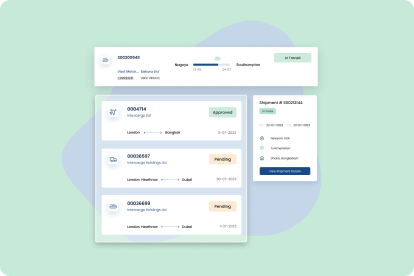
Keep all your data in one place which can be accessed from anywhere and anyplace
Let us help you 24/7 manage your supply chain needs
Latest News & Updates

No post-peak relief for ocean freight as capacity tightens
The expected post-peak easing in ocean freight rates has failed to materialise, with resilient US import demand, weather disruption and carrier capacity cuts keeping the market under pressure. According to analysis presented during Cargo Trans' latest FreightTea webinar, September US imports are expected to reach some 2.3m teu - approximately 10% above the same month last year. The strength of demand has extended this year's peak season, despite expectations just weeks earlier that the market was beginning to soften. "When we last had this conversation on 30 July, we had every reason to believe that we were past the peak," said Barış Aytan, CargoTrans' director of client success and commercial operations. But the anticipated easing has not followed. Rates have remained elevated, after China-US west coast rates reached around $6,000 and east coast rates climbed above $9,000 during the peak. But the webinar highlighted capacity, rather than demand alone, as the key factor supporting rates. "The peak season has been extended; it hasn't ended," Mr Aytan said. "The demand is resilient." Three typhoons affecting Chinese ports in recent weeks have compounded the situation, with vessel delays around Shanghai reaching seven to 10 days. As of 12 September, 157 vessels were reportedly waiting to berth in Shanghai, with the resulting backlog potentially extending into October. At the same time, carriers are preparing for China's Golden Week holiday, with 78 blank sailings expected between weeks 38 and 43. The Pacific Southwest is expected to take the largest hit, with 29 blank sailings removing around 32% of capacity on the affected services. Geopolitical disruption is also influencing capacity decisions. Despite continued risks around the Red Sea, carriers are gradually returning to the route, encouraged by significantly higher freight rates. Mr Aytan noted that China-North Europe rates had risen from around $2,000 several months ago to almost $5,000 towards the end of July. "There is an appetite for risk right now," he said, adding that carriers can justify insurance premiums while seeking to capitalise on higher rates. However, the return of services should not be interpreted as evidence that Red Sea security risks have disappeared. "The situation there, the risk landscape there, is not any better than what it was two months ago," Mr Aytan said. Meanwhile, improving conditions at the Panama Canal could provide some additional capacity and help narrow the historical rate gap between US east and west coast services. The result is a market in which "effective capacity is actually the biggest story on the ocean trade" - with demand still strong, but available capacity determining where rates go next.
Source: theloadstar.com
Read more
FMC leaves carriers facing open-ended exposure to charge complaints
A potentially significant change at the US Federal Maritime Commission (FMC) has gone largely under the radar, after the regulator confirmed there is no three-year statute of limitations on charge complaints relating to fees assessed on or after 16 June 2022 - leaving carriers exposed to claims that might otherwise have been time-barred. Charge complaints - a mechanism allowing those holding an interest in affected cargoes to challenge carrier fees deemed unfair - experienced a massive post-pandemic uptick as shippers sought recompense for what they saw as unjust detention and demurrage practices. As one source active in litigation told The Loadstar, with much of the activity taking place between 2021 and 2023, the statute of limitations was coming up for claims to be lodged before they timed out, meaning the change could prove a blessing, particularly for SMEs. And yet, outside a few legal circles, little mention has been made of a change that could prevent the expected rush of claims from shippers seeking to lodge cases before the three-year deadline. "From now on, there's no statute of limitations," the source said. They added: "The statute of limitations has always been three years. There's no statute of limitations on charge complaints now, so presumably in 2032 you could go to something from July of 2022 and go after them for it." But ending the statute of limitations is just one part of a far broader push to even out the playing field for SMEs, with the FMC no longer limiting the route through which charge complaints can be made, allowing them to be filed through small claims and formal processes. While this route had been open to shippers and others looking to bring a claim, those who chose not to follow the specific charge complaint mechanism lost the benefit of the Ocean Shipping Reform Act, in which the carrier had to prove the reasonableness of the charge. "Now, no matter which route you choose to take, the burden of proof falls with the carrier who must prove that the amount they have charged is legitimate, and they must do that whatever medium the complaint is lodged through," the source added. Specialist supply chain law firm Husch Blackwell issued a note suggesting that, given the changes, shippers and NVOCCs review their D&D assessments and "ensure they maintain thorough invoice and bill of lading records to preserve potential claims". Sources have told The Loadstar repeatedly over the years that smaller shippers had been forced to make a calculation when it came to the FMC, with the cost of bringing a claim often itself more expensive than what they were ever likely to recoup. With this latest change, shippers have further evidence that, despite initial expectations that the Trump administration would bow to corporate interests, that appears to be the case only when those interests are waving an American flag.
Source: theloadstar.com
Read more
How a team learns to trust a quote it did not build
Four in five of the AI-built quotes on cargo.one go out without a person touching them. Every team running at that number started at zero, with a person reading every quote, trusting none of them. What happened in between was not a leap of faith, and it was not simply time. Trust is a process, and like any process in a forwarding operation, it can be designed, run, and improved systematically. We have run enough of these deployments to see the same six patterns emerge. Where all six are in place, teams move fast. Where one or more are missing, adoption stalls, however well-designed the AI workers may be. 1 - Every decision is inspectable. A quote is a chain of decisions: which rate, which charges, which margin. The AI worker shows all of it: every quote traces back to the rate it chose and the rule that chose it. The first thing a skeptic does is rebuild a few quotes by hand and compare. Let them. A skeptic who can verify becomes an advocate and someone who ends up defending it 2 - High quality & trusted inputs. The AI worker builds from the same rate sources the team already searches on cargo.one, in the system it already works in. Look behind any AI-built quote and you recognize everything in it. People extend trust to a tool that works from the same facts they do. 3 - Authority is yours. Any quote can be adjusted or overwritten on the platform, by anyone on the team (with the right permissions), before it leaves. That safety valve is what makes every next step possible: nobody hands over a workflow they cannot take back. 4 - Autonomy arrives in steps. First a person reviews everything the worker builds. Then it sends on its own inside a narrow scope - general cargo under a set weight, on named lanes - while everything unusual routes to a person. Then the scope widens as evidence accumulates. Three levels, and the team decides when to climb: * Assisted: a person reviews every quote before it leaves * Supervised: the worker sends on its own inside a scope the team has drawn; everything unusual routes to a person. * Autonomous: the worker handles the flow end-to-end; the team manages by exception. 5 - Feedback is visible. When the team corrects a quote, the correction becomes a rule, and after review, gets added to the AI worker, so the next thousand quotes follow it. This is the most underestimated of the six: people keep investing in a system they can watch getting smarter. 6 - Someone watches the full system. What really counts is the picture across thousands of quotes, including margins by lane, win rates by customer, and the outliers worth a closer look. Monitoring is set up with the team during deployment, with a path from any number down to the single quote behind it. A supervisor steers AI workers much the way they steer people: watch the numbers, sample the work, look into the outliers. Buy-in by design Every one of these six aspects leaves a decision with the team. The rates are their own, the rules are the ones they wrote, and they are involved in the pace-setting. That changes something no metric captures. Six months in, the AI worker doesn't feel like software that was rolled out to the team. It feels like something they co-built, and teams treat it that way. They argue about its rules, show it off to other branches, and notice when it gets smarter, because they made it smarter. Put simply, trust converts. Where the AI worker runs well, the mechanic is the same. Quotes go out in minutes, not hours. Volume jumps, because every request gets an answer. Faster answers win more business. The freed-up hours go where they earn most: business development and the complex shipments that need a human. More requests come in, and the AI worker quotes those too. Here is the part that matters most: every gain in that cycle depends on trust. A team that still checks every quote caps its own volume at human speed. That is why the six patterns are not the soft part of the rollout: they are what releases the return. Getting there takes two to four weeks, from kickoff to an AI worker quoting your first lanes, with a defined scope, a named team on both sides, and your number attached: the hours back, the quotes that stop going unanswered, the win rate on your lanes. It all starts with a working session on how your team prices today. Reach out to me or the team at cargo.one.
Source: theloadstar.com
Read more
Privacy Preference Center
This website uses cookies and similar technologies, (hereafter “technologies”), which enable us, for example, to determine how frequently our internet pages are visited, the number of visitors, to configure our offers for maximum convenience and efficiency and to support our marketing efforts. These technologies incorporate data transfers to third-party providers based in countries without an adequate level of data protection (e. g. United States). For further information, including the processing of data by third-party providers and the possibility of revoking your consent at any time, please see your settings under “Consent Preferences” and our
Privacy Notice