
Solutions
About Us
My Intercargo
Support
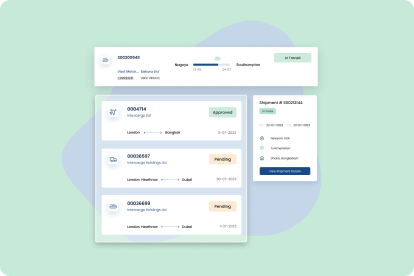
Keep all your data in one place which can be accessed from anywhere and anyplace
Let us help you 24/7 manage your supply chain needs
Latest News & Updates

How a team learns to trust a quote it did not build
Four in five of the AI-built quotes on cargo.one go out without a person touching them. Every team running at that number started at zero, with a person reading every quote, trusting none of them. What happened in between was not a leap of faith, and it was not simply time. Trust is a process, and like any process in a forwarding operation, it can be designed, run, and improved systematically. We have run enough of these deployments to see the same six patterns emerge. Where all six are in place, teams move fast. Where one or more are missing, adoption stalls, however well-designed the AI workers may be. 1 - Every decision is inspectable. A quote is a chain of decisions: which rate, which charges, which margin. The AI worker shows all of it: every quote traces back to the rate it chose and the rule that chose it. The first thing a skeptic does is rebuild a few quotes by hand and compare. Let them. A skeptic who can verify becomes an advocate and someone who ends up defending it 2 - High quality & trusted inputs. The AI worker builds from the same rate sources the team already searches on cargo.one, in the system it already works in. Look behind any AI-built quote and you recognize everything in it. People extend trust to a tool that works from the same facts they do. 3 - Authority is yours. Any quote can be adjusted or overwritten on the platform, by anyone on the team (with the right permissions), before it leaves. That safety valve is what makes every next step possible: nobody hands over a workflow they cannot take back. 4 - Autonomy arrives in steps. First a person reviews everything the worker builds. Then it sends on its own inside a narrow scope - general cargo under a set weight, on named lanes - while everything unusual routes to a person. Then the scope widens as evidence accumulates. Three levels, and the team decides when to climb: * Assisted: a person reviews every quote before it leaves * Supervised: the worker sends on its own inside a scope the team has drawn; everything unusual routes to a person. * Autonomous: the worker handles the flow end-to-end; the team manages by exception. 5 - Feedback is visible. When the team corrects a quote, the correction becomes a rule, and after review, gets added to the AI worker, so the next thousand quotes follow it. This is the most underestimated of the six: people keep investing in a system they can watch getting smarter. 6 - Someone watches the full system. What really counts is the picture across thousands of quotes, including margins by lane, win rates by customer, and the outliers worth a closer look. Monitoring is set up with the team during deployment, with a path from any number down to the single quote behind it. A supervisor steers AI workers much the way they steer people: watch the numbers, sample the work, look into the outliers. Buy-in by design Every one of these six aspects leaves a decision with the team. The rates are their own, the rules are the ones they wrote, and they are involved in the pace-setting. That changes something no metric captures. Six months in, the AI worker doesn't feel like software that was rolled out to the team. It feels like something they co-built, and teams treat it that way. They argue about its rules, show it off to other branches, and notice when it gets smarter, because they made it smarter. Put simply, trust converts. Where the AI worker runs well, the mechanic is the same. Quotes go out in minutes, not hours. Volume jumps, because every request gets an answer. Faster answers win more business. The freed-up hours go where they earn most: business development and the complex shipments that need a human. More requests come in, and the AI worker quotes those too. Here is the part that matters most: every gain in that cycle depends on trust. A team that still checks every quote caps its own volume at human speed. That is why the six patterns are not the soft part of the rollout: they are what releases the return. Getting there takes two to four weeks, from kickoff to an AI worker quoting your first lanes, with a defined scope, a named team on both sides, and your number attached: the hours back, the quotes that stop going unanswered, the win rate on your lanes. It all starts with a working session on how your team prices today. Reach out to me or the team at cargo.one.
Source: theloadstar.com
Read more
Air Canada Cargo welcomes return of Tel Aviv flights
Air Canada's cargo division has welcomed the news that the airline will resume flights to Tel Aviv earlier than it had planned. The four-times-a-week service from Toronto will resume on 30 November using Boeing 787 Dreamliner aircraft. Departures from Toronto are on Monday, Tuesday, Thursday and Sunday, and from Tel Aviv on Monday, Tuesday, Wednesday and Friday. The flights were suspended as a result of the conflict in the Middle East and were previously planned to return in mid-January. Air Canada Cargo said the flights would provide customers with cargo capacity, flexibility and connectivity between Israel, Canada and destinations across Air Canada's global network. "The earlier return of Air Canada's Tel Aviv service provides our customers with predictable capacity, network connectivity and flexibility for shipments moving between Israel, Canada and destinations across our global network," said Matthieu Casey, managing director - commercial at Air Canada Cargo. "This route supports important trade flows and gives shippers reliable access to a broad range of markets through our Toronto hub." The cargo division added that the service would likely prove popular with customers moving time-sensitive, high-value, healthcare, technology and e-commerce. The decision was made after "a thorough review of the security environment in the Middle East", the airline said. While the airline has decided to advance the return of its flights to Tel Aviv, its operations to Dubai will remain suspended until mid-January. Air Canada joins a growing list of airlines in announcing plans to resume flights to the Middle East following a widespread withdrawal from the region in the wake of the US and Israel's attacks on Iran in late February. Dutch carrier KLM plans to reinstate flights to Dubai, Dammam and Riyadh at the start of the winter season, after suspending the routes earlier this year due to the Middle East conflict. Elsewhere in Europe, Wizz Air said earlier this month that it would progressively restore 12 routes to the Middle East this winter.
Source: aircargonews.net
Read more
Transpacific spot rates top $10,000 as Asia-Europe slide accelerates
Container spot freight rates on the transpacific and Asia-Europe continued on their completely divergent directions for the seventh straight week, with Asia-US east coast rates now hitting levels not seen since July 2022. This week's World Container Index (WCI) by Drewry saw its Shanghai-New York breach the $10,000 per 40ft level, the first time it has done so since during the latter days of Covid, after rising 7% this week to end at $10,394 per 40ft. US freight forwarder Freight Right said the carriers' pricing power from Asia into the US east coast remained stronger than to the west coast and some shippers desperate to secure space were booking at rates almost $1,000 higher than current index levels. "East Coast pricing remains significantly higher, with rates now above $10,000 and reaching approximately $11,000 per container in some cases. "Like the West Coast, the lane is experiencing constrained capacity and increasingly unstable vessel schedules," it said. The WCI's Shanghai-Los Angeles leg increased 5% week-on-week to end at $7,712 per 40ft amid similar trade dynamics, and Freight Right warned that more concerning for shippers was the diminishing schedule reliability levels caused by a confluence of Asian port congestion and increasing numbers of blank sailings, leading to higher cases of rollovers at loading ports. "The bigger operational concern is no longer price," Freight Right added. "Vessel schedules have become increasingly unreliable. A shipment can secure space and still see its scheduled departure pushed back several days. "When a booking rollover is combined with a delayed vessel departure, total delays can approach two weeks," it said. And with nine transpacific blank sailings announced for next week compared to eight this week, according to Drewry's Container Capacity Insight, the tight capacity outlook is set to continue and Drewry said it "expects rates to rise slightly next week amid impending pre-Golden Week demand and continued capacity management by carriers". Meanwhile, the recent declines seen on the Asia-Europe trades accelerated this week, with its Shanghai-Rotterdam route down 9% on the previous week to $3,626 per 40ft, while the Shanghai-Genoa leg declined 5% to $4,016 per 40ft. Comparing to the same period in 2022 - when Asia-US east coast were last at the same level as today - Asia-North Europe stood at around $9,000 per 40ft and Asia0-Mediterranean was at $11,000 per 40ft. Despite the pricing weakness in comparison to the transpacific, analysts at Linerlytica noted that today's Asia-Europe spot rates are still around double this time last year, and described current pricing as resilient, despite the drops. "The freight rate resilience has been supported by stronger than expected demand even after the cargo demand peaked in May, and the severe port congestion in China in the last two months. "Although congestion in Chinese ports is starting to clear from the peaks in early September, the congestion has shifted to Southeast Asia ports. "Waiting times in Singapore have risen to over four days due to vessel bunching," Linerlytica said earlier this week. Meanwhile, Drewry's Container Capacity Insight records four Asia-Europe blank sailings scheduled for next week, up from one this week, "indicating tighter capacity". "With tight capacity and continued congestion in Asia, Drewry expects Asia-Europe rates to decline slightly next week, as demand remains weak," it said. A further factor is the increasing number of carriers returning to Red Sea routings, which has the effect of injecting capacity simply through the shorter sailing distances.
Source: theloadstar.com
Read more
Privacy Preference Center
This website uses cookies and similar technologies, (hereafter “technologies”), which enable us, for example, to determine how frequently our internet pages are visited, the number of visitors, to configure our offers for maximum convenience and efficiency and to support our marketing efforts. These technologies incorporate data transfers to third-party providers based in countries without an adequate level of data protection (e. g. United States). For further information, including the processing of data by third-party providers and the possibility of revoking your consent at any time, please see your settings under “Consent Preferences” and our
Privacy Notice