
Solutions
About Us
My Intercargo
Support
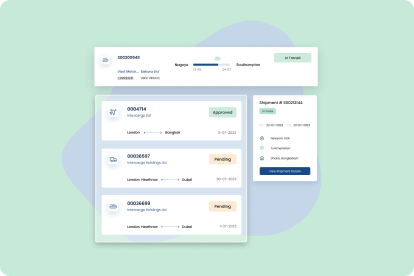
Keep all your data in one place which can be accessed from anywhere and anyplace
Let us help you 24/7 manage your supply chain needs
Latest News & Updates

Nanjing steps up deepsea ambitions with direct North Africa service
China's Nanjing port has taken another step towards its ambition of scaling up from being a river port to offering deep-sea container services. Cosco Shipping Lines has started a direct liner service between Nanjing and North Africa, using the newly built general cargo ship Guo Fu Hai. On Friday, the 79,800 dwt Guo Fu Hai, which can carry up to 2,970 teu, filled just over half its capacity at Nanjing's Longtan Container Terminal. Cargoes included machinery and vehicles. This was the largest container loading at Longtan to date, as only around 20 international container routes are connected to Nanjing, and these are all intra-Asia services. This is Guo Fu Hai's maiden voyage and the ship will sail on to Ningbo and Hong Kong, before arriving in Egypt's Port Said and Libya's Benghazi port in around 20 days. In recent years, container transport from Nanjing has continuously made breakthroughs. In December 2024, the port saw its first container ship voyage to the west, when the 2,526 teu Honwell departed for Russia's St Petersburg port. In August last year, the same ship fulfilled the first container shipment from Nanjing to Europe, via the Northern Sea Route. In 2025, Nanjing's container volumes crossed the 4m teu mark for the first time. By 2035, Nanjing hopes to handle 6.3m teu annually. Port officials said the departure of Guo Fu Hai tests Nanjing's capacity for navigation, berthing, and operational support for ocean-going vessels, and also indicates its evolution from primarily being a transhipment conduit for hinterland cargoes to Shanghai and Ningbo. Cosco Shipping Lines' Jiangsu branch's operations manager Wang Jianping said: "With this route, cargo sources from nearby areas like Anhui, Zhenjiang, and Yangzhou that were previously transhipped to Shanghai port can also be barged to Nanjing for export, saving transportation costs for enterprises." Mr Wang calculated that, on average, each container could save about CNY1,000 ($149) in transport, customs declaration, inspection and other costs.
Source: theloadstar.com
Read more
Transpac rates close in on Covid records as carriers pile in capacity
Container shipping spot rates from the Far East to the US are approaching their highest levels seen during the Covid-19 disruption, with carriers increasing capacity on the eastbound transpacific as they seek to capitalise on the surge. According to Xeneta chief analyst Peter Sand, spot rates from the Far East to the US west and east coasts have risen by 324% and 325%, respectively, since 28 February, before the Hormuz crisis. The average spot rate on 17 September was $7,960 per feu to the US west coast and $11,259 per feu to the US east coast. That leaves the west coast rate 17.9% below its Covid-era record of $9,699 per forty foot, set in February 2022, while the east coast is 11.2% below its peak of $12,683, reached in January 2022. "That leaves freight rates on these critical trades just 18% and 11% short of the all-time high set during the Covid-19 disruption. With bunker prices pushing fuel surcharges higher, surpassing the pandemic peak cannot be ruled out, which would be an extraordinary market development," said Mr Sand. "If a freight rate record is broken, it is most likely to occur on the trade into US East Coast, but even if we do not see a new all-time high, the fact we are even discussing the possibility demonstrates how sensitive critical ocean container shipping trades are to geopolitical forces and how a regional conflict in the Middle East can have major implications at a global level." Carriers are responding to the strength of the transpacific market by adding capacity, particularly to the US east coast. Xeneta said offered capacity on the trade is 6-7% higher in September than in August. "Carriers are seizing the opportunity while the market is hot, adding capacity into US East Coast ahead of what could be a turn in the market within the next two to three weeks. Offered capacity on the Far East to US East Coast trade is 6-7% higher in September than in August," Mr Sand said, and added he expects another rate increase as shippers bring forward cargo ahead of China's Golden Week holiday. "We should expect one more freight rate push at the start of October as shippers rush cargo out of Asia ahead of the Golden Week shutdown, before rates start to soften, or at least the pace of growth will slow." Separate analysis from Sea-Intelligence pointed to improved carrier capacity management as a key factor behind elevated transpacific utilisation. Eastbound transpacific vessel utilisation has risen from typically 80-85% in 2018-19 to around 85-90% in recent years, with 2026 levels around eight percentage points above the pre-pandemic period, according to its data. "The root cause of the increased utilisation appears to be a stronger discipline in capacity deployment by the carriers. This does not imply collusion across competitors, but indicates that carriers have become better at adjusting capacity on the trade, to match the rapidly shifting demand fluctuations." While geopolitical disruption, disciplined capacity deployment and shippers advancing cargo ahead of Golden Week are keeping the transpacific market tight, with rates within striking distance of their pandemic-era records, maintaining tight capacity could become more challenging as major carriers seek to grow market share, potentially putting pressure on utilisation and freight rates. Maersk's orderbook now stands at 35% of its existing fleet following an order for 26 large vessels, while MSC, CMA CGM and Cosco have orderbooks equivalent to 39%, 39% and 52% of their current fleets respectively.
Source: theloadstar.com
Read more
FMC leaves carriers facing open-ended exposure to charge complaints
A potentially significant change at the US Federal Maritime Commission (FMC) has gone largely under the radar, after the regulator confirmed there is no three-year statute of limitations on charge complaints relating to fees assessed on or after 16 June 2022 - leaving carriers exposed to claims that might otherwise have been time-barred. Charge complaints - a mechanism allowing those holding an interest in affected cargoes to challenge carrier fees deemed unfair - experienced a massive post-pandemic uptick as shippers sought recompense for what they saw as unjust detention and demurrage practices. As one source active in litigation told The Loadstar, with much of the activity taking place between 2021 and 2023, the statute of limitations was coming up for claims to be lodged before they timed out, meaning the change could prove a blessing, particularly for SMEs. And yet, outside a few legal circles, little mention has been made of a change that could prevent the expected rush of claims from shippers seeking to lodge cases before the three-year deadline. "From now on, there's no statute of limitations," the source said. They added: "The statute of limitations has always been three years. There's no statute of limitations on charge complaints now, so presumably in 2032 you could go to something from July of 2022 and go after them for it." But ending the statute of limitations is just one part of a far broader push to even out the playing field for SMEs, with the FMC no longer limiting the route through which charge complaints can be made, allowing them to be filed through small claims and formal processes. While this route had been open to shippers and others looking to bring a claim, those who chose not to follow the specific charge complaint mechanism lost the benefit of the Ocean Shipping Reform Act, in which the carrier had to prove the reasonableness of the charge. "Now, no matter which route you choose to take, the burden of proof falls with the carrier who must prove that the amount they have charged is legitimate, and they must do that whatever medium the complaint is lodged through," the source added. Specialist supply chain law firm Husch Blackwell issued a note suggesting that, given the changes, shippers and NVOCCs review their D&D assessments and "ensure they maintain thorough invoice and bill of lading records to preserve potential claims". Sources have told The Loadstar repeatedly over the years that smaller shippers had been forced to make a calculation when it came to the FMC, with the cost of bringing a claim often itself more expensive than what they were ever likely to recoup. With this latest change, shippers have further evidence that, despite initial expectations that the Trump administration would bow to corporate interests, that appears to be the case only when those interests are waving an American flag.
Source: theloadstar.com
Read more
Privacy Preference Center
This website uses cookies and similar technologies, (hereafter “technologies”), which enable us, for example, to determine how frequently our internet pages are visited, the number of visitors, to configure our offers for maximum convenience and efficiency and to support our marketing efforts. These technologies incorporate data transfers to third-party providers based in countries without an adequate level of data protection (e. g. United States). For further information, including the processing of data by third-party providers and the possibility of revoking your consent at any time, please see your settings under “Consent Preferences” and our
Privacy Notice