
Solutions
About Us
My Intercargo
Support
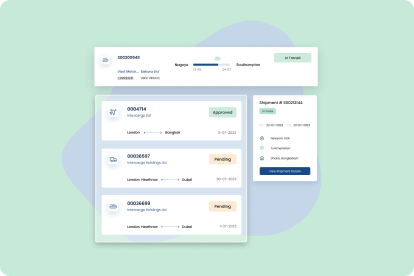
Keep all your data in one place which can be accessed from anywhere and anyplace
Let us help you 24/7 manage your supply chain needs
Latest News & Updates

DHL and Alibaba to explore how AI can improve logistics for SMEs
DHL Group and Chinese e-commerce giant Alibaba have signed a Memorandum of Understanding (MoU) to explore how artificial intelligence (AI) can improve the end-to-end logistics experience for small and medium-sized enterprises (SMEs) trading internationally. The companies intend to evaluate how AI-powered tools can support customers from sourcing and supplier discovery to logistics quotation, booking and shipment execution to make cross-border trade simpler, faster and more accessible. DHL and Alibaba will explore the integration of DHL Global Forwarding's logistics services into Alibaba's agentic AI platform Accio. This is a plug-and-play enterprise AI agent that "equips businesses with an immediate, no-code taskforce" designed to support the diverse operational needs of SMEs worldwide, explained DHL. Through an agentic approach, Accio is expected to be able to connect to DHL Global Forwarding's quotation and booking capabilities, enabling businesses to obtain real-time freight forwarding quotes, evaluate shipping options and book shipments more seamlessly. The new capability is the first in a planned suite of DHL logistics capabilities designed to automate key business tasks, improve operational efficiency and enable SMEs to scale more effectively. Katja Busch, chief commercial officer DHL and head of DHL customer solutions & innovation, said: "SMEs are the backbone of the global economy, but many still face challenges navigating the complex rules, regulations, and trade requirements that come with international expansion. "By bringing together Alibaba.com's digital commerce expertise and DHL's logistics capabilities, we want to explore how technology can help businesses spend less time managing complexity and more time focusing on growth." Kuo Zhang, president of Alibaba.com, commented: "AI is fundamentally changing how businesses participate in global trade, making capabilities that once required significant time, expertise and resources more accessible to small and medium-sized enterprises. "At Alibaba.com, our vision for Accio is to help businesses move from opportunity to execution across the trade journey. By exploring ways to connect Accio with DHL's global logistics capabilities, we hope to lower the barriers to cross-border commerce and help SMEs move faster and with greater confidence as they grow internationally." Tim Robertson, executive vice president accelerated digitalisation, DHL Global Forwarding, added: "Global trade is becoming increasingly digital, and customers expect logistics to be as seamless as the rest of their business activities. "Through this collaboration, we will explore how advanced AI capabilities can support customers with faster access to information, greater transparency and more efficient logistics processes. "We see significant potential in combining intelligent digital platforms with DHL's logistics network and expertise." The agreement was announced during Alibaba.com's CoCreate 2026 Conference in Los Angeles.
Source: aircargonews.net
Read more
How a team learns to trust a quote it did not build
Four in five of the AI-built quotes on cargo.one go out without a person touching them. Every team running at that number started at zero, with a person reading every quote, trusting none of them. What happened in between was not a leap of faith, and it was not simply time. Trust is a process, and like any process in a forwarding operation, it can be designed, run, and improved systematically. We have run enough of these deployments to see the same six patterns emerge. Where all six are in place, teams move fast. Where one or more are missing, adoption stalls, however well-designed the AI workers may be. 1 - Every decision is inspectable. A quote is a chain of decisions: which rate, which charges, which margin. The AI worker shows all of it: every quote traces back to the rate it chose and the rule that chose it. The first thing a skeptic does is rebuild a few quotes by hand and compare. Let them. A skeptic who can verify becomes an advocate and someone who ends up defending it 2 - High quality & trusted inputs. The AI worker builds from the same rate sources the team already searches on cargo.one, in the system it already works in. Look behind any AI-built quote and you recognize everything in it. People extend trust to a tool that works from the same facts they do. 3 - Authority is yours. Any quote can be adjusted or overwritten on the platform, by anyone on the team (with the right permissions), before it leaves. That safety valve is what makes every next step possible: nobody hands over a workflow they cannot take back. 4 - Autonomy arrives in steps. First a person reviews everything the worker builds. Then it sends on its own inside a narrow scope - general cargo under a set weight, on named lanes - while everything unusual routes to a person. Then the scope widens as evidence accumulates. Three levels, and the team decides when to climb: * Assisted: a person reviews every quote before it leaves * Supervised: the worker sends on its own inside a scope the team has drawn; everything unusual routes to a person. * Autonomous: the worker handles the flow end-to-end; the team manages by exception. 5 - Feedback is visible. When the team corrects a quote, the correction becomes a rule, and after review, gets added to the AI worker, so the next thousand quotes follow it. This is the most underestimated of the six: people keep investing in a system they can watch getting smarter. 6 - Someone watches the full system. What really counts is the picture across thousands of quotes, including margins by lane, win rates by customer, and the outliers worth a closer look. Monitoring is set up with the team during deployment, with a path from any number down to the single quote behind it. A supervisor steers AI workers much the way they steer people: watch the numbers, sample the work, look into the outliers. Buy-in by design Every one of these six aspects leaves a decision with the team. The rates are their own, the rules are the ones they wrote, and they are involved in the pace-setting. That changes something no metric captures. Six months in, the AI worker doesn't feel like software that was rolled out to the team. It feels like something they co-built, and teams treat it that way. They argue about its rules, show it off to other branches, and notice when it gets smarter, because they made it smarter. Put simply, trust converts. Where the AI worker runs well, the mechanic is the same. Quotes go out in minutes, not hours. Volume jumps, because every request gets an answer. Faster answers win more business. The freed-up hours go where they earn most: business development and the complex shipments that need a human. More requests come in, and the AI worker quotes those too. Here is the part that matters most: every gain in that cycle depends on trust. A team that still checks every quote caps its own volume at human speed. That is why the six patterns are not the soft part of the rollout: they are what releases the return. Getting there takes two to four weeks, from kickoff to an AI worker quoting your first lanes, with a defined scope, a named team on both sides, and your number attached: the hours back, the quotes that stop going unanswered, the win rate on your lanes. It all starts with a working session on how your team prices today. Reach out to me or the team at cargo.one.
Source: theloadstar.com
Read more
Transpac rates close in on Covid records as carriers pile in capacity
Container shipping spot rates from the Far East to the US are approaching their highest levels seen during the Covid-19 disruption, with carriers increasing capacity on the eastbound transpacific as they seek to capitalise on the surge. According to Xeneta chief analyst Peter Sand, spot rates from the Far East to the US west and east coasts have risen by 324% and 325%, respectively, since 28 February, before the Hormuz crisis. The average spot rate on 17 September was $7,960 per feu to the US west coast and $11,259 per feu to the US east coast. That leaves the west coast rate 17.9% below its Covid-era record of $9,699 per forty foot, set in February 2022, while the east coast is 11.2% below its peak of $12,683, reached in January 2022. "That leaves freight rates on these critical trades just 18% and 11% short of the all-time high set during the Covid-19 disruption. With bunker prices pushing fuel surcharges higher, surpassing the pandemic peak cannot be ruled out, which would be an extraordinary market development," said Mr Sand. "If a freight rate record is broken, it is most likely to occur on the trade into US East Coast, but even if we do not see a new all-time high, the fact we are even discussing the possibility demonstrates how sensitive critical ocean container shipping trades are to geopolitical forces and how a regional conflict in the Middle East can have major implications at a global level." Carriers are responding to the strength of the transpacific market by adding capacity, particularly to the US east coast. Xeneta said offered capacity on the trade is 6-7% higher in September than in August. "Carriers are seizing the opportunity while the market is hot, adding capacity into US East Coast ahead of what could be a turn in the market within the next two to three weeks. Offered capacity on the Far East to US East Coast trade is 6-7% higher in September than in August," Mr Sand said, and added he expects another rate increase as shippers bring forward cargo ahead of China's Golden Week holiday. "We should expect one more freight rate push at the start of October as shippers rush cargo out of Asia ahead of the Golden Week shutdown, before rates start to soften, or at least the pace of growth will slow." Separate analysis from Sea-Intelligence pointed to improved carrier capacity management as a key factor behind elevated transpacific utilisation. Eastbound transpacific vessel utilisation has risen from typically 80-85% in 2018-19 to around 85-90% in recent years, with 2026 levels around eight percentage points above the pre-pandemic period, according to its data. "The root cause of the increased utilisation appears to be a stronger discipline in capacity deployment by the carriers. This does not imply collusion across competitors, but indicates that carriers have become better at adjusting capacity on the trade, to match the rapidly shifting demand fluctuations." While geopolitical disruption, disciplined capacity deployment and shippers advancing cargo ahead of Golden Week are keeping the transpacific market tight, with rates within striking distance of their pandemic-era records, maintaining tight capacity could become more challenging as major carriers seek to grow market share, potentially putting pressure on utilisation and freight rates. Maersk's orderbook now stands at 35% of its existing fleet following an order for 26 large vessels, while MSC, CMA CGM and Cosco have orderbooks equivalent to 39%, 39% and 52% of their current fleets respectively.
Source: theloadstar.com
Read more
Privacy Preference Center
This website uses cookies and similar technologies, (hereafter “technologies”), which enable us, for example, to determine how frequently our internet pages are visited, the number of visitors, to configure our offers for maximum convenience and efficiency and to support our marketing efforts. These technologies incorporate data transfers to third-party providers based in countries without an adequate level of data protection (e. g. United States). For further information, including the processing of data by third-party providers and the possibility of revoking your consent at any time, please see your settings under “Consent Preferences” and our
Privacy Notice