
Solutions
About Us
My Intercargo
Support
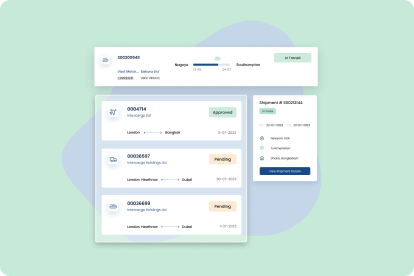
Keep all your data in one place which can be accessed from anywhere and anyplace
Let us help you 24/7 manage your supply chain needs
Latest News & Updates

European Aviation completes acquisition of European Cargo aircraft
European Aviation has completed the acquisition of troubled European Cargo's aircraft, including its fleet of A340 cargo aircraft, with plans to restart flights. The company said that it had acquired European Cargo's 16 A340 aircraft, including seven "flight-ready" freighters, a large quantity of Rolls-Royce Trent 553 and 556 spare engines, including several with little time since overhaul. The aircraft acquisition came about after European Cargo fell into administration earlier this year. Also included in the purchase are more than 14,000 line items of spares for the A340 aircraft and Trent engines. News that European Aviation was interested in rescuing the company emerged in August. European Aviation chairman and chief executive Paul Stoddart said: "We are delighted to have concluded our acquisition of all of the assets of [European Cargo] with the joint administrators. "Whilst this is a massive investment from [European Aviation], I feel totally confident that we can keep this excellent fleet of cargo aircraft flying for the foreseeable future." European Cargo began to run into trouble when its largest customer asked for a 30% reduction in service price due to softer volumes. In addition, the wars in Ukraine and in the Middle East resulted in increasing jet fuel prices that negatively impacted the business through reduced profit margin per flight. The airline entered administration in June of this year, with 174 of its 219 staff made redundant. European Aviation, which is owned by ex-Formula One team boss Paul Stoddart, previously owned European Cargo. The company sold 49% of its stake in European Cargo in 2022 and the remaining 51% stake two years later. The airline emerged in April 2020 during the onset of the Covid-19 pandemic, after European Aviation sought to offer the UK government capacity to transport medical equipment from Malaysia. It had been acquiring Airbus four-engined A340-600 passenger jets from carriers such as Virgin Atlantic and initially operated them as temporary freighters. European Cargo subsequently obtained approval to operate the -600s in a permanent cargo configuration, with a 76t payload capability, and has been gradually converting its fleet. The airline had been operating the aircraft between China and Bournemouth and Teesside in the UK, largely carrying e-commerce shipments. No cargo door is added during the conversion process, allowing the aircraft to potentially be turned back into passenger aircraft in the future, but making the cargo loading process more complicated than on a fully converted freighter. European Cargo's most recent financial statement shows it made a full-year net loss of $26m in 2024 -- on revenues of $136m -- a slight improvement on its net loss of $30.6m in 2023.
Source: aircargonews.net
Read more
Airfreight rates strong as peak season approaches
Airfreight rates appear strong as the peak season draws near, with year on year gains on transpacific lanes robust while Asia-Europe trade remains in recovery following the end of the de minimis exemption in the EU. The latest data from TAC Index found that the global Baltic Air Freight Index (BAI00) gained 0.9% over seven days to 21 September. This leaves the index up "20.9% versus where it was a year ago, with rates remaining strong in the run-up to the traditional peak season". Further, jet fuel price increases are also putting pressure on rates. "With jet fuel rates now up more than double at +116.5% year-on-year (YoY) to September 18, according to the IATA Jet Fuel Price Monitor, pressure for rates to rise further would seem to be increasing." China-Europe rates are growing stronger week on week as the trade recovers from disruption to e-commerce volumes following the end of the de minimis exemption in the EU in July. In comparison, China-US rates were slightly down week on week (WoW), though year on year transpacific rates are well up. "Rates on the busiest lanes out of China were firming up again WoW to Europe but a little lower to the US - though still up much more YoY on Transpacific lanes since volumes of small parcels to Europe fell following the end to the EU de minimis regime in July," said TAC Index. Highs and lows Performance is increasingly lane-specific, rather than uniformly rising across the market, highlighted TAC Index. BAI Spot rates out of Hong Kong were little changed WoW, but the full index of outbound routes from Hong Kong (BAI30) - reflecting the whole spectrum of spot and forward contract volumes - gained 0.3% week on week to leave it up 19.6% year on year. Outbound Shanghai (BAI80) was similar, gaining 0.6% week on week to leave it up 19.7% year on year. From Southeast Asia, rates were also mainly rising week on week on lanes from Bangkok, Hanoi and Malaysia - though falling a little from Vietnam to Europe. From East Asia, rates were rising week on week to Europe from Japan and Taiwan, but also a little lower from Seoul - as well as a little down from both Seoul and Taiwan on lanes to the US. Rates from India were up week on week to the US but unchanged to Europe. From Europe, rates on Transatlantic routes to the US fell back overall after recent gains - though not on lanes from Amsterdam, Frankfurt or London. There were also falls in rates week on week to India, Japan, Mexico, Brazil, South Africa and the UAE - but also further gains on lanes to China and Australia. The index of outbound routes from Frankfurt (BAI20) bucked the rising global trend, dropping by 3.4% week on week, though still remained up 21.1% year on year By contrast, outbound London Heathrow (BAI40) rebounded from some recent falls, jumping exactly 10% week on week to leave it up 11.4% year on year. Out of the US, rates were mostly firmer again week on week, including on lanes to Europe and to China - though lower to South America and certain other lanes such as to the UK and Korea. The index of outbound routes from Chicago (BAI50) edged up a further 1% week on week to leave it up some 45.7% year on year compared with low levels last year when standoffs over US tariffs and trade terms were in full swing. Rates from Mexico to Europe fell sharply week on week but remain in positive territory year on year.
Source: aircargonews.net
Read more
Nanjing steps up deepsea ambitions with direct North Africa service
China's Nanjing port has taken another step towards its ambition of scaling up from being a river port to offering deep-sea container services. Cosco Shipping Lines has started a direct liner service between Nanjing and North Africa, using the newly built general cargo ship Guo Fu Hai. On Friday, the 79,800 dwt Guo Fu Hai, which can carry up to 2,970 teu, filled just over half its capacity at Nanjing's Longtan Container Terminal. Cargoes included machinery and vehicles. This was the largest container loading at Longtan to date, as only around 20 international container routes are connected to Nanjing, and these are all intra-Asia services. This is Guo Fu Hai's maiden voyage and the ship will sail on to Ningbo and Hong Kong, before arriving in Egypt's Port Said and Libya's Benghazi port in around 20 days. In recent years, container transport from Nanjing has continuously made breakthroughs. In December 2024, the port saw its first container ship voyage to the west, when the 2,526 teu Honwell departed for Russia's St Petersburg port. In August last year, the same ship fulfilled the first container shipment from Nanjing to Europe, via the Northern Sea Route. In 2025, Nanjing's container volumes crossed the 4m teu mark for the first time. By 2035, Nanjing hopes to handle 6.3m teu annually. Port officials said the departure of Guo Fu Hai tests Nanjing's capacity for navigation, berthing, and operational support for ocean-going vessels, and also indicates its evolution from primarily being a transhipment conduit for hinterland cargoes to Shanghai and Ningbo. Cosco Shipping Lines' Jiangsu branch's operations manager Wang Jianping said: "With this route, cargo sources from nearby areas like Anhui, Zhenjiang, and Yangzhou that were previously transhipped to Shanghai port can also be barged to Nanjing for export, saving transportation costs for enterprises." Mr Wang calculated that, on average, each container could save about CNY1,000 ($149) in transport, customs declaration, inspection and other costs.
Source: theloadstar.com
Read more
Privacy Preference Center
This website uses cookies and similar technologies, (hereafter “technologies”), which enable us, for example, to determine how frequently our internet pages are visited, the number of visitors, to configure our offers for maximum convenience and efficiency and to support our marketing efforts. These technologies incorporate data transfers to third-party providers based in countries without an adequate level of data protection (e. g. United States). For further information, including the processing of data by third-party providers and the possibility of revoking your consent at any time, please see your settings under “Consent Preferences” and our
Privacy Notice