We understand the ever changing needs of our customers

we provide a high level of service dedicated to fulfilling all your shipping requirements

Watch Video
Road Freight

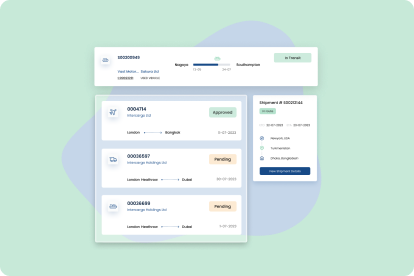
Keep all your data in one place which can be accessed from anywhere and anyplace

Let us help you 24/7 manage your supply chain needs

Back to Global Coverage

Kazakhstan Freight Forwarding Services
Air, Sea & Road Freight Between Kazakhstan and the UK

Intercargo provides reliable freight forwarding services between Kazakhstan and the United Kingdom, helping businesses import and export cargo efficiently by air, multimodal sea and overland freight.

Whether you are importing goods from Kazakhstan into the UK, exporting products from the UK to Kazakhstan, or managing regular international shipments, our experienced freight forwarding team provides complete end to end logistics solutions. From collection and customs clearance to final delivery, we manage every stage of the shipment process.
Air Freight Kazakhstan to UK
When speed matters, our Kazakhstan air freight services provide fast, secure and reliable transportation between Kazakhstan and the United Kingdom.
We arrange air freight through Almaty International Airport (ALA) and Nursultan Nazarbayev International Airport in Astana (NQZ), with UK arrivals through London Heathrow, London Stansted, Manchester Airport, Birmingham Airport and East Midlands Airport.

Our air freight solutions include:

  • Air freight from Kazakhstan to the UK
  • Express and economy air cargo
  • Door to door delivery
  • Time critical shipments
  • Air freight from the UK to Kazakhstan
  • Airport to airport services
  • Customs clearance support
  • High value and commercial cargo

Whether you need urgent delivery of oil and gas equipment, mining machinery, precision instruments or commercial goods, our air freight specialists can provide the most efficient solution.
Logistics solutions
Sea & Multimodal Freight Kazakhstan to UK
As a landlocked nation, freight between Kazakhstan and the UK combines ocean shipping with rail and overland transport via regional logistics corridors.
We route multimodal shipments through major European and Baltic ports or Caspian Sea feeder links (Aktau Port), connecting seamlessly to UK gateways.

Our multimodal freight services include:

  • Full Container Load (FCL)
  • Multimodal rail and sea solutions
  • Customs documentation
  • Project cargo
  • Less than Container Load (LCL)
  • Door to door logistics
  • Cargo insurance
  • Oversized and heavy lift shipments

Whether shipping mining equipment, industrial machinery, steel products or consumer goods, we can tailor a multimodal freight solution to suit your budget and transit requirements.
Logistics solutions
Import from Kazakhstan to the UK
Intercargo helps UK businesses import products and cargo from Kazakhstan through a fully managed freight forwarding service.

Our import services include:

  • Supplier coordination
  • Air, sea and multimodal transportation
  • Duty and VAT guidance
  • Final delivery throughout the UK
  • Collection from Kazakh factories, mines and commercial premises
  • UK customs clearance
  • Warehousing and distribution

We regularly support imports including:

  • Metals and mineral products
  • Chemical and petroleum products
  • Machinery and mechanical appliances
  • Agricultural and grain products
  • Textiles and raw materials
  • Industrial equipment
Our experienced team ensures your cargo moves efficiently from Kazakhstan to the UK while remaining compliant with all customs and import requirements.
Logistics solutions
Export from the UK to Kazakhstan
We also help UK businesses export goods to customers, distributors and partners throughout Kazakhstan.
Whether shipping to Almaty, Astana, Shymkent, Aktau, Atyrau or other industrial hubs, our export specialists can arrange a seamless freight solution by air, multimodal sea or overland routes.

Our export services include:

  • Air freight exports
  • Export documentation
  • Cargo insurance
  • Commercial and industrial shipments
  • Multimodal and rail exports
  • Customs compliance
  • Door to door delivery

From single shipments to regular freight movements, we provide scalable logistics solutions designed around your business requirements.
Logistics solutions
Customs Clearance & Freight Forwarding
Successful international shipping depends on accurate customs documentation and compliance.

Intercargo provides:

  • Import customs clearance
  • Commodity code guidance
  • Duty and tax assistance
  • End to end shipment visibility
  • Export customs clearance
  • Shipping documentation
  • Freight forwarding management

Our experienced freight forwarding team helps minimise delays and keeps your cargo moving smoothly between Kazakhstan and the United Kingdom.
Logistics solutions
Why Choose Intercargo for Kazakhstan Freight?
We support importers, exporters, manufacturers, distributors, retailers and energy businesses moving cargo between Kazakhstan and the UK.
Air And Multimodal Freight Specialists
Uk And Kazakhstan Trade Lane Expertise
Import And Export Solutions
Customs Clearance Support
Door To Door Logistics
Dedicated Account Management
Global Carrier Network
Competitive Freight Rates
Get a Kazakhstan Freight Quote

Looking for air freight from Kazakhstan to the UK, multimodal freight from Kazakhstan to the UK, or export services from the UK to Kazakhstan?
Contact Intercargo today for a tailored freight forwarding quotation and expert advice on the most efficient shipping solution for your cargo.
Logistics solutions
Latest News & Updates

Analysis: CH Robinson + RXO - the market weighs it up

Key takeaway: RXO is forecast to earn about 2 cents of Ebitda on each dollar of revenue this year against about 6 cents at CH Robinson, and the $300m of cost synergies - net savings from combining the two freight brokers - management is targeting would more than close the difference. Shareholders are weighing the payoff against the debt and new shares that come with the deal and the legal uncertainty around it. CH Robinson (CHRW) proudly announced yesterday that ...

Source: theloadstar.com

Read more

ePost moves to bigger facility at O'Hare

International shipping and logistics specialist ePost Global has moved to a 104,000 square ft facility in Itasca, near Chicago O'Hare International Airport The new site has nearly three times the previous ePost facility's footprint and, ePost said, the expansion "addresses [its] rapid growth in the region". ePost Global's largest US processing operation for both ecommerce parcels and mail, the expanded facility "strengthens the company's ability to accommodate additional customers, a broader range of shipment profiles and continued growth in international shipping volumes", it said in a statement. The larger footprint also provides greater flexibility to scale operations during peak periods and times of network disruption, it noted. The expansion comes as ePost Global prepares for what it thinks will be its busiest peak season to date. Sustained growth in customers and shipping volumes had pushed the company's previous Chicago-area operation to capacity, creating the need - it said - for a larger, more advanced facility designed to support continued growth. Kelly Martinez, co-president of ePost Global, explained: "Chicago has become our highest-volume US operation, and we reached the point where demand was outgrowing the space. "Coming off a record year, we're on track for another record peak season for ePost Global. This [expansion] gives us the capacity to innovate, scale our operations, and deliver the flexibility and reliability our customers need." Broadening coverage As well as increasing overall handling capacity, the expanded operation in Chicago will allow ePost Global to process a broader range of shipment profiles, including small parcels, poly mailers and larger packages. The additional space and throughput will also provide greater flexibility during seasonal surges and periods of network disruption, when capacity across shipping networks is under the greatest strain. Fabrizio Alvear, co-founder and co-president of ePost Global, observed: "When e-commerce brands and retailers are growing, their shipping partner needs to be ready to grow with them. "We are investing ahead of demand so we can accept more volume without imposing artificial limits when capacity matters most. "This facility gives us room to serve customers through the coming peak season and continue scaling well beyond it." The ePost operation at the new facility combines automated sortation with advanced scanning and tracking, optical character recognition and piece-to-container verification. Together, these capabilities enable the identification of exceptions in real time, improve sort accuracy, reduce repeat scanning and manual handling, and allow more shipments to move directly from induction into the correct outbound container to destination hubs around the world.

Source: aircargonews.net

Read more

The off-peak that isn't: why January squeezes Europe's ecommerce logistics

Christmas returns, New Year demand for supplements and fitness products, and up to four weekday holidays leave some EU markets with just 11 delivery days in three weeks. Most of the industry has its eyes on the fourth quarter. As The Loadstar reported last week, US consumers are expected to spend 6.7% more online this holiday season than last year. But for Europe's ecommerce networks, the pressure does not ease on 24 December. It simply shifts into January - a month most logistics calendars still file under off-peak. In the first weeks of the year, three separate loads converge on the same warehouses, carriers and pickup points. And they land in the tightest delivery window of the year. Three loads, one window The first load is December coming back. As soon as offices reopen, shoppers start sending back Christmas gifts and online orders. In the UK, Royal Mail braced for half a million gifts to be returned in the first week of January 2026, with returns expected to climb by about 25%. Those parcels compete with new outbound orders for the same dock doors, staff and sorting capacity. The second load is fresh demand. Many consumers start the year with health goals, and their baskets follow: supplements, sports nutrition, fitness equipment and diet products. Official UK figures show how strong the effect can be. The Office for National Statistics reported that retail sales volumes rose 1.8% in January 2026, the largest monthly gain since May 2024, with online sellers of sports supplements among the drivers. Supplements are the clearest case, but any category tied to New Year resolutions follows the same curve. The third load is missing capacity. Public holidays shut carriers and pickup points. Temporary staff hired for the Christmas peak are gone by the end of December. And warehouses set receiving cut-offs ahead of the holidays, so an inbound delivery that slips by a few days can miss the first sales week of the year. Eleven delivery days in three weeks The holidays eat into that window more than many shippers realise. At WAPI, we counted the delivery days in the 18 EU markets where we fulfill supplements and collect cash on delivery (COD). Only 11 to 13 of the 15 weekdays between 21 December 2026 and 8 January 2027 are delivery days. Holidays that fall on a Saturday are not included. 6 markets sit at the bottom of the range, with 11 delivery days each: Bulgaria, Cyprus, Latvia, Poland, Romania and Slovakia. Each loses four weekdays to public holidays in the period, although in Slovakia the status of 6 January still needs to be confirmed before plans are locked in. Figure 1. Weekday holidays between 21 December and 8 January in the six EU markets with the fewest delivery days. Source: WAPI Nor do the closures line up. Latvia shuts on 31 December, Bulgaria moves its 26 December holiday to Monday 28 December, and Romania closes on both 6 and 7 January. A network serving several countries from one warehouse therefore has to plan a separate cut-off for each market. In Poland, a parcel that misses the last delivery on Wednesday 23 December will not move again until Monday 28 December - the same week the first returns start rolling in. A second wave from China While Europe works through its January peak, the next supply problem is already building in Asia. Chinese New Year falls on 6 February 2027, 11 days earlier than in 2026. China's State Council usually publishes the official holiday window around November, so the exact 2027 dates are not yet known. The public holiday itself is the smallest part of the disruption. Factories typically wind down two to three weeks before the holiday, and many stay closed or run at reduced capacity for a month or more. Full output often does not return until mid-March, because a share of workers never come back to the same factory. For European ecommerce, the timing is what hurts. Working back from those closures, the last reliable departures from China fall in early to mid January 2027 - squarely in the European demand peak. Packaging, labels and raw materials for the February and March replenishment therefore need to be ordered before Christmas, while warehouse teams in Europe are still absorbed by the fourth quarter. Figure 2. The European January peak and the last reliable departures from China fall in the same weeks. Sources: WAPI, industry estimates Where January hurts most The squeeze does not hit all goods equally. Two groups carry the most risk: orders paid by cash on delivery, and products with a short shelf life. In January, many supplement orders fall into both. With COD, the buyer pays only when the parcel arrives. If it turns up late, or sits at a closed pickup point, the buyer can simply refuse it - and the seller pays for transport both ways and loses the sale. COD remains widespread across some regions in Europe, and those regions lose the most delivery days over the holidays. The cost of a refusal also grows with time. The parcel works its way back through the network alongside the Christmas returns and joins the same inspection queue. For a vitamin pack with only a few months of shelf life left, that delay can decide whether it returns to sale or is written off. In my experience, most January failures start small: a parcel that waits too long at a pickup point, or a delivery attempt that fails on the last day before a closure. In our network, flagging parcels that are close to the pickup deadline lets the team reach the buyer in time, and that cuts expired pickups by 40-55%. When a new delivery request goes to the carrier automatically, it arrives 80% faster than a manual one. In January, that speed is often the difference between a sale and a refusal. 5 questions for your 3PL before the December cut-off Most of these failures can be caught before the holidays. 5 questions reveal whether a logistics partner is ready for the peak after the peak. Conclusion The January peak, the year's shortest delivery window and the next round of orders to Asia all land in the same few weeks. A plan drawn up in December is too late for all three. For shippers and their logistics partners, January really starts in October, while stock targets, receiving slots and supplier orders can still be set with the Christmas peak ahead. This post was sponsored by WAPI.

Source: theloadstar.com

Read more

Privacy Preference Center

This website uses cookies and similar technologies, (hereafter “technologies”), which enable us, for example, to determine how frequently our internet pages are visited, the number of visitors, to configure our offers for maximum convenience and efficiency and to support our marketing efforts. These technologies incorporate data transfers to third-party providers based in countries without an adequate level of data protection (e. g. United States). For further information, including the processing of data by third-party providers and the possibility of revoking your consent at any time, please see your settings under “Consent Preferences” and our


Privacy Notice


Privacy Preference Center

Strickly Necessary Cookies
Always Active

Performance Cookies

Functional Cookies

Targeting Cookies