We understand the ever changing needs of our customers

we provide a high level of service dedicated to fulfilling all your shipping requirements

Watch Video
Road Freight

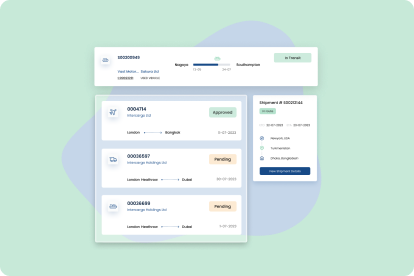
Keep all your data in one place which can be accessed from anywhere and anyplace

Let us help you 24/7 manage your supply chain needs

Latest News & Updates

Cockpit recording from Miami 767 overrun indicates highly-unstable approach

US investigators have revealed that a pilot of the Boeing 767-300 freighter that overran at Miami warned about excessive speed on final approach, while the aircraft subsequently generated multiple sink-rate and ground-proximity alerts as it descended. After the aircraft touched down, one of the crew called for a go-around just 5 seconds before the jet left the runway surface. National Transportation Safety Board investigators provided the update after further analysis of the cockpit-voice and flight-data recorders from the 21 Air aircraft, which overran Miami's runway 30 on 6 September. About 1 minute 11 seconds before touchdown, as one of the pilots called for 20° flap, the other "cautioned they were too fast", said the inquiry. This pilot also made additional comments regarding the aircraft's excessive speed throughout the remainder of the cockpit-voice recording. "There was not a consistent verbal response to the comments about speed," the inquiry adds. Over the 40 seconds between the 1,000ft call-out and touchdown, the jet issued several aural warnings of excessive sink rate, including below 500ft. It also generated four 'too low, terrain' warnings after the 100ft call-out, after which - just 10 seconds before touchdown - one of the pilots called for 30° flap. Another 'too low, terrain' alert was issued at about 40ft. Some 15 seconds after the touchdown - and about 5 seconds before the aircraft left the paved runway surface - one of the pilots "called for a go-around", said the inquiry. While the cockpit-voice and flight-data recordings have yet to be fully synchronised, investigators had previously indicated that, about this time, the aircraft's throttles were increased to go-around thrust for a few seconds before being reduced to idle power. As the aircraft - branded for Amazon Air - went off the end of the runway, it struck a van and a car, killing five people before coming to a stop.

Source: aircargonews.net

Read more

New US sanctions 'a warning to anyone supporting Iran's airlines'

Supply chain operatives active in the Middle East could find themselves exposed to new US sanctions against the Iranian aviation sector, with the threat of increasing delays in cargo processing also on the cards. Amid increasing its military activity against Iranian targets, the Trump administration yesterday issued 36 sanctions targeting not only Iranian aviation, but companies considered to be supporting it, with Turkish, Malaysian, and Emirati firms explicitly listed. US treasury secretary Scott Bessent said: "We promised severe consequences for those providing financial lifelines to the Iranian regime. Let this be a warning to anyone doing business with Iran's remaining airlines: you are at risk of being cut off from the global financial system." Going after third-country firms supporting the activity of sanctioned Mahan Air, for example, is something of a step-change in the US approach, with Washington paying particularly close attention to those providing aircraft transfers, cargo services, or GSSA support. Worryingly for businesses, operating through the Office of Foreign Assets Control (OFAC) the sanctions announcement exposes businesses to possible repercussions even if they have unwittingly supported Iranian aviation, if it is deemed they "should have known". The treasury also noted that its Financial Crimes Enforcement Network (FinCEN) would be "highlighting several key red flag indicators to help detect, prevent, and report potentially suspicious activity". Forwarders handling parts and maintenance materials to countries neighbouring Iran will need to carry out more stringent compliance checks to make sure they are not ultimately servicing sanctioned Iranian airlines. If a shipment listed for a UAE-based company ends up with one of the sanctioned carriers, OFAC will ask whether the forwarder "should have known" this was a procurement front for the Iranian airline before deciding how to act. With previous sanctions, SME forwarders have often found themselves caught in a balancing act between the cost of compliance and the risk of the getting it wrong, which led them to opt out of potentially exposed markets rather than continue. Miad Maleki, ,former senior treasury official and fellow at the Foundation for Defense of Democracies, said the suspension would hit major airfreight hubs, including Doha, Dubai, and Istanbul, leaving forwarders with yet another conundrum from the US war on Iran. Kuehne+Nagel (K+N) subsidiary Apex Logistics recently found itself in hot water with the US authorities, the Singapore-based firm being investigated over suspicions it has been defying US sanctions on China by supplying the country with restricted AI chips. Despite K+N telling The Loadstar it had not been contacted by US authorities and that Apex was cooperating in the investigation, it said this and the new sanctions on Iran pointed to "a more hawkish approach" from Washington on sanctions policing.

Source: theloadstar.com

Read more

Major carriers carving out designer networks to avoid competing on routes

Container shipping alliances are increasingly carving out distinct network niches, rather than competing head-to-head on the same port pairs, according to new analysis from Sea-Intelligence. It examined direct port-pair connections operated in July by the Gemini Cooperation, MSC, and the Ocean and Premier alliances; MSC is not formally part of an alliance but was included because of the scale of its standalone network. The consultant found 54% of the port-pair connections offered by alliances on the transpacific are served by just one grouping, rising to 65% on Asia-Europe. "This shows a high degree of specialised connections in an otherwise commoditised market," commented Sea-Intelligence. On the transpacific, the Ocean Alliance has the broadest direct network, covering 169 unique port pairs and generating 748 connections - an average of 4.4 connections per pair. The Premier Alliance has 116 unique pairs but has the highest frequency, at 5.2 connections per pair. Gemini offers 70 unique pairs at an average 4.8 connections, while MSC has the leanest network, with 84 pairs and an average 2.6 connections per pair. On Asia-Europe: MSC expands to 241 unique port pairs, averaging 4.1 connections per pair; Ocean Alliance covers 235 pairs at 4.9 connections; while Gemini and Premier cover 106 and 122 pairs respectively. The degree of overlap is particularly low on Asia-Europe; just 21% of port pairs are offered by two alliances, 9% by three, and only 5% by all four. On the transpacific, 24% of pairs are shared by two alliances, 16% by three, and 7% by all four. Among exclusive transpacific port pairs, Ocean accounts for 51%, followed by Premier at 26%, MSC at 15% and Gemini at 8%. On Asia-Europe, MSC accounts for 40% of exclusive port pairs, Ocean 34%, Gemini 16% and Premier 10%. The analysis also highlighted sharply different regional strategies: the Premier Alliance directs 78% of its unique transpacific port pairs to the North American west coast; MSC puts 80% of its unique connections on the east coast; the Ocean Alliance and Gemini also favour the east coast, at 65% and 64% respectively. On Asia-Europe: Gemini, Ocean and Premier concentrate 72%, 67%, and 67% respectively of their unique port pairs in the Mediterranean; MSC again stands apart, splitting its specialised coverage almost evenly between North Europe and the Mediterranean, at 49% and 51%. Sea-Intelligence said the findings suggested the "carrier alliances are designing highly specialised direct networks to differentiate their commercial products", rather than simply duplicating competing services. However, in a recent episode of The Loadstar News in Brief Podcast, director of the Global Shipper's Forum James Hookham highlighted the "monopolistic aspect" of alliances on certain trades, and the lack of choice this presented shippers in the instance of low schedule reliabilty or unfair surcharges.

Source: theloadstar.com

Read more

Privacy Preference Center

This website uses cookies and similar technologies, (hereafter “technologies”), which enable us, for example, to determine how frequently our internet pages are visited, the number of visitors, to configure our offers for maximum convenience and efficiency and to support our marketing efforts. These technologies incorporate data transfers to third-party providers based in countries without an adequate level of data protection (e. g. United States). For further information, including the processing of data by third-party providers and the possibility of revoking your consent at any time, please see your settings under “Consent Preferences” and our


Privacy Notice


Privacy Preference Center

Strickly Necessary Cookies
Always Active

Performance Cookies

Functional Cookies

Targeting Cookies