We understand the ever changing needs of our customers

we provide a high level of service dedicated to fulfilling all your shipping requirements

Watch Video
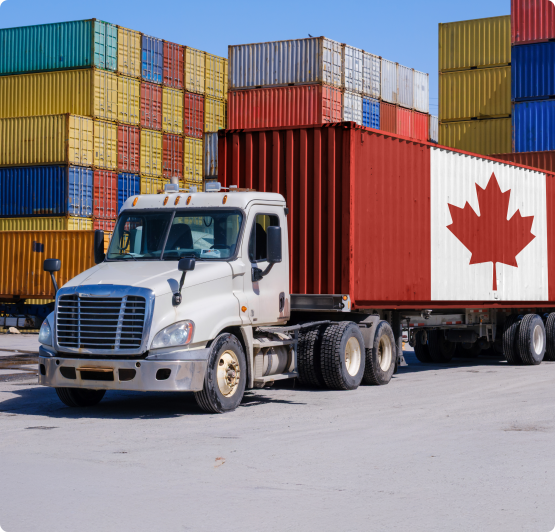
Road Freight

Keep all your data in one place which can be accessed from anywhere and anyplace

Let us help you 24/7 manage your supply chain needs

Back to Global Coverage

Canada Freight Forwarding Services
Air & Sea Freight Between Canada And The UK

Intercargo provides reliable freight forwarding services between Canada and the United Kingdom, helping businesses import and export cargo efficiently by air and sea.

Whether you are importing goods from Canada into the UK, exporting products from the UK to Canada, or managing regular international shipments, our experienced freight forwarding team provides complete end-to-end logistics solutions. From collection and customs clearance to final delivery, we manage every stage of the shipment process.
Logistics solutions
Air Freight Canada to UK
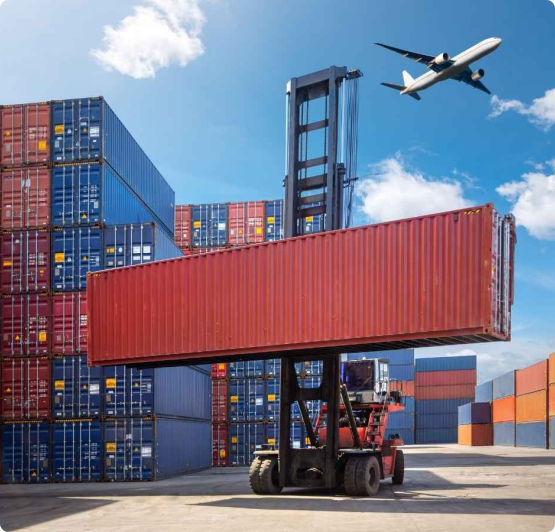
When speed matters, our Canada air freight services provide fast, secure and reliable transportation between Canada and the United Kingdom.
We arrange air freight through major Canadian airports including Toronto Pearson International Airport (YYZ), Vancouver International Airport (YVR), Montréal-Trudeau International Airport (YUL), Calgary International Airport (YYC) and Halifax Stanfield International Airport (YHZ), with UK arrivals through London Heathrow, London Stansted, Manchester Airport, Birmingham Airport and East Midlands Airport.
Our air freight solutions include:

  • Air freight from Canada to the UK
  • Express and economy air cargo
  • Door to door delivery
  • Time critical shipments
  • Air freight from the UK to Canada
  • Airport to airport services
  • Customs clearance support
  • High value and commercial cargo

Whether you need urgent delivery of electronics, retail products, machinery, automotive parts or commercial goods, our air freight specialists can provide the most efficient solution.
Logistics solutions
Sea Freight Canada to UK
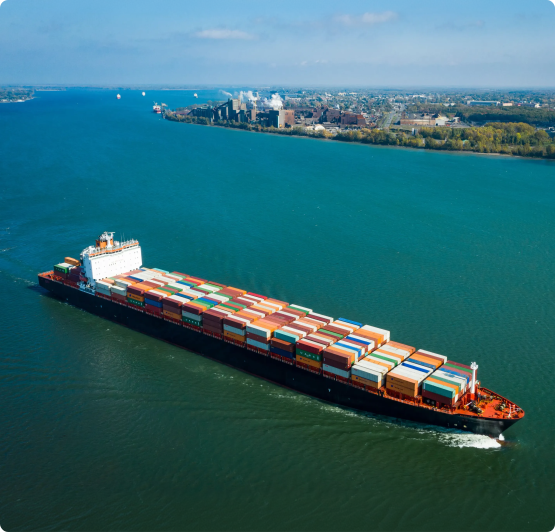
For larger shipments and cost-effective transportation, our sea freight services provide dependable shipping solutions between Canada and the UK.
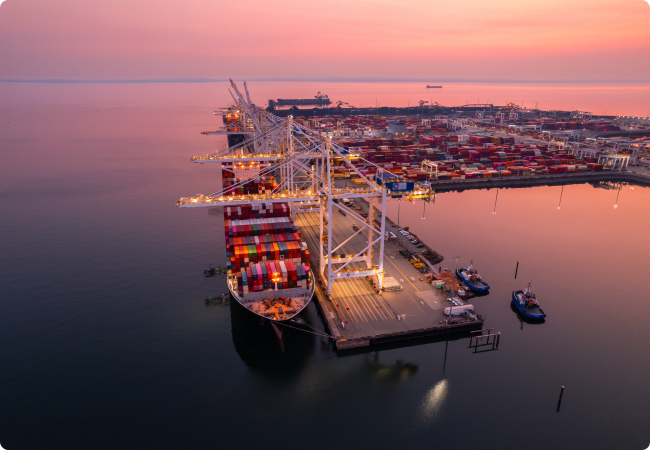
We regularly arrange cargo movements through major Canadian ports including Port of Vancouver, Port of Montreal, Port of Halifax, Port of Prince Rupert and Port of Toronto, with UK arrivals through Port of Felixstowe, Southampton, London Gateway, Liverpool, Tilbury and Immingham.
Our sea freight services include:

  • Full Container Load (FCL)
  • Port to port shipping
  • Customs documentation
  • Project cargo
  • Less than Container Load (LCL)
  • Door to door logistics
  • Cargo insurance
  • Oversized and heavy lift shipments

Whether shipping machinery, commercial products, manufacturing equipment, retail stock or industrial cargo, we can tailor a sea freight solution to suit your budget and transit requirements.
Logistics solutions
Import from Canada to the UK
Intercargo helps UK businesses import products and cargo from Canada through a fully managed freight forwarding service. Our import services include:

  • Supplier coordination
  • Air and sea freight transportation
  • Duty and VAT guidance
  • Final delivery throughout the UK
  • Collection from Canadian factories, warehouses and commercial premises
  • UK customs clearance
  • Warehousing and distribution

We regularly support imports including:

  • Electronics
  • Machinery
  • Manufacturing components
  • Consumer goods
  • Automotive parts
  • E-commerce products
  • Retail stock
  • Furniture
Our experienced team ensures your cargo moves efficiently from Canada to the UK while remaining compliant with all customs and import requirements.
Logistics solutions
Export from the UK to Canada
We also help UK businesses export goods to customers, distributors and partners throughout Canada. Whether shipping to Toronto, Vancouver, Montreal, Calgary, Edmonton, Ottawa or Halifax, our export specialists can arrange a seamless freight solution by air or sea.
Our export services include:

  • Air freight exports
  • Export documentation
  • Cargo insurance
  • Commercial and industrial shipments
  • Sea freight exports
  • Customs compliance
  • Door-to-door delivery

From single shipments to regular freight movements, we provide scalable logistics solutions designed around your business requirements.
Logistics solutions
Customs Clearance & Freight Forwarding
Successful international shipping depends on accurate customs documentation and compliance.
Intercargo provides:

  • Import customs clearance
  • Commodity code guidance
  • Duty and tax assistance
  • End-to-end shipment visibility
  • Export customs clearance
  • Shipping documentation
  • Freight forwarding management

Our experienced freight forwarding team helps minimise delays and keeps your cargo moving smoothly between Canada and the United Kingdom.
Logistics solutions
Why Choose Intercargo for Canada Freight?
We support importers, exporters, manufacturers, distributors, retailers and e-commerce businesses moving cargo between Canada and the UK.
Air Freight And Sea Freight Specialists
Uk And Uae Trade Lane Expertise
Import And Export Solutions
Customs Clearance Support
Door To Door Logistics
Dedicated Account Management
Global Carrier Network
Competitive Freight Rates
Get a Canada Freight Quote

Looking for air freight from Canada to the UK, sea freight from Canada to the UK, or export services from the UK to Canada? Contact Intercargo today for a tailored freight forwarding quotation and expert advice on the most efficient shipping solution for your cargo.
Logistics solutions
Latest News & Updates

Saudi air cargo capacity drops amid disruption from Riyadh shutdown

Saudi Arabia has lost almost a third of its international air cargo capacity over the past three days, as Riyadh's airport shutdown disrupts shipments and heightened airspace risks complicate routing options. Rotate data captured today shows combined inbound and outbound capacity on freighters and widebody passenger aircraft across Saudi Arabia down 33% against the equivalent 72-hour period a week earlier, a decline of 3,537 tonnes, to 7,292 tonnes. At Riyadh, capacity across all airlines, excluding narrowbody passenger aircraft, fell 99%, from 3,925 tonnes to just 26 tonnes. The latest notice to airmen for King Khalid International Airport states that the aerodrome is unavailable, due to precautionary measures until 9pm UTC on 17 October. Saudi Arabia's General Authority of Civil Aviation said yesterday it had extended the suspension while authorities completed checks on the safety and operational readiness of airport facilities. It did not specify a reopening date. Airline suspensions could prolong the capacity squeeze even after the airport reopens: Air France-KLM has suspended Riyadh services to the end of October; Etihad's Abu Dhabi-Riyadh flights are cancelled until 19 October, according to Reuters; and Delta has postponed the launch of its Atlanta-Riyadh service from 23 October to March 2027, delaying an additional source of belly capacity. Oman Air has confirmed that some Saudi-bound shipments are waiting in Muscat following cancellations. "The KSA situation has so far mainly impacted some planned passenger flights into RUH where we have cancelled services in line with airport closure," Mike Duggan, head of Oman Air Cargo, told The Loadstar. "We have a small amount of cargo waiting in MCT as a result." Mr Duggan said the airline's planned Saudi road feeder service was still being developed, although continued disruption could accelerate its introduction. "It has not impacted our RFS services so far, as the KSA element for our RFS is still in planning stage - perhaps it may give us some impetus to start sooner if the situation remains." He added that Oman Air Cargo had otherwise experienced limited impact to date and continued to monitor developments. Forwarder Expeditors has identified road transport among alternative routing options for affected shipments. Its 9 October advisory noted suspended Riyadh services by Saudia Cargo and restrictions affecting several other cargo carriers, but did not quantify diverted freight or identify replacement gateways. The disruption also raises questions for flights passing through Saudi airspace without landing. EASA's conflict-zone bulletin, revised on 9 October, recommended avoiding two defined areas of Saudi airspace at all altitudes, and exercising caution throughout the remainder of the Jeddah flight information region. It highlighted risks from missiles and drones, interception activity, falling debris, and the potential misidentification of civil aircraft during air defence operations. Saudi airspace forms part of a southern Europe-Asia corridor through Egypt and onwards to Oman or the UAE, identified in OPSGROUP's 6 October operational assessment. Further avoidance could increase flight distances and fuel requirements, potentially reducing cargo payload on weight-constrained services. For Saudia Cargo, the shutdown comes during a fleet expansion. Saudia's international freighter and widebody belly capacity fell 19% over the past three days, to 7,410 tonnes. Saudia Cargo carried 573,000 tonnes in 2025, approximately 0.8% below its 2024 total. Its partnerships to develop Asia-Europe connectivity through Zhengzhou and Riyadh could disrupt connecting shipments, alongside Saudi imports and exports. Four new 777 freighters are scheduled for delivery between this month and May 2027, under a purchase-and-leaseback agreement with DAE, adding capacity just as the carrier faces uncertainty over operations at its key gateway.

Source: theloadstar.com

Read more

Navi Mumbai highlights cargo achievements following operational challenges

Recently opened Navi Mumbai International Airport (NMIA) has highlighted its cargo achievements since it welcomed its first flight, while it also tackles operational issues facing its freight operations. The Indian airport said that between January and September, it has handled 11,853 tonnes of cargo, while it has processed 24 scheduled and chartered international freighters since all-cargo operations started in August. International airfreight accounts for 54.6% of total cargo throughput, while domestic volumes have a 45.4% share. "NMIA's modern airside infrastructure has facilitated immediate adoption by top-tier international and domestic freighter operators," the airport said in a press release. "The facility has proven its handling readiness for wide-body and heavy-lift aircraft, including regular operations by the Boeing 777F, Boeing 747-8F, and specialised charters with the Antonov An-124." The airport said that Cathay Cargo is operating daily flights; Silk Way West has established Boeing 777 freighter flights to Baku and Hong Kong Air Cargo has also added flights "linking NMIA with critical manufacturing and e-commerce distribution centres across East Asia". Navi Mumbai also said that it had managed to handle eight dedicated cargo freighters in a single operating day on 9 October, including Cathay Cargo, Challenge Air, Qatar Airways, Aerologic, AFCOM, MNG Airlines, ASL Airlines, and Atlas Air. "In addition to scheduled international carriers, the airport's regular cargo traffic comprises a growing consortium of international and domestic cargo operators, including DHL Aviation, IndiGo, Qatar Airways Cargo, Air India Express, Turkish Airlines, Sichuan Airlines, Jiangsu Jingdong Cargo, and SF Airlines," the airport added. Operational challenges While the airport was keen to highlight its successes since opening, there have also been challenges. Customs brokers have said the airport's cargo operations have faced operational challenges, while freighter operator Challenge Group announced that it would suspend freighter flights at the airport due to a lack of reliability. The airline announced it would suspend operations to the airport on 1 October, although one of its Boeing 767 freighters did conduct a flight on 8 October. Local reports suggest that the airport has responded by adding extra manpower and improving communications with freight forwarders. The airport also temporarily waived demurrage charges as a gesture of goodwill. Air Cargo News has contacted airport operator Adani for an update on the airport's cargo operations. NMIA opened its doors back in December, but freighter operations did not get underway until 1 August, when an IndiGo freighter took off from the airport. Freighter operators have been asked to temporarily move their flights from Mumbai's Chhatrapati Shivaji Maharaj International Airport (CSMIA) to NMIA while work is carried out on cargo infrastructure at CSMIA. The work is expected to take 10 months and was due to start in August. The airport features temperature-controlled zones catering to GDP-compliant active and passive pharmaceutical storage and agricultural perishables and segregated staging facilities designed for valuable goods, vulnerable electronics, and heavy/oversized industrial cargo. The airport operator also pointed out that the hub is situated around 14 km from the Jawaharlal Nehru Port Authority (JNPA), meaning it can also be used for sea-air operations.

Source: aircargonews.net

Read more

GFS ship sinks after missile attack, second ship sustains damage

Missiles struck two container ships in Global Feeder Shipping's (GFS) fleet in the Strait of Hormuz in the last 24 hours, with one vessel subsequently sinking after catching fire. Singapore's Maritime and Port Authority (MPA) said that the 2008-built 2,824 teu GFS Pride was damaged and caught fire before sinking. All of its 21 crewmen were evacuated, with no injuries reported. The other ship, 2015-built 4,350 teu GFS Giselle, sustained hull damage but remained operational and proceeded under its own power to a safe anchorage. All 22 crew members were safe, and no injuries were reported. Both ships are Singapore-flagged but had no Singaporeans among their crew. SeaSearcher's AIS data shows that GFS Pride was approximately one nautical mile east of Ras Makhbuq, Oman, when it was hit. Iran's Islamic Revolutionary Guard Corps Navy said an unnamed container ship carrying more than 2,500 containers had struck a mine while transiting what it described as an "unauthorised and dangerous" route through the strait. The sinking of GFS Pride is the second vessel loss since the US-Israel-Iran war began on 28 February, according to data from the International Maritime Organization, the United Nations' shipping agency. The earlier incident involved a bulk carrier, Cape Dao, which sank in the Gulf of Oman yesterday, after being hit by two torpedoes on 23 September. One Indian seafarer was killed and two others were injured. Both GFS Pride and GFS Giselle were originally owned by Dubai-based Simatech Shipping, before the latter's liner operations were acquired by GFS in October 2018. Abu Dhabi-based AD Ports owns 81% of GFS. GFS' website states that GFS Pride served a Khor Fakkan-Fujairah-Karachi service, and was supposed to have arrived in Khor Fakkan on Friday. GFS Giselle is deployed on a Fujairah-Khor Fakkan-India (Nhava Sheva) service and was due to have arrived in Khor Fakkan, also on Friday. MPA said it was in contact with the vessels' management company and was closely monitoring developments. The authority expressed concern over continued attacks on commercial shipping in the Strait of Hormuz, including the latest incidents involving the two Singapore-registered ships. It described the attacks as unprovoked and unjustifiable, saying they violated international law. MPA added that all actions affecting international shipping must comply with international law, particularly the United Nations Convention on the Law of the Sea, and must not jeopardise the safety of vessels or seafarers.

Source: theloadstar.com

Read more

Privacy Preference Center

This website uses cookies and similar technologies, (hereafter “technologies”), which enable us, for example, to determine how frequently our internet pages are visited, the number of visitors, to configure our offers for maximum convenience and efficiency and to support our marketing efforts. These technologies incorporate data transfers to third-party providers based in countries without an adequate level of data protection (e. g. United States). For further information, including the processing of data by third-party providers and the possibility of revoking your consent at any time, please see your settings under “Consent Preferences” and our Privacy Notice.


Manage Consent Preferences
Strictly Necessary Cookies
Always Active

Performance Cookies

Functional Cookies

Targeting Cookies