
Solutions
About Us
My Intercargo
Support
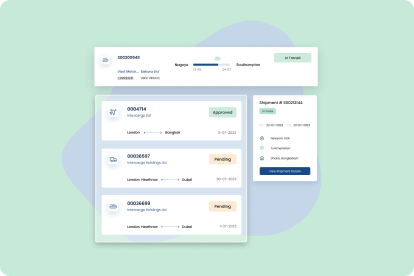
Keep all your data in one place which can be accessed from anywhere and anyplace
Let us help you 24/7 manage your supply chain needs
Latest News & Updates

Transpacific spot rates top $10,000 as Asia-Europe slide accelerates
Container spot freight rates on the transpacific and Asia-Europe continued on their completely divergent directions for the seventh straight week, with Asia-US east coast rates now hitting levels not seen since July 2022. This week's World Container Index (WCI) by Drewry saw its Shanghai-New York breach the $10,000 per 40ft level, the first time it has done so since during the latter days of Covid, after rising 7% this week to end at $10,394 per 40ft. US freight forwarder Freight Right said the carriers' pricing power from Asia into the US east coast remained stronger than to the west coast and some shippers desperate to secure space were booking at rates almost $1,000 higher than current index levels. "East Coast pricing remains significantly higher, with rates now above $10,000 and reaching approximately $11,000 per container in some cases. "Like the West Coast, the lane is experiencing constrained capacity and increasingly unstable vessel schedules," it said. The WCI's Shanghai-Los Angeles leg increased 5% week-on-week to end at $7,712 per 40ft amid similar trade dynamics, and Freight Right warned that more concerning for shippers was the diminishing schedule reliability levels caused by a confluence of Asian port congestion and increasing numbers of blank sailings, leading to higher cases of rollovers at loading ports. "The bigger operational concern is no longer price," Freight Right added. "Vessel schedules have become increasingly unreliable. A shipment can secure space and still see its scheduled departure pushed back several days. "When a booking rollover is combined with a delayed vessel departure, total delays can approach two weeks," it said. And with nine transpacific blank sailings announced for next week compared to eight this week, according to Drewry's Container Capacity Insight, the tight capacity outlook is set to continue and Drewry said it "expects rates to rise slightly next week amid impending pre-Golden Week demand and continued capacity management by carriers". Meanwhile, the recent declines seen on the Asia-Europe trades accelerated this week, with its Shanghai-Rotterdam route down 9% on the previous week to $3,626 per 40ft, while the Shanghai-Genoa leg declined 5% to $4,016 per 40ft. Comparing to the same period in 2022 - when Asia-US east coast were last at the same level as today - Asia-North Europe stood at around $9,000 per 40ft and Asia0-Mediterranean was at $11,000 per 40ft. Despite the pricing weakness in comparison to the transpacific, analysts at Linerlytica noted that today's Asia-Europe spot rates are still around double this time last year, and described current pricing as resilient, despite the drops. "The freight rate resilience has been supported by stronger than expected demand even after the cargo demand peaked in May, and the severe port congestion in China in the last two months. "Although congestion in Chinese ports is starting to clear from the peaks in early September, the congestion has shifted to Southeast Asia ports. "Waiting times in Singapore have risen to over four days due to vessel bunching," Linerlytica said earlier this week. Meanwhile, Drewry's Container Capacity Insight records four Asia-Europe blank sailings scheduled for next week, up from one this week, "indicating tighter capacity". "With tight capacity and continued congestion in Asia, Drewry expects Asia-Europe rates to decline slightly next week, as demand remains weak," it said. A further factor is the increasing number of carriers returning to Red Sea routings, which has the effect of injecting capacity simply through the shorter sailing distances.
Source: theloadstar.com
Read more
DHL and Alibaba to explore how AI can improve logistics for SMEs
DHL Group and Chinese e-commerce giant Alibaba have signed a Memorandum of Understanding (MoU) to explore how artificial intelligence (AI) can improve the end-to-end logistics experience for small and medium-sized enterprises (SMEs) trading internationally. The companies intend to evaluate how AI-powered tools can support customers from sourcing and supplier discovery to logistics quotation, booking and shipment execution to make cross-border trade simpler, faster and more accessible. DHL and Alibaba will explore the integration of DHL Global Forwarding's logistics services into Alibaba's agentic AI platform Accio. This is a plug-and-play enterprise AI agent that "equips businesses with an immediate, no-code taskforce" designed to support the diverse operational needs of SMEs worldwide, explained DHL. Through an agentic approach, Accio is expected to be able to connect to DHL Global Forwarding's quotation and booking capabilities, enabling businesses to obtain real-time freight forwarding quotes, evaluate shipping options and book shipments more seamlessly. The new capability is the first in a planned suite of DHL logistics capabilities designed to automate key business tasks, improve operational efficiency and enable SMEs to scale more effectively. Katja Busch, chief commercial officer DHL and head of DHL customer solutions & innovation, said: "SMEs are the backbone of the global economy, but many still face challenges navigating the complex rules, regulations, and trade requirements that come with international expansion. "By bringing together Alibaba.com's digital commerce expertise and DHL's logistics capabilities, we want to explore how technology can help businesses spend less time managing complexity and more time focusing on growth." Kuo Zhang, president of Alibaba.com, commented: "AI is fundamentally changing how businesses participate in global trade, making capabilities that once required significant time, expertise and resources more accessible to small and medium-sized enterprises. "At Alibaba.com, our vision for Accio is to help businesses move from opportunity to execution across the trade journey. By exploring ways to connect Accio with DHL's global logistics capabilities, we hope to lower the barriers to cross-border commerce and help SMEs move faster and with greater confidence as they grow internationally." Tim Robertson, executive vice president accelerated digitalisation, DHL Global Forwarding, added: "Global trade is becoming increasingly digital, and customers expect logistics to be as seamless as the rest of their business activities. "Through this collaboration, we will explore how advanced AI capabilities can support customers with faster access to information, greater transparency and more efficient logistics processes. "We see significant potential in combining intelligent digital platforms with DHL's logistics network and expertise." The agreement was announced during Alibaba.com's CoCreate 2026 Conference in Los Angeles.
Source: aircargonews.net
Read more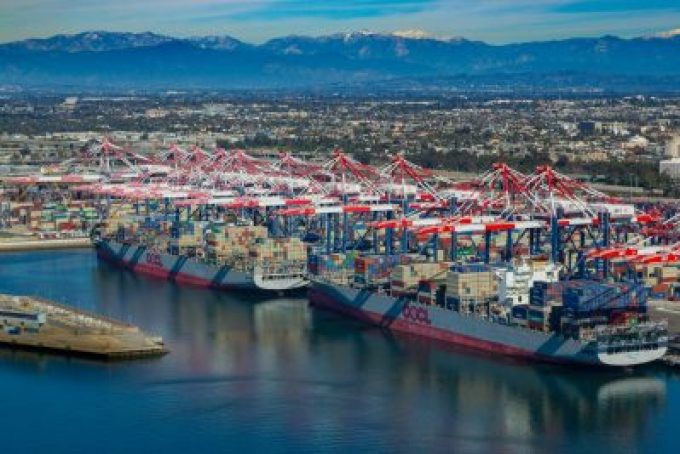
Record Long Beach volumes mask trouble ahead as capacity tightens, warns LB boss
The port of Long Beach announced record traffic volume for the past month, but its management is in no mood for celebrations. CEO Noel Hacegaba attributed the increase to disruptions rather than market growth and warned of economic concerns as well as capacity challenges. At 919,922 teu, the port's August throughput was up 2% year on year, setting a new record for the month. Imports were up 3.6%, while exports climbed 4%. The rise in imports brought the port's tally for the first eight months to 6,687,078 teu, a rise of 1.3% over the same period in 2025, which was a record year. Next door the port of Los Angeles reported throughput of 956,000 teu for August, matching the volume of 12 months earlier, which had been a record-setting year. In the three months from June through August, the port handled over 2.9m teu, which constituted the best three-month run in its history. The momentum is expected to continue this month. Mr Hacegaba anticipates strong volume in September, which will likely continue into October, possibly to the first week of November, he said, citing predictions from carriers and cargo owners and the congestion at Asian ports caused by storms. The National Retail Federation recently upped its projections for September, stating that volumes may crest this month, as the peak season is lasting longer than anticipated. Nevertheless Mr Hacegaba struck a note of caution in his remarks on the latest results and the outlook for the coming months, pointing to several factors that boosted August volumes at the port of Long Beach. He mentioned the restrictions at the Panama Canal, which have induced carriers and cargo owners to move more of their traffic through US west coast ports. Earlier this month Gene Seroka, executive director of the port of Los Angeles, told media that the situation at the Panama Canal, in conjunction with disruptions in the Middle East affecting the Suez Canal, had caused a shift of more than 5% in cargo from ports on the US Atlantic and Gulf coasts. According to him, cargo owners have shifted a small portion of their imports as a hedge on the draft restrictions on the Panama Canal and may "have further guidance in the weeks and months ahead". Mr Hacegaba cited ongoing frontloading as another reason for the strong volumes through Long Beach. "Tariffs and geopolitical uncertainties are accelerating diversification of sourcing," he added, pointing to the rise of imports from Vietnam as more cargo owners pursue a China-plus-one strategy. While US retail numbers have continued to defy warnings of consumers running out of spending power as inflation remains on the ascent, Mr Hacegaba pointed to signals that suggest a likely turn for the worse ahead. He noted the Conference Board data was down in August for a second month in a row, with consumer confidence and new construction on the decline. The fact that cargo volumes are still strong while consumer confidence is softening is not necessarily contradictory, as sourcing decisions were made some time ago, he remarked. For now, the strong volumes are causing pressure on the inland transport side. Anne Reinke, president and CEO of the Intermodal Association of North America, who joined Mr Hacegaba on his media briefing, warned that dray capacity is "dramatically constrained", with rates soaring. This has been corroborated by JB Hunt, which recently announced that it was handling record intermodal volume and that its spending on drayage drivers was going up. Other intermodal service providers have confirmed that capacity is tight, exacerbated by a shortage of drivers. Rail volumes are also up. The driver shortage caused by Washington's clampdown on non-domiciled truckers and those with insufficient English language skills and the ensuing rise in trucking rates have prompted domestic shippers to shift to intermodal transport. In July domestic intermodal volume was up 12% over July 2025. Both Ms Reinke and Mr Hacegaba urged cargo owners to strengthen their partnerships with intermodal service providers in order to secure adequate capacity, adding that the uncertain outlook on Panama Canal transit limits is further reason to seek strong intermodal partners. Mr Hacegaba remarked that the diversification of sourcing is expected to boost volumes through the port, which has ramifications for the rail infrastructure. "Speed to market is key," he said, and went on to highlight the port's Pier B project, a $1.8bn undertaking to expand and modernise the rail yard. Begun in 2024, it is planned for completion in 2032. "Pier B reduces processing time from four days to one," he said.
Source: theloadstar.com
Read more
Privacy Preference Center
This website uses cookies and similar technologies, (hereafter “technologies”), which enable us, for example, to determine how frequently our internet pages are visited, the number of visitors, to configure our offers for maximum convenience and efficiency and to support our marketing efforts. These technologies incorporate data transfers to third-party providers based in countries without an adequate level of data protection (e. g. United States). For further information, including the processing of data by third-party providers and the possibility of revoking your consent at any time, please see your settings under “Consent Preferences” and our
Privacy Notice