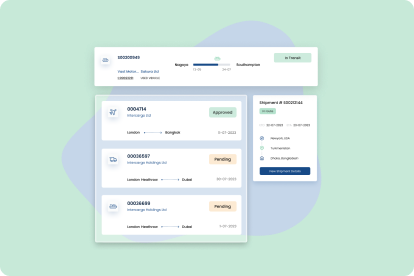
Discover your all-in-one digital freight platform
Escape the chaos of calls, faxes, and endless emails. Step into a connected world where suppliers, shippers, customs, ports, and more unite on a single platform for seamless, contextual collaboration
Being an IATA accredited agent we have access to over 121 airlines, this includes scheduled freighters and passenger aircrafts.
With our LCL service, you can ship as little or as much as you like, weekly consoles are our business and get you yours.
We provide comprehensive road freight services, covering both Less-Than-Truckload (LTL) and Full-Truckload (FTL) options.
To meet your requirements we have access to vehicles of all sizes from small vans to artic with 24/7 availability and live tracking.
Escape the chaos of calls, faxes, and endless emails. Step into a connected world where suppliers, shippers, customs, ports, and more unite on a single platform for seamless, contextual collaboration
Our solutions are tailored to fit your business and its unique workflows, offering real-time order tracking from placement to delivery. Stay informed with up-to-date order statuses, track progress, and receive timely notifications for key milestones, whether shipping by air, sea, or road.

For packages requiring urgent delivery that can be achieved by road to destinations in the UK or mainland Europe, you can rely on Intercargo to deliver direct in the fastest time possible.

Get to know more about values, knowledge and experience, quickly download our company profile.


Saudia Cargo moves to extend sea - air options
Saudia Cargo has expanded its strategic collaboration with the Saudi Ports Authority (Mawani) and the Zakat, Tax and Customs Authority (ZATCA) to facilitate new sea to air logistics routes designed to keep cargo moving through Saudi Arabia and onward to global markets. The agreed new initiative is expected to create a sea to air logistics corridor originating on Saudi Arabia's western coast ports. The initiative represents, a statement from Saudia Cargo said, "a proactive response to regional developments affecting shipping patterns and international flight schedules, helping safeguard supply chain continuity". Saudia Cargo will play a central role in moving maritime shipments that have been transported inland onto and over a rapid air bridge, helping shorten overall cargo transit times. ZATCA will also play an important role as an enabler and regulator, with cargo moving through maritime and air gateways in an integrated transit framework that allows cargo to move under a single customs declaration. Pre-clearance capabilities and smart inspection controls will enable containers to move from port berth to airport runway under significantly reduced timeframes. Balancing cost efficiency with speed of delivery, the sea to air logistics corridor "supports a more integrated national logistics approach in which seaports and airports operate as complementary, connected entry points, enabling cargo to shift smoothly between modes as conditions evolve", the Saudia Cargo statement said. Execution The first routes of the new sea to air corridors have already been activated, with cargo moving inland from Jeddah Islamic Port. Any further increase in Saudia Cargo freight traffic will build on what was a challenging last year or the Saudi Arabian flag-carrier. The airline saw its cargo volumes last year decline by 0.8% to 573,000 tonnes across around 4,000 flights. Last year also saw the carrier announce a series of strategic partnerships that "strengthened Saudia Cargo's local and international presence". These included agreements with the Saudi Tourism Authority and the Al-Ahsa Development Authority to support national development.
Source: aircargonews.net
Read more
Air cargo left behind in aviation policy framework discussions
Air cargo governance often develops in parallel to overall aviation governance and planning and should be more involved in the development of policy frameworks, according to one speaker at the IATA World Cargo Symposium in Peru. Leonardo Boszczowski, ICAO regional officer, aviation security and facilitation, said it was not uncommon for aeronautical policy frameworks to overlook air cargo development. Meanwhile, airport master planning and infrastructure development can also lack the involvement of air cargo stakeholders, as can airport operational planning. For example, he said, at many airports it is common for the aviation security manager to focus only on the passenger side of the operation, for instance, access control, baggage security, and not have the same knowledge of the cargo side of the airport. "When the national inspector wants to see the air cargo process, then it is very common for the aviation security manager to call the cargo guy because they understand the air cargo side is not part of the airport," Boszczowski said. Service-level targets were another area identified by Boszczowski where passenger and cargo were operating in parallel rather than in coordination. He pointed out that it was common for the passenger side of the airport to measure performance in terms of queue time for immigration, the check-in process and other areas, whereas "we don't see discussions about this kind of level of service related to air cargo terminals", he said. "Cargo is often treated as a niche rather than a core component of the aviation sector and it could limit the system performance of air cargo," Boszczowski said. He encouraged air cargo stakeholders to become more involved in the national air transport and airport facilitation committees that serve as platforms for interagency coordination and identify and solve bottlenecks and operational gaps. "It is important to position cargo within the operational governance and that governance must align with the operational performance and be fully integrated with the airport system," he said. "Stakeholders working together can deliver coordinated and integrated solutions, for example, setting measurables and outcomes, to improve the competitiveness of a state."
Source: aircargonews.net
Read more
BIFA representative meets with policymakers to discuss Windsor Framework
Pawel Jarza from the Policy and Compliance team of the British International Freight Association (BIFA) has met with representatives of the European Commission in Brussels to discuss the operation of the Windsor Framework and its impact on the movement of goods between Great Britain and Northern Ireland. The Windsor Framework, which dates to 2023, offered a new set of arrangements to restore the smooth flow of trade within the UK internal market in a post-Brexit operating environment. Jarza's meeting formed part of ongoing engagement between industry and policymakers to assess how the post-Brexit trading arrangements are functioning in practice and to identify areas where processes might be improved for freight forwarders and their customers. Jarza highlighted the operational realities faced by members of BIFA - the UK freight forwarder association - when moving goods across the Irish Sea. While the Windsor Framework has simplified certain procedures, such as removing the requirement for export declarations on goods moving from Great Britain to Northern Ireland, freight forwarders continue to navigate a complex trading environment, BIFA considers. Key challenges discussed included the need to operate between two tariff regimes and to determine whether goods are considered 'at risk' of entering the EU market. Further requirements, including safety and security declarations and the implementation of systems such as Import Control System 2 (ICS2), also contribute to the complexity of border processes, it was noted. Discussions also covered issues surrounding the movement of small parcels and lower-value consignments, where the detailed provisions of the Framework can create practical difficulties for operators. Need for further dialogue BIFA used the meeting, the association said, to relay feedback from its members and to emphasise the importance of continued dialogue between industry and regulators to ensure the Framework works as effectively as possible. Jarza highlighted: "Freight forwarders operate at this border every day and have first-hand knowledge of what works and what does not. "If members encounter systemic issues, it is important that they let us know so we can raise these with government departments and the European Commission, and where possible propose practical solutions." Progress on AI Last month (February), BIFA confirmed that it had formed a new artificial intelligence (AI) and technology working group in response to growing interest from the trade association's members in the opportunities and challenges presented by AI. The trade association said the new working group will examine AI specifically from a freight forwarder's perspective.
Source: aircargonews.net
Read more

This website uses cookies and similar technologies, (hereafter “technologies”), which enable us, for example, to determine how frequently our internet pages are visited, the number of visitors, to configure our offers for maximum convenience and efficiency and to support our marketing efforts. These technologies incorporate data transfers to third-party providers based in countries without an adequate level of data protection (e. g. United States). For further information, including the processing of data by third-party providers and the possibility of revoking your consent at any time, please see your settings under “Consent Preferences” and our